
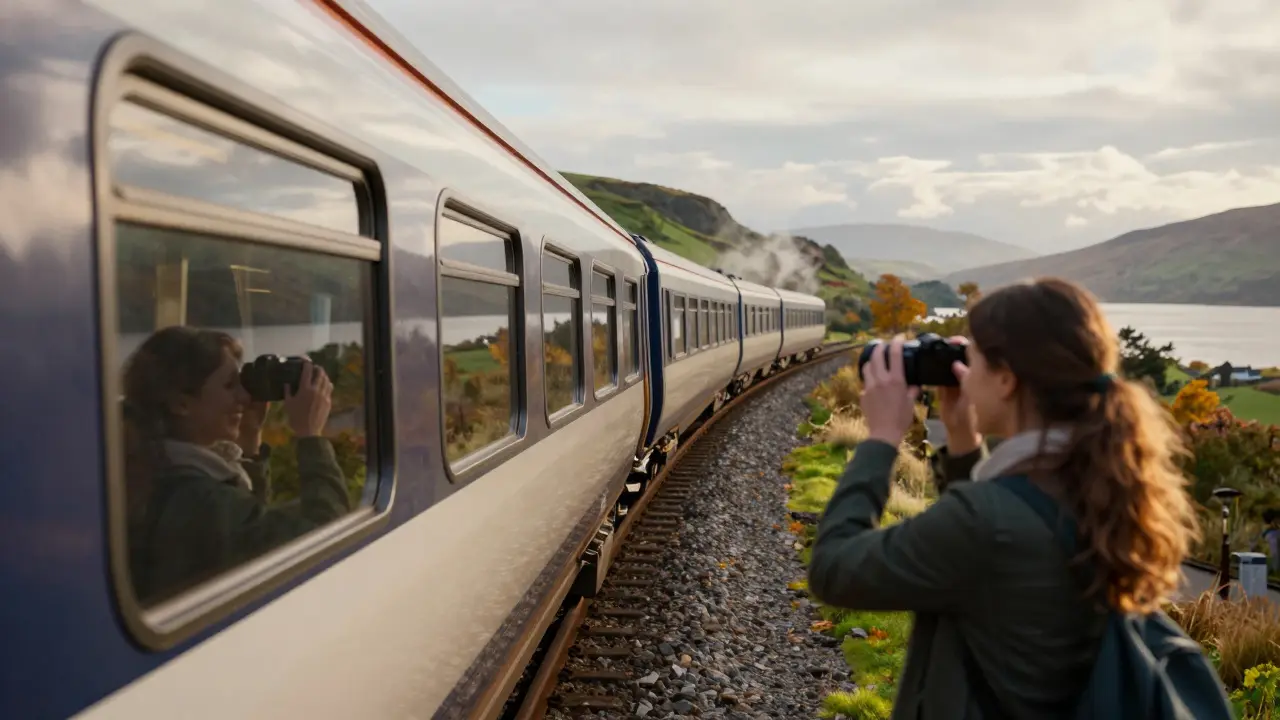
Getting around Scotland by train isn’t just about moving from point A to point B-it’s one of the best ways to see the country. Whether you’re hopping between cities on ScotRail, sleeping under the stars on the Caledonian Sleeper, or staring out the window as the train winds through glens and lochs, the rails here offer something you won’t find on a bus or in a rental car. This guide cuts through the noise and tells you exactly what you need to know to ride smart, save money, and not miss the most beautiful stretches of track in the UK.
ScotRail: Your Everyday Key to Scotland
ScotRail runs over 90% of passenger trains in Scotland. It’s the backbone of travel between Glasgow, Edinburgh, Aberdeen, Inverness, and dozens of smaller towns. If you’re planning a trip that includes cities, airports, or major tourist spots like Stirling or Fort William, you’ll likely use ScotRail.
Don’t assume all tickets are the same. Off-peak fares are often half the price of peak ones. Peak hours are 6:30-9:30 AM and 4:00-7:00 PM on weekdays. If you can travel mid-morning or after 7 PM, you’ll save up to £40 on a Glasgow to Edinburgh trip. Advance tickets, available up to 12 weeks ahead, are the cheapest way to ride. Book online through the ScotRail app or website-no need to wait in line at the station.
ScotRail’s trains are mostly modern, with free Wi-Fi, power sockets, and accessible toilets. But don’t count on reliable mobile signals in the Highlands. Download your timetable, map, and entertainment before you leave the city. The app also shows real-time delays and platform changes, which matter more in rural areas where trains are less frequent.
One pro tip: The ScotRail Daily Ticket lets you hop on and off unlimited times in one day. If you’re doing a day trip from Edinburgh to North Berwick, Linlithgow, and Stirling, this saves money over buying three separate tickets. It’s valid on all ScotRail services except the Caledonian Sleeper and special tourist trains.
The Caledonian Sleeper: Sleep Your Way Across Scotland
If you’ve ever dreamed of waking up in the Highlands after falling asleep in London, the Caledonian Sleeper makes that real. It runs six nights a week (not Sunday) between London Euston and four Scottish destinations: Fort William, Inverness, Aberdeen, and Edinburgh/Glasgow.
There are two main options: Classic and Club. Classic is a shared berth with curtains, basic bedding, and a shared bathroom down the corridor. Club is a private room with an en-suite toilet and sink, better bedding, and breakfast included. A Classic single from London to Inverness starts at £99 if booked early. Club starts at £220. Prices rise fast-book at least two months ahead for the best deals.
Here’s what most travelers miss: The train splits in the middle of the night. If you’re going to Fort William, make sure your carriage is detached for the southern route. Listen for announcements or check the digital display above your berth. Miss this, and you’ll wake up in Inverness instead of the Highlands.
Breakfast is served in the dining car or delivered to your room. The porridge is made with Scottish oats. The coffee? Strong. The croissants? Not great. Bring your own snacks if you’re picky. And yes, you can bring your own alcohol-there’s no bar car, so this is your only chance to enjoy a whisky before sunrise.
The Caledonian Sleeper isn’t just a train-it’s an experience. The views at dawn, when the train crosses the Forth Bridge or climbs past Rannoch Moor, are unforgettable. Pack a good book, a warm jacket, and a sense of adventure.
Scenic Trains: Where the Journey Is the Destination
Scotland has more than one scenic route-but only a few are worth planning a trip around. The West Highland Line from Glasgow to Fort William is the most famous. It’s not just a train ride; it’s a postcard come to life.
You’ll pass Loch Lomond, the Glenfinnan Viaduct (famous from the Harry Potter films), and Rannoch Moor. The train climbs 1,300 feet in under 40 miles. It’s slow. It’s breathtaking. And it’s often packed with tourists in summer. Book seats on the right side going north (left side going south) for the best views of the lochs and mountains.
The Far North Line from Inverness to Thurso and Wick is quieter but just as wild. You’ll ride through the Flow Country-the largest blanket bog in Europe-and past the ruins of Castle of Mey. Trains run just twice a day in winter. If you miss one, you’re stuck until tomorrow. Check the timetable before you leave your hotel.
The Kyle of Lochalsh Line, from Inverness to the village of Kyle, ends at the foot of the Isle of Skye. The bridge into Skye is one of the most photographed spots in Scotland. Many people take this train just to get to the ferry. But if you ride all the way to Kyle, you’ll see red deer, eagles, and the Cuillin mountains in the distance.
There’s also the Borders Railway from Edinburgh to Tweedbank. It’s not mountainous, but it’s the only modern rail line built in Scotland in 100 years. It connects historic towns like Melrose and Galashiels, with views of rolling hills and sheep pastures. Great for a quiet weekend trip.
How to Save Money on Scottish Trains
Train fares in Scotland can be expensive if you don’t know the tricks. Here’s how to cut costs without sacrificing comfort:
- Use a Railcard: The 16-25 Railcard, Senior Railcard, or Two Together Railcard gives you 1/3 off most fares. You can buy them online in minutes. Even if you’re not a student, the Senior Railcard is available from age 60.
- Split your journey: Sometimes buying two separate tickets is cheaper than one. For example, Glasgow to Inverness might cost £65 direct, but Glasgow to Perth (£25) + Perth to Inverness (£30) could total £55. Use sites like TrainSplit or Trainline to check.
- Travel on Sundays: Many fares are discounted on Sundays. ScotRail’s Anytime Day Ticket is often cheaper than its weekday off-peak version.
- Avoid peak times: As mentioned, peak hours mean higher prices. Even if you’re not in a rush, waiting an hour can save you money.
There’s no national rail pass for Scotland like the Eurail Pass. But if you’re planning to take three or more long-distance trips, the ScotRail Explorer Ticket lets you travel on any ScotRail route for 3 or 5 days within a month. It’s £99 for 3 days, £149 for 5. Good for backpackers or slow travelers.
What to Pack for a Scottish Train Trip
You don’t need much, but a few things make the difference between a good trip and a great one:
- Layers: Weather changes fast. A waterproof jacket, thermal base layer, and a warm hat go further than a bulky coat.
- Portable charger: Power sockets are common, but not always available. A 20,000mAh power bank keeps your phone alive for 2-3 full charges.
- Snacks: Station food is overpriced. Bring sandwiches, fruit, nuts, or oat bars. On the Caledonian Sleeper, you can’t buy food after 10 PM.
- Headphones: Trains aren’t always quiet. Noise-canceling headphones help on long rides.
- A paper map: Signal drops in the Highlands. Downloading offline maps helps, but a printed Ordnance Survey map of your route is foolproof.
And don’t forget your camera. The light in the Scottish Highlands at 7 AM in autumn is unlike anywhere else. Golden mist over lochs, snow on distant peaks, sheep grazing beside the tracks-these are the moments you’ll remember.
Common Mistakes and How to Avoid Them
Even seasoned travelers mess up on Scottish trains. Here’s what to watch out for:
- Assuming all stations are busy: Many rural stops have no staff, no ticket machines, and no shelters. Buy your ticket before you arrive, or use the conductor’s mobile app to pay on board.
- Missing the last train: In winter, the last train from Inverness to Edinburgh leaves at 8:15 PM. If you’re hiking or sightseeing, check the timetable before sunset.
- Forgetting the difference between Edinburgh Waverley and Edinburgh Haymarket: Waverley is the main station. Haymarket is for trains to the west and north. Confusing them can add an hour to your journey.
- Thinking the train is always on time: Delays happen. Weather, sheep on the tracks, signal failures-Scotland’s rail system is charming but not perfect. Build in a 30-minute buffer for connections.
If you’re traveling with kids, bring small games or coloring books. The train ride to Oban can take over 3 hours. A tablet works, but nothing beats watching the scenery roll by with a chocolate bar in hand.
Can I bring my bike on ScotRail trains?
Yes, but only on certain services and with a reservation. Bikes are allowed on most ScotRail trains outside peak hours. You need to book a bike space in advance via the ScotRail app or website. Some trains have limited space-only two bikes per train on busy routes. Folding bikes are free and don’t need booking.
Are there toilets on the Caledonian Sleeper?
Yes. All carriages have accessible toilets, and Club rooms have their own en-suite facilities. Classic berth passengers share toilets at the end of each carriage. They’re cleaned regularly, but bring hand sanitizer. Water pressure can be low, especially after midnight.
Is it worth taking the scenic trains in winter?
Absolutely. Winter brings fewer crowds, clearer skies, and snow-dusted landscapes that look like a painting. The West Highland Line is especially stunning with snow on the hills. But check the weather forecast. Heavy snow can delay trains. Dress warmly, and make sure your phone is charged-some stations have no heating or lighting.
Can I use my UK railcard on the Caledonian Sleeper?
Yes. Most UK railcards, including the 16-25, Senior, and Two Together, give you a 1/3 discount on Caledonian Sleeper fares. You still need to book in advance, and the discount applies to the base fare, not upgrades like Club rooms. Always show your railcard when boarding.
What’s the best way to get from Glasgow Airport to the city center by train?
Take the Glasgow Airport Rail Link (GARL), which connects directly to Glasgow Central Station. Trains run every 10 minutes and take 12 minutes. A single ticket costs £9.50. If you’re heading to Edinburgh, you can transfer at Glasgow Central without leaving the station. Avoid taxis-they’re slower and cost £35-£50.
Next Steps: Planning Your Trip
Start by picking one route. If you’re new to Scotland, begin with the West Highland Line. It’s the most iconic, the most reliable, and the most rewarding. Book your ScotRail ticket early, pack your layers, and get ready to see Scotland not just as a place on a map-but as a landscape that moves beneath you.
After you’ve ridden the scenic lines, consider the Caledonian Sleeper for an overnight adventure. It’s not just transport. It’s a story you’ll tell for years.
Comments (14)
-
Elmer Burgos January 6, 2026Just got back from the West Highland Line and wow. The views at sunrise over Rannoch Moor? Pure magic. I didn't even need headphones, the silence was better than any playlist.
Pro tip: Bring a thermos of tea. The coffee on the train was okay but nothing beats your own brew when the mountains are outside your window.

-
Jasmine Oey January 8, 2026Okay but have y’all even SEEN the Caledonian Sleeper? Like, it’s not just a train, it’s a LIFESTYLE. I booked a Club room and woke up to a proper Scottish breakfast with real porridge (not that sad instant stuff) and the view of the Forth Bridge at dawn? I cried. Like, actual tears. This isn’t transport, this is poetry on rails.
Also, if you’re not bringing your own whisky, you’re doing it wrong. No bar car? That’s a feature, not a bug.

-
Marissa Martin January 9, 2026I appreciate the guide but I’m still not sure why anyone would choose a train over a car. The delays are ridiculous, and the lack of reliable Wi-Fi in the Highlands is just… irresponsible. I spent three hours waiting in Fort William because of a sheep on the tracks. Again. Why not just rent a car and go at your own pace?

-
James Winter January 10, 2026USA trains suck. Canada’s got better. Scotland’s trains? Fine I guess. But you’re telling me we pay 99 bucks to sleep in a bunk with strangers? No thanks. I’ll drive. Or fly. Or take a damn bus.

-
Patrick Bass January 10, 2026You mention the ScotRail Daily Ticket but neglect to note that it doesn’t apply to the Kyle of Lochalsh Line on weekends. That’s a common oversight. Also, the Far North Line timetable changes seasonally - always double-check with National Rail Enquiries, not just the app.

-
k arnold January 12, 2026Wow. A 12-page essay on how to ride a train. Did you get paid by ScotRail? Or is this just your personal travel blog repackaged as ‘guide’? I’m impressed by the effort. Not impressed by the need.

-
Tiffany Ho January 12, 2026This is so helpful!! I’m planning my first trip to Scotland next month and I was so nervous about the trains but now I feel ready 😊 I’m definitely getting the ScotRail Explorer Ticket and bringing my own snacks. No more overpriced pastries!

-
michael Melanson January 12, 2026The part about splitting tickets is gold. I did Glasgow to Inverness via Perth last year and saved £18. Didn’t even know that was a thing until I read this. Honestly, this is the best travel guide I’ve seen in months.

-
lucia burton January 13, 2026The cognitive dissonance in modern rail infrastructure is fascinating - we’ve got hyper-modern digital ticketing and real-time delay tracking, yet we’re still reliant on analog systems like paper maps and physical railcards. It’s a hybrid ecosystem that reflects Scotland’s broader cultural duality: ancient landscapes, 21st-century logistics. The emotional resonance of riding the West Highland Line isn’t just visual - it’s systemic. You’re not just a passenger; you’re a participant in a socio-technological narrative where resilience is encoded in every delayed departure.

-
Zach Beggs January 15, 2026I used to hate trains in Scotland until I took the Kyle of Lochalsh line. The way the light hits the Cuillins in the afternoon? Unreal. And the guy who sold me a sandwich at the station? Said he’d been working there for 37 years. That’s the kind of stuff you don’t get on a bus.

-
Kenny Stockman January 17, 2026You guys are overthinking this. Just buy a ticket, sit by the window, and enjoy the ride. No need for railcards, splits, or whisky stashes. The train’s gonna get you there. The scenery? Free.

-
Antonio Hunter January 17, 2026I’ve taken the Caledonian Sleeper three times now, and each time I learn something new. Last trip, I realized the train splits at Carstairs - not Fort William, as some assume. The announcement is quiet, and the digital display is small. I recommend setting a phone alarm for 1:30 AM, just in case. Also, the porridge is better if you add a pinch of salt. Small thing, but it makes a difference.

-
Paritosh Bhagat January 19, 2026I have to say, this guide is decent but it completely ignores the fact that the Caledonian Sleeper’s Classic berths are a health hazard. Shared toilets with low water pressure? No hot water after midnight? That’s not charming - that’s inhumane. And you’re telling people to bring their own alcohol? What is this, a 1970s train? The lack of proper hygiene standards is unacceptable. Also, the grammar in this post is sloppy. ‘Don’t count on reliable mobile signals’ - should be ‘Do not rely on’.

-
Ben De Keersmaecker January 19, 2026The West Highland Line is one of the most geologically significant rail routes in Europe. The Glenfinnan Viaduct alone is a feat of early 20th-century civil engineering built over glacial moraine. But beyond the engineering, the cultural layering - from Gaelic place names to the lingering presence of the Highland Clearances in the empty glens - makes this journey more than a tourist attraction. It’s a living archive. If you’re just taking photos, you’re missing half the story.
