
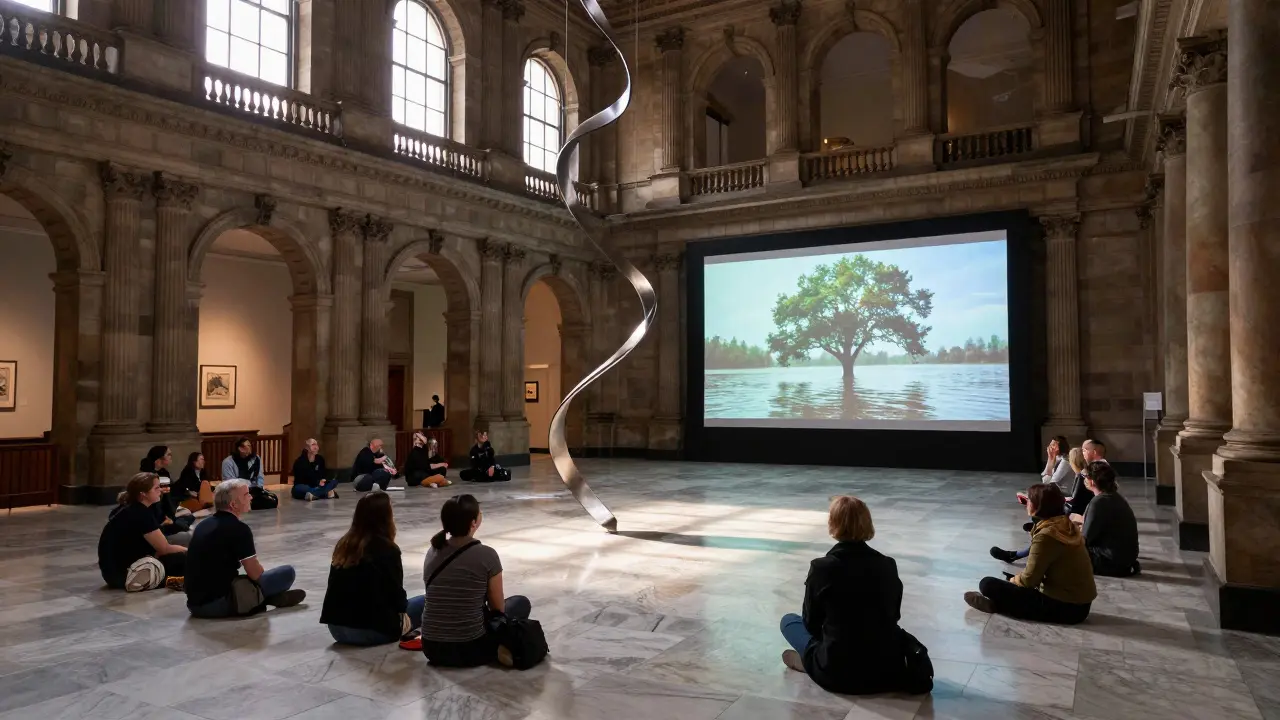
When you walk into the Gallery of Modern Art Glasgow, you don’t just step inside a museum-you step into a story. The building itself used to be a bank. Not just any bank, but the Royal Exchange, built in 1802 as a hub for merchants trading tea, tobacco, and cotton. Its grand columns and marble floors were meant to show wealth and power. Today, those same spaces hold twisted metal sculptures, video installations about climate change, and paintings that make you question what art even is. That’s the point.
From Bank to Art Space
The Royal Exchange opened its doors in 1802 as a financial center for Glasgow’s booming trade empire. By the 1970s, the building sat empty. The city nearly tore it down. But a group of artists, local historians, and city planners pushed back. They argued that Glasgow didn’t need another luxury hotel or office block. It needed a space where people could see art that challenged them. In 1996, after a £12 million renovation, the Gallery of Modern Art reopened. The banking hall? Now it’s the main exhibition room. The old vaults? Turned into intimate screening rooms. The building didn’t just change function-it changed meaning.
What You’ll See Today
The Gallery doesn’t collect art to preserve it. It collects art to provoke it. The permanent collection includes work by Scottish artists like Joan Eardley, whose rough brushstrokes captured the grit of Glasgow’s tenements, and Eduardo Paolozzi, whose metallic sculptures look like robots dreaming of the future. But most of what you’ll see changes every few months.
In late 2025, the gallery hosted “After the Flood”, a show that used water-damaged photographs, audio recordings from displaced communities, and a room filled with rising water to simulate the feeling of climate-driven displacement. Visitors weren’t just looking at art-they were feeling it. One piece, a 12-minute video loop of a single tree in a flooded park, had people sitting on the floor for the full duration, just watching it sway.
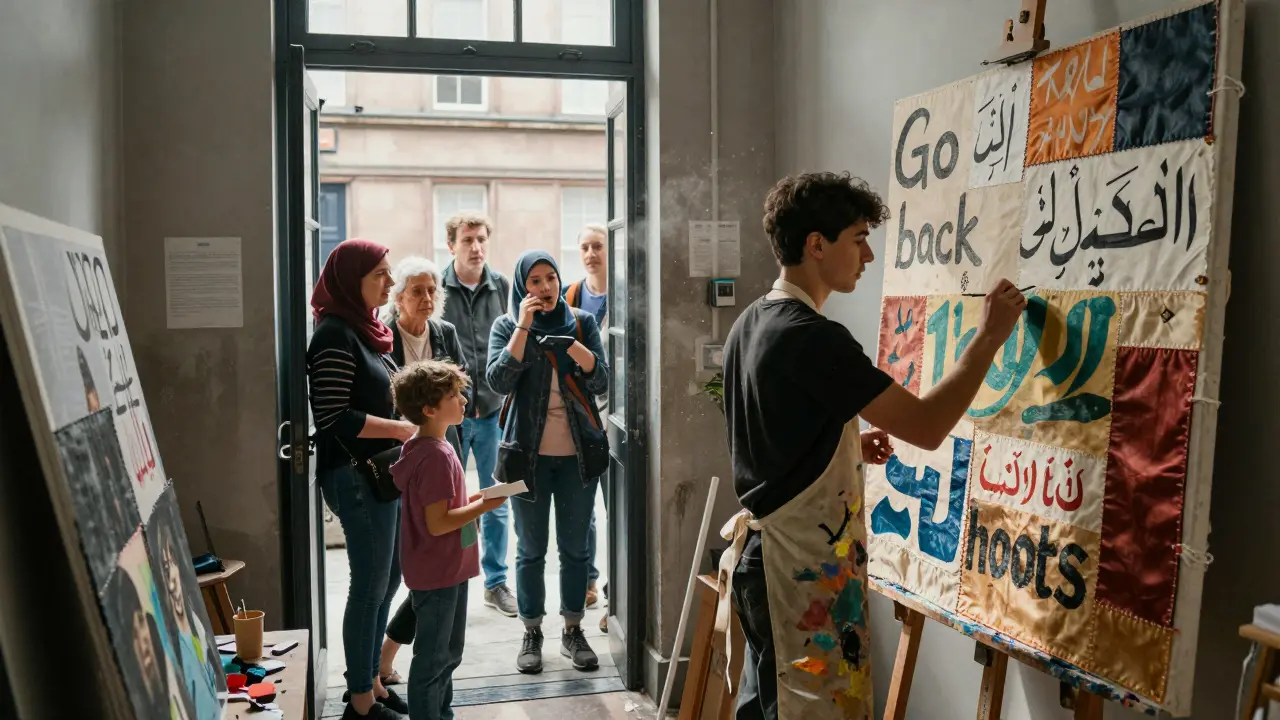
Another recent exhibition, “The Quiet Rebellion”, featured work by young artists from Glasgow’s immigrant communities. One artist stitched together fabric from her grandmother’s hijab and painted over it with protest slogans in Urdu and Scots. Another built a wall of old mobile phones, each one playing a voice message from someone who’d been told to “go back home.” The gallery didn’t just display these works-it hosted live Q&As, poetry readings, and community dinners around them.
It’s Not Just About the Art
The Gallery of Modern Art Glasgow doesn’t charge admission. Ever. That’s not a gimmick-it’s policy. The city believes art shouldn’t be a privilege. You can walk in at 10 a.m. on a Tuesday, have coffee from the café (which uses beans roasted just down the road), and spend three hours with a 30-foot mural of Glasgow’s skyline made entirely from recycled plastic bottles. No ticket. No lines. No pressure.
The building’s layout encourages wandering. There are no signs pointing you to “the next exhibit.” Instead, you follow the flow of people, the sound of a drumbeat echoing from a side room, or the smell of linseed oil from an artist working live in the studio space on the second floor. You might bump into a student sketching in the corner, or a retired teacher explaining a piece to a group of kids. That’s the vibe: open, messy, alive.
Why It Matters
Glasgow has always been a city that talks back. From the 1919 rent strikes to the punk scene of the 1970s, it’s a place where people refuse to stay quiet. The Gallery of Modern Art is an extension of that. It doesn’t celebrate tradition. It questions it. It doesn’t just hang paintings-it creates conversations.
Unlike London’s Tate Modern or Edinburgh’s Scottish National Gallery of Modern Art, this space doesn’t try to be grand. It’s small. It’s loud. It’s sometimes confusing. But it’s real. It’s where a 14-year-old from Govan can stand in front of a video of a factory worker singing in Punjabi, and say, “That’s my mum.”
Planning Your Visit
Here’s what you need to know if you’re heading there:
- Location: Royal Exchange Square, Glasgow G1 3AH. Right next to the St. Enoch Centre and a 10-minute walk from Glasgow Central Station.
- Hours: Open daily from 10 a.m. to 5 p.m., with extended hours until 8 p.m. on Fridays.
- Free entry: Always. No booking needed for general galleries.
- Special events: Check their website for artist talks, film screenings, and late-night openings. They often partner with local music collectives and poetry slams.
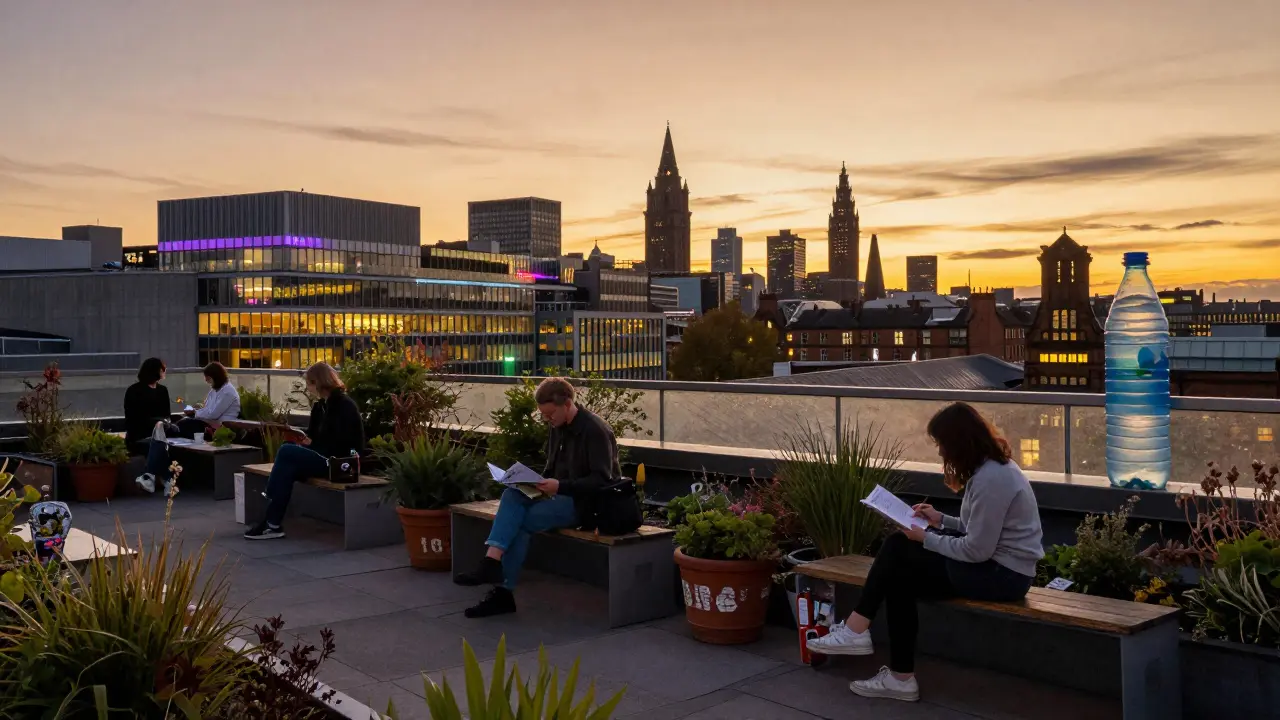
- Don’t miss: The rooftop garden. It’s small, but it’s the only place in central Glasgow where you can sit among plants and look down at the city’s skyline without a single car horn.
There’s no gift shop with postcards of Monet. Instead, you’ll find zines made by local artists, handmade ceramics from the city’s pottery collectives, and secondhand books on radical politics. Take one. Leave one. That’s the rule.
More Than a Museum
The Gallery of Modern Art Glasgow isn’t trying to be the most famous art space in Scotland. It doesn’t need to be. It’s doing something harder: it’s staying human. It lets the building breathe. It lets the art change. It lets you leave confused, angry, moved, or silent-and it’s okay if you don’t know why.
That’s why people keep coming back. Not for the famous names. Not for the Instagrammable walls. But because here, art doesn’t just hang on a wall. It talks. And if you listen, it might just answer you back.
Is the Gallery of Modern Art Glasgow free to enter?
Yes, entry to all permanent and temporary exhibitions at the Gallery of Modern Art Glasgow is completely free. There are no tickets, no booking fees, and no suggested donations. The museum is publicly funded by the City of Glasgow and operates under a policy that art should be accessible to everyone, regardless of income.
What’s the history of the building?
The building was originally the Royal Exchange, constructed in 1802 as a commercial hub for Glasgow’s global trade. Merchants bought and sold tobacco, cotton, and sugar here during the height of the British Empire. After decades of decline, the building was nearly demolished in the 1970s. A grassroots campaign saved it, and after a major renovation completed in 1996, it reopened as a public art gallery. Its original banking hall, vaults, and marble staircases were preserved and repurposed to house contemporary art.
Are there any permanent exhibits?
Yes, the gallery maintains a rotating selection of works from its permanent collection, which includes major pieces by Scottish artists like Joan Eardley, Eduardo Paolozzi, and Charles Avery. These works are displayed alongside changing temporary exhibitions, so you’ll always see something new. The collection focuses on modern and contemporary Scottish art, with strong representation from Glasgow’s diverse communities.
Can you see artists working live at the gallery?
Yes, the gallery has an open studio space on the second floor where visiting artists work during exhibition periods. You can watch them paint, sculpt, or film in real time. Some artists even invite visitors to ask questions or share their own stories. These sessions are not scheduled like guided tours-they happen spontaneously, so keep an eye out for open doors and people gathered around a workspace.
Is the gallery suitable for children?
Absolutely. The gallery has a dedicated family zone with interactive installations designed for kids. There are also free art workshops every weekend, led by local educators. Many exhibitions include child-friendly audio guides or tactile elements. The rooftop garden is a favorite spot for families to relax after exploring the galleries. It’s one of the few art spaces in Scotland that actively welcomes younger visitors without talking down to them.
Comments (13)
-
Megan Blakeman February 14, 2026
Just read this and cried a little. Not because it’s sad, but because it’s so... real. That tree video? I sat there for 12 minutes too. Didn’t move. Didn’t think. Just watched. Art shouldn’t need explanation. It just needs space to breathe. And this place? It gives that.
❤️

-
ravi kumar February 14, 2026
As someone from India, I’ve seen so many museums that feel like temples to the past. This? It feels alive. The fact that they let artists work right in front of you? That’s the kind of openness I wish we had back home. No门票, no pressure. Just art. People. And silence where it matters.
Hope one day we get something like this in Kolkata.

-
Akhil Bellam February 15, 2026
Let’s be honest-this is just gentrified nostalgia wrapped in ‘radical’ packaging. A bank turned into an art space? Big deal. Every mid-tier city does this. The real question: who’s funding this? Corporate donors? The same elites who built the original exchange? Don’t pretend this is ‘for the people’ when the rooftop garden probably costs more than a month’s rent for half of Glasgow.
It’s not art-it’s performance. And I’m not buying it.

-
Amber Swartz February 16, 2026
OMG. THE ROOFTOP GARDEN. I CRIED. I ACTUALLY CRIED. NO CAR HORN. JUST BIRDS. AND PLANTS. AND A SKYLINE. THAT’S ALL I NEEDED. I’VE BEEN TO 12 MUSEUMS THIS YEAR AND THIS WAS THE ONLY ONE THAT MADE ME FEEL LIKE I COULD JUST... BE.
WHY ISN’T EVERYONE TALKING ABOUT THIS?!?!

-
Robert Byrne February 16, 2026
You’re all missing the point. The building’s history isn’t just ‘cool’-it’s a metaphor. The Royal Exchange was built on colonial extraction. Now it’s a space for displaced voices, recycled materials, and immigrant stories. That’s not coincidence. That’s reparative architecture. And if you don’t see that, you’re not looking hard enough. The art isn’t decorative-it’s diagnostic.

-
Tia Muzdalifah February 17, 2026
i went last summer and just wandered around for hours. no plan. no map. just followed the sound of drums and ended up in this tiny room where a guy was painting with tea. he said ‘it’s the color of grief here.’ i didn’t get it then. i get it now.
also the coffee was fire. like, seriously. best i’ve had outside of seattle.

-
Zoe Hill February 18, 2026
That moment when you’re standing in front of a 30-foot mural made of plastic bottles and you realize… we made this mess. But we’re also the ones turning it into something beautiful. That’s hope. That’s what this place is. Not perfection. Not polish. Just… possibility.
Also, I cried at the mobile phone wall. Don’t judge me. 😅

-
Albert Navat February 20, 2026
From a curatorial standpoint, this is a textbook case of institutional recontextualization. The adaptive reuse of a colonial financial infrastructure into a platform for postcolonial discourse is not just architecturally significant-it’s semiotically revolutionary. The absence of admission fees functions as a performative act of anti-capitalist pedagogy, disrupting the commodification of aesthetic experience. The open studio? That’s not accessibility-it’s epistemic democratization. And the rooftop garden? A biopolitical intervention in urban alienation.

-
King Medoo February 20, 2026
They say ‘art should be free’-but what about the artists? Who pays them? Who pays the security guard who’s there at 3 a.m. because ‘no one locks up’? Who pays for the heating in winter? Who pays for the fact that someone’s crying in the video room and no one knows how to help? This isn’t art. It’s a trap. A beautiful, well-lit, Instagrammable trap.
And now everyone’s pretending it’s magic. 🤡

-
Rae Blackburn February 21, 2026
Did anyone else notice the cameras? The ones in the corners? The ones that don’t blink? They’re not for security. They’re for surveillance. They’re recording who sits where. Who cries. Who lingers. Who’s ‘moved.’ This isn’t a gallery. It’s a behavioral study. And the city? They’re selling the data. That’s why it’s free. So you’ll stay longer. So they can map your soul.
They know you came back. They know you cried. They know you didn’t leave.

-
LeVar Trotter February 21, 2026
Let’s talk about the open studio. I’ve been to places where artists work behind glass. This? You walk in, and someone’s welding a sculpture while a kid asks, ‘Why’s it bent?’ and the artist says, ‘Because the world is.’ That’s the difference. This isn’t curated. It’s co-created. And that’s rare. Really rare.
Also, the zine section? I left with a pamphlet on how to start a community garden. I didn’t even know I needed it until I read it. That’s the power of this place.

-
Tyler Durden February 22, 2026
That tree video. 12 minutes. I didn’t move. Didn’t check my phone. Didn’t think about work. Didn’t think about anything. Just watched. The leaves. The water. The silence. And then-I realized. I hadn’t sat still like that in years. Not since I was a kid. Not since before the world got loud.
This place didn’t give me art. It gave me back my breath.

-
Aafreen Khan February 23, 2026
free entry? lol. what a joke. they probly make it back on the zines and coffee. also the rooftop garden? cute. but have u seen the rent in glasgow? this place is just for rich hipsters who wanna feel woke while sipping oat milk lattes. the real people? they’re still paying bills. this isn’t art. it’s a vibe. and vibes don’t feed kids.
