
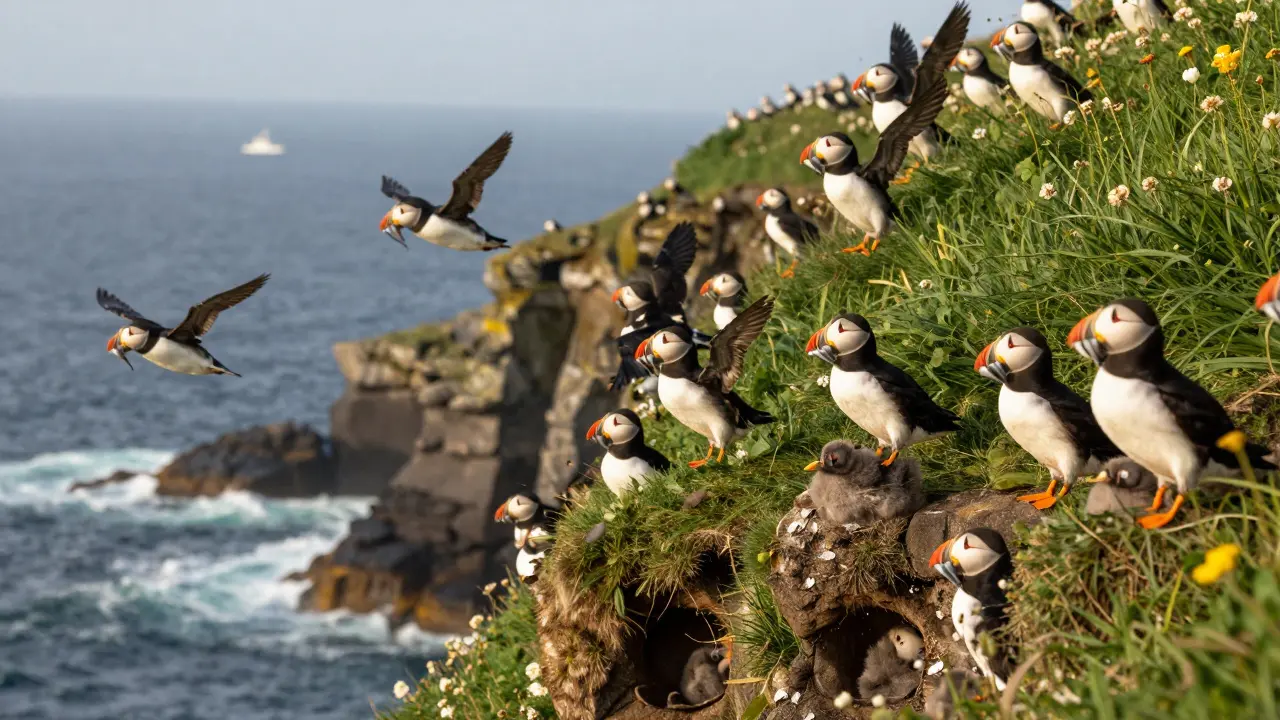
Every spring, the rocky cliffs of Scotland come alive with a burst of color and noise. Thousands of puffins return to breed, their bright orange beaks and clownish faces making them one of the most loved birds in the UK. If you want to see puffins in their natural habitat, timing and location matter. You won’t find them in cities or on busy beaches. You’ll need to head to remote islands where human traffic is low and the sea provides enough fish to feed their chicks.
When Do Puffins Breed in Scotland?
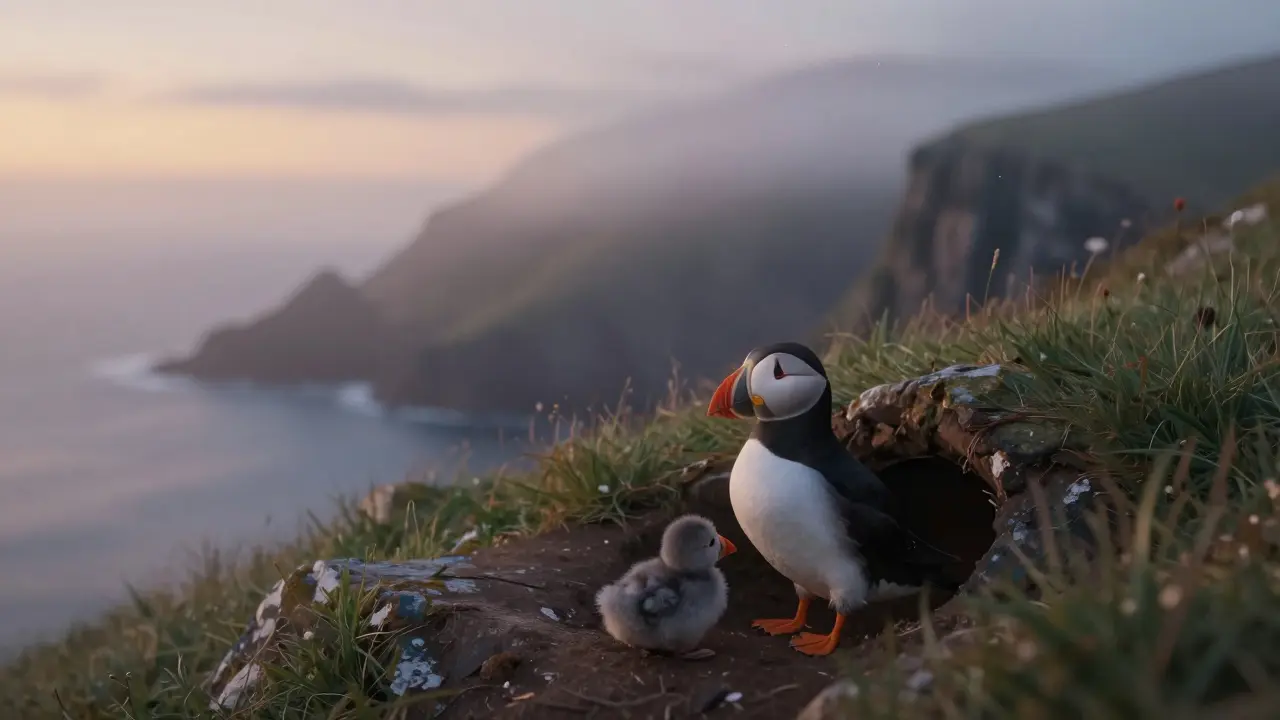
Puffins arrive on Scottish islands between late March and early April. By mid-April, they’re already digging burrows in the grassy cliffs. The real show starts in May, when eggs are laid-usually just one per pair. Chicks hatch in late May or early June, and by July, you’ll see fluffy gray pufflings waddling near burrow entrances, waiting for their parents to return with herring or sand eels.
The breeding season lasts until late July. After that, the adults and chicks head out to sea. By August, most puffins have left the islands. If you visit after mid-August, you’re unlikely to see any. The birds don’t return until the next spring.
That means your best window is May through July. Early June is peak time: the chicks are out, the adults are busy flying back and forth, and the light lasts longer, making photography easier. Weather matters too. Calm seas mean more feeding flights. Rain or strong winds? Fewer puffins will be visible.
Best Islands to See Puffins in Scotland
Not all Scottish islands are equal when it comes to puffin viewing. Some have hundreds of nests. Others have none. Here are the top three spots where puffins reliably return year after year.
- North Rona - A wild, uninhabited island off the north coast. Only researchers and licensed boat operators land here. It’s one of the most untouched puffin colonies in the UK, with over 20,000 breeding pairs. Access is difficult, but if you’re on a wildlife tour from Thurso or Scrabster, this is a rare chance to see puffins with almost no other people around.
- Isle of May - The most popular puffin destination in Scotland. Just a 20-minute boat ride from North Berwick, it’s managed by NatureScot. Boardwalks guide visitors safely past nesting areas. In June, you can watch puffins carrying fish in their beaks-sometimes five or six at once-while chicks peek out of burrows. Over 50,000 puffins nest here annually. The island also has guillemots, razorbills, and kittiwakes, making it a full seabird experience.
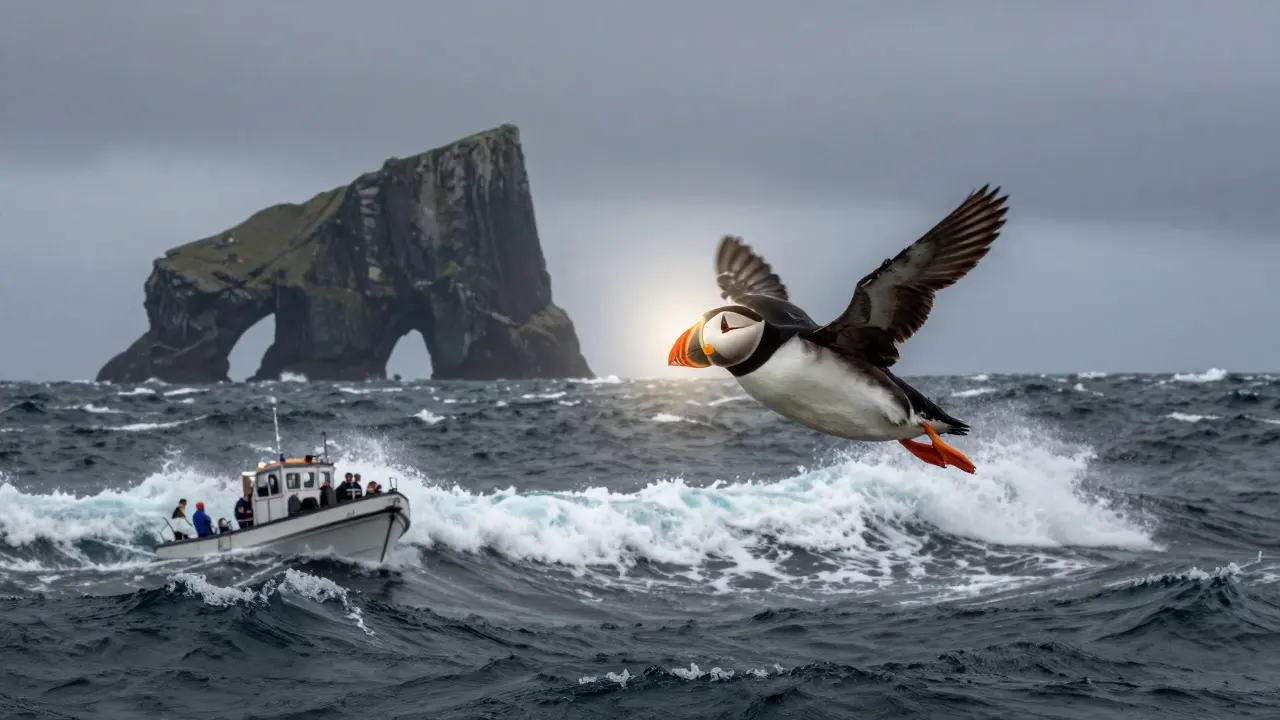
- Staffa - Famous for Fingal’s Cave, this small island near Mull has a smaller but still significant puffin colony. You’ll need to take a guided boat from Fionnphort or Tobermory. The cliffs here are steep, so viewing is mostly from the water. But if you’re lucky, a puffin will fly low over the boat, its wings beating fast, orange beak glowing in the sun.
Other islands like Rum, Easdale, and the Firth of Forth islands have puffins too, but numbers are smaller and access is trickier. Stick to the big three if you want guaranteed sightings.
How to Watch Puffins Without Disturbing Them
Puffins are not afraid of people-but they are sensitive to noise, sudden movements, and close approaches. A single startled puffin can abandon its burrow. That means your behavior matters more than your camera.
- Stay on marked paths. Never walk into grassy areas where burrows are hidden. A single step can crush a chick or collapse a nest.
- Keep noise low. Talk quietly. Don’t shout or use loud speakers. Puffins hear well, and sudden sounds make them fly off.
- Don’t use flash photography. It startles them. Natural light is better anyway-morning and late afternoon give the best glow on their beaks.
- Keep your distance. Even 10 meters is close enough. Use zoom lenses. Binoculars work too.
- Don’t feed or try to touch them. They’re wild animals. Hand-feeding puffins is illegal and dangerous-for them and you.
Many guided tours now use trained wildlife guides who know the exact routines of each colony. These guides can tell you when puffins are flying in for a feed, where the chicks are hiding, and how to spot a pair that’s just laid an egg. It’s worth paying extra for a knowledgeable guide. They’re not just showing you birds-they’re protecting them.
What to Bring for Puffin Watching
Scotland’s weather changes fast, even in summer. You’ll be on a boat, then on rocky ground. Dress smart.
- Waterproof jacket and boots. Even on sunny days, sea spray and mist roll in quickly.
- Warm layers. It’s often colder on the water than on land. A fleece or insulated jacket is better than a heavy coat.
- Binoculars. A good pair (8x or 10x magnification) helps you see details without getting too close.
- Zoom lens for your camera. 300mm or longer is ideal. Puffins fly fast and land far from paths.
- Snacks and water. Boats don’t always have cafes. Bring your own.
- Patience. You might wait 20 minutes for one puffin to fly in. That’s normal. The best moments come when you stop looking for them-and they show up anyway.
Why Puffins Are Declining in Scotland
Despite their charm, puffins are under pressure. In the last 20 years, numbers have dropped by over 40% in some colonies. The main reasons?
- Food shortages - Sand eels, their main food, have vanished from parts of the North Sea due to warming waters and overfishing. Without enough fish, puffins can’t feed their chicks. Many nests fail.
- Invasive predators - Rats and stoats, accidentally brought to islands by boats, eat eggs and chicks. Islands like the Isle of May have been cleared, but others still struggle.
- Plastic pollution - Puffins mistake plastic bits for food. Chicks die with stomachs full of bottle caps and fishing line.
- Boat traffic - Too many tourists, especially in peak season, can stress colonies. Even quiet boats that get too close disrupt feeding patterns.
Organizations like the RSPB and Marine Conservation Society are working to fix this. They’ve removed rats from islands, created marine protected areas, and banned certain types of fishing near puffin colonies. But it’s slow work. Every visitor who follows the rules helps.
Planning Your Trip
If you’re planning a puffin trip in 2026, here’s what to do:
- Book boat tickets early. The Isle of May sells out weeks ahead in June. Check NatureScot’s website for booking.
- Choose a guided tour. Avoid unlicensed operators. Look for those with RSPB or Scottish Wildlife Trust accreditation.
- Visit between May 20 and July 10. That’s the sweet spot.
- Check the weather. Wind over 25 knots cancels most boat trips. Call ahead.
- Respect the rules. No drones. No off-path walking. No loud music.
There’s something unforgettable about seeing a puffin fly low over the waves, beak full of fish, wings a blur. It’s not just a bird. It’s a survivor. A symbol of wild Scotland. And if you visit right, you’ll leave not just with photos-but with a deeper respect for the sea and the cliffs that hold it all together.
When is the best time to see puffins in Scotland?
The best time to see puffins in Scotland is between late May and mid-July. This is when the chicks have hatched and the adults are flying back and forth with fish. May is when they arrive and nest, June is peak activity, and by late July, most have left. Avoid visiting after August-you’ll see very few, if any.
Can you see puffins on the mainland of Scotland?
No, puffins only breed on remote islands with steep cliffs and no land predators. You might spot one flying over the sea near the coast, but you won’t see nesting colonies on the mainland. To see them up close, you need to take a boat to islands like the Isle of May, North Rona, or Staffa.
Are puffins endangered in Scotland?
Puffins are classified as vulnerable in the UK. Their numbers have dropped by more than 40% in the last 20 years due to food shortages, plastic pollution, and invasive predators. Some colonies, like on the Isle of May, are stable thanks to conservation efforts, but others are declining fast. Protecting their feeding grounds and keeping tourists at a distance are key to their survival.
How much does it cost to visit puffin islands?
Boat trips to puffin islands vary. A round-trip to the Isle of May costs around £35-£45 per adult. Tours to North Rona or Staffa can be £60-£80, depending on the operator. Some include a guide, binoculars, and a wildlife talk. Booking through NatureScot or RSPB often includes a donation to conservation. Never pay for unlicensed tours-they don’t follow wildlife protection rules.
Can you take a drone to photograph puffins?
No. Drones are banned on all puffin breeding islands in Scotland. Even flying one nearby can cause puffins to abandon their nests. The noise and shadow scare them. Conservation groups and national parks enforce this strictly. If you’re caught, you could be fined. Stick to ground-level photos and zoom lenses.
Comments (14)
-
Nikhil Gavhane March 3, 2026
Seeing puffins in the wild is one of those quiet miracles that reminds you nature still holds its magic. I’ve watched them from a distance on the Isle of May, and the way they dive back into the sea with five fish in their beak-it’s like they’re carrying the ocean itself home.
It’s not just about the photo. It’s about respecting that space. I’ve seen people get too close, thinking they’re being cute, and then the puffins vanish. That’s not just losing a sight-it’s breaking a rhythm older than any human tradition.
Conservation isn’t about rules. It’s about humility. We’re guests here, not owners.

-
Rajat Patil March 4, 2026
The information provided in this post is very clear and well-structured. I appreciate the emphasis on responsible tourism and the ecological challenges faced by puffins.
It is important that visitors understand that their presence, however well-intentioned, can have unintended consequences. The suggestion to use guided tours with accredited organizations is particularly wise.
Conservation efforts require cooperation between authorities, tour operators, and tourists. This post serves as a responsible guide for all three.

-
deepak srinivasa March 6, 2026
Why do puffins only carry fish in their beaks? Is it because their tongues help hold them? Or is it just anatomy? I’ve seen videos where they look like they’re balancing a whole grocery store.
Also, are sand eels really the only food source? What about other small fish? I wonder if climate change is shifting their entire prey ecosystem, not just reducing numbers.
And how do they know where to dive? Do they remember routes? Or is it instinct?

-
pk Pk March 7, 2026
If you’re planning a trip to see puffins, don’t wait. Book early. Don’t think you can just show up and find a spot. The Isle of May fills up faster than a concert ticket.
And listen-use a guide. Not because you need hand-holding, but because they’re the ones who know where the chicks are hiding, when the wind will die down, and which boat operators actually care about the birds.
You’re not just going on a tour. You’re becoming part of the protection. That’s powerful. And honestly? It’s the only way this works anymore.

-
NIKHIL TRIPATHI March 9, 2026
I went to Staffa last summer. It was foggy. We almost turned back.
Then, out of nowhere, a puffin flew right over the boat-low, fast, beak full of silvery fish, wings like a hummingbird on caffeine. I didn’t even raise my camera. Just stared.
That’s the thing. You don’t need perfect light. You don’t need the perfect shot. You just need to be there, quiet, when it happens.
And yeah, the boat ride was rough. But I’d do it again tomorrow. Even if the sea was angry.

-
Shivani Vaidya March 10, 2026
It is essential that tourism infrastructure does not compromise the natural behavior of wildlife. The restriction on drones is not excessive. It is necessary.
Similarly, the advice to avoid flash photography and maintain distance is not merely courteous. It is scientifically sound.
Preservation requires discipline. Discipline requires education. Education begins with clear, factual guidance such as this post provides.

-
Rubina Jadhav March 12, 2026
I didn’t know puffins couldn’t be seen on the mainland. That’s good to know. I’ll stick to the islands then. No point in going somewhere you can’t see them.

-
sumraa hussain March 12, 2026
Okay so I went to the Isle of May last year and I swear one of them looked me dead in the eye like ‘you’re lucky I didn’t drop this fish on your head’
And then another one flew past my face so close I felt the wind from its wings
And then I cried. Not because I was sad. Because I was too small to be part of something so wild
Also I ate a sandwich on the boat and crumbs fell. I regret it. I’m sorry puffins.
Next time I’m bringing a thermos of tea and a notebook. No camera. Just me. And them. And silence.

-
Raji viji March 13, 2026
Let’s be real-puffins are just seabirds with a PR team. Look at them. Orange beak? Clumsy waddle? They’re basically ducks that got drunk on vitamin supplements and called themselves ‘charismatic megafauna.’
And don’t get me started on the ‘conservation hero’ narrative. Rats? Plastic? Overfishing? Yeah, that’s all true. But guess what? Humans didn’t create the North Sea’s ecosystem collapse. We just got blamed because we’re easy.
Also, ‘no drones’? Bro. I’ve seen puffins from 200 feet up. They don’t even flinch. This is fearmongering wrapped in a nature documentary.
And don’t tell me about ‘respecting the space.’ I respect the space. I just want to see the damn birds. Not from 10 meters. From 3. Come on.

-
Rajashree Iyer March 15, 2026
There is a metaphysical truth in the puffin’s flight: it carries not fish, but the rhythm of the sea in its beak.
Each dive is a prayer. Each return, a covenant between the wind and the cliff.
We are not observers. We are interruptions. And yet, we are invited-not because we deserve it, but because the earth still remembers how to be gentle.
When you stand on that island, trembling with cold and awe, you are not seeing a bird.
You are remembering what it means to belong to something older than your name.

-
Parth Haz March 15, 2026
This is an exceptionally well-researched and thoughtful guide. The inclusion of specific conservation organizations and the emphasis on accredited tour operators demonstrates a deep understanding of sustainable ecotourism.
I commend the author for not only informing readers about where to go, but also why it matters. This level of responsibility should be the standard for all wildlife tourism content.

-
Vishal Bharadwaj March 16, 2026
Wait so puffins are vulnerable? Really? Last time I checked they were everywhere. I saw one on a postcard in Edinburgh. And they’re cute. Cute animals get saved. That’s how it works.
Also, I heard the sand eel thing is a myth. It’s actually the boats that scare them. And the tourists. And the drones. And the wind. And maybe the moon.
Also, why is North Rona so special? It’s just a rock. I’ve seen rocks. I’ve seen birds. I don’t get the hype.
And who says you can’t see them on the mainland? I saw one from my balcony in Aberdeen. It was flying. It was there. So… yeah.

-
anoushka singh March 17, 2026
Did anyone else notice that the post says you can’t feed them but then talks about how they carry fish? Like… isn’t that feeding? I’m confused.
Also, why do we care so much about puffins and not like… the fish they eat? Aren’t they just middlemen?
And can we talk about how expensive these tours are? £80 just to see birds? I could’ve bought a new phone.

-
Nikhil Gavhane March 18, 2026
They’re not feeding themselves. They’re feeding their chicks. That’s the difference. A puffin carrying fish isn’t eating-it’s parenting.
You don’t see a parent walking down the street with a sandwich in their mouth and say ‘hey, aren’t you feeding yourself?’
It’s the same. It’s not about the bird. It’s about the baby waiting in the burrow. That’s the miracle. Not the beak. Not the color. The care.