
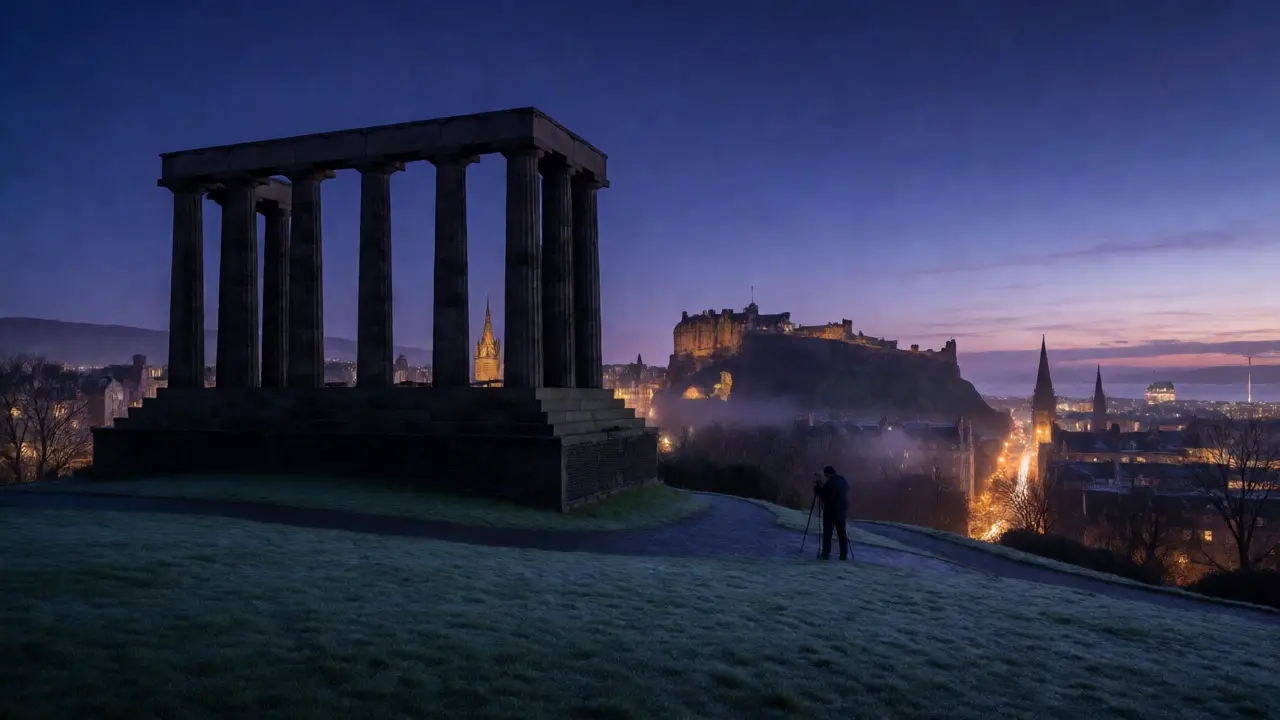
You’ve probably seen the photo. That jagged skyline of Edinburgh, with the Castle perched high on its volcanic rock and the spires of the Old Town poking through the mist. But if you want the shot that actually stops your thumb mid-scroll, you don’t go to the Castle. You go to Calton Hill. It’s a small, grassy outcrop in the New Town that packs more historical weight and photographic potential than half the city combined. And here’s the kicker: it’s free. No tickets, no queues, just you, your camera, and a view that changes every ten minutes as the sun climbs.
Most tourists rush past Calton Hill because they’re too busy climbing Arthur’s Seat or wandering the Royal Mile. Big mistake. Calton is where Edinburgh shows off its intellect and its ego in equal measure. It’s a hill covered in monuments that were meant to make Athens look like a provincial village. If you’re looking for the best sunrise spot in Scotland, or just trying to figure out which monument is which without reading a plaque, this guide breaks it all down.
Why Calton Hill Beats Every Other Viewpoint
Edinburgh has plenty of viewpoints. Arthur’s Seat is higher, yes, but it’s a hike. The Castle esplanade is iconic, but it’s crowded and costs money. Calton Hill sits at just 103 meters above sea level, yet it offers a 360-degree panorama that includes both the Old Town and the modern financial district. Why does this matter? Because light hits differently here. From Calton, you see the sun rise over the Firth of Forth, illuminating the eastern side of the Castle, while the western sky stays blue. That contrast is gold for photographers.
It’s also accessible. You can walk up from Princes Street in about ten minutes via a gentle slope. There are no stairs until the very top, making it manageable for most fitness levels. Plus, it’s open 24/7. Want to watch the sunset after work? Go. Want to catch the first light before your morning meeting? Doable. The lack of barriers means you can set up a tripod anywhere, though you’ll need to be polite about not blocking the path.
The Monuments: A Tourist’s Guide to the “Athens of the North”
Calton Hill isn’t just a hill; it’s an outdoor museum of unfinished ambitions. In the early 19th century, Edinburgh was booming intellectually. People started calling it the "Athens of the North," so they decided to build Athenian-style monuments. Some got finished. Most didn’t. Here’s what you’re actually looking at:
| Monument | Status | Best For | Entry Fee |
|---|---|---|---|
| National Monument | Unfinished (only 12 columns built) | Silhouette shots, dramatic skies | Free |
| Nelson Monument | Completed (1815) | Panoramic views from tower | £5 adult |
| Dugald Stewart Monument | Completed (1831) | Circular composition, classic Greek style | Free |
| City Observatory | Active historic site | Time ball drop (1pm daily) | Free grounds |
The National Monument is the star of the show. Modeled on the Parthenon in Athens, construction began in 1826 but ran out of money by 1829. Today, it stands as a haunting reminder of ambition unchecked by budget. Photographers love it because those twelve unadorned columns create perfect vertical lines against the sky. At sunrise, the stone turns a warm pinkish-grey, contrasting sharply with the dark silhouette of the Castle behind it.
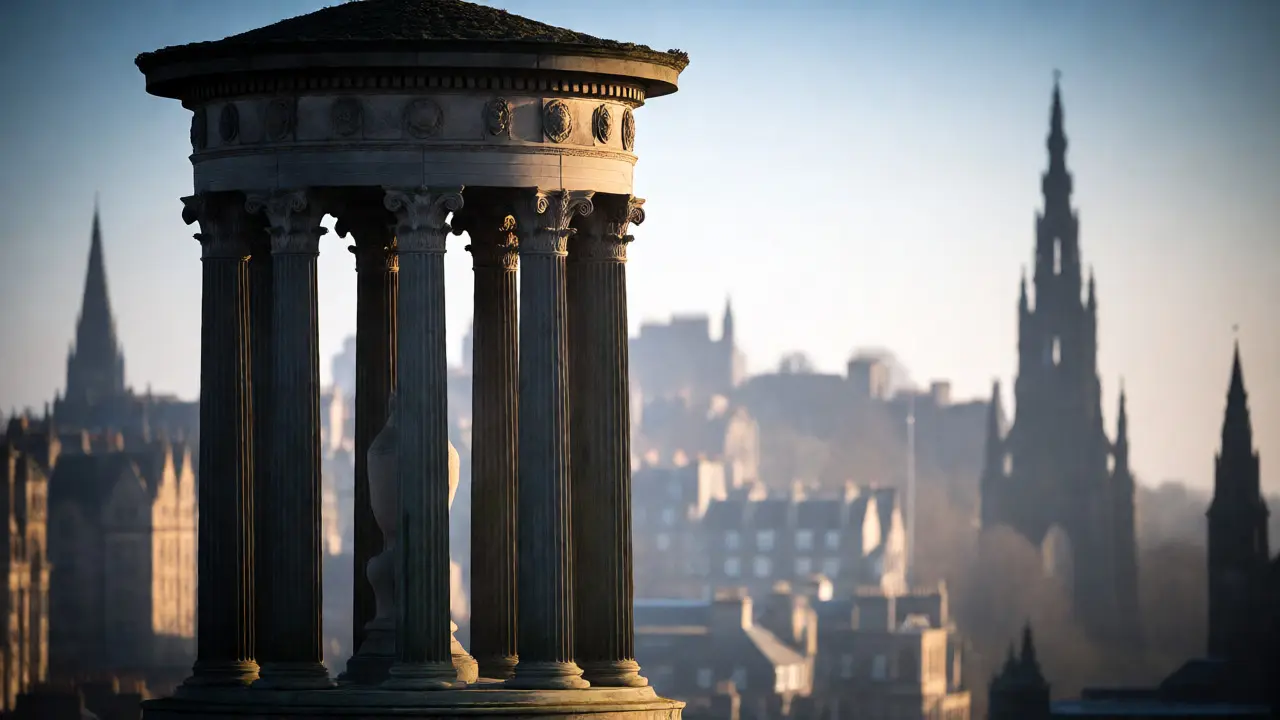
Next to it stands the Dugald Stewart Monument, a circular colonnade honoring the philosopher Dugald Stewart. Unlike the National Monument, this one is complete. It’s smaller, prettier, and often overlooked. Use it as a foreground element in wide-angle shots. Its round shape leads the eye naturally toward the center of the frame.
Capturing the Sunrise: Timing and Technique
Sunrise in Edinburgh varies wildly depending on the time of year. In summer (June), the sun rises around 4:30 AM. By December, it’s closer to 8:30 AM. Check a local weather app for exact times, but arrive 30 minutes before official sunrise. Why? Because the "blue hour"-that twilight period before the sun breaches the horizon-is when the city lights still glow, creating a magical mix of artificial and natural light.
- Lens Choice: A wide-angle lens (16-35mm) captures the full sweep of the skyline. A telephoto lens (70-200mm) compresses the distance, making the Castle look huge behind the monuments.
- Tripod: Essential for low-light shots. Even with a fast camera, handheld shots blur below 1/60s shutter speed.
- Battery Backup: Cold mornings drain batteries fast. Bring a spare.
- Layer Up: Wind chill on Calton Hill is real. Even in July, it can feel 5°C colder than street level.
One trick locals use: shoot the Time Ball at the City Observatory. At exactly 1 PM (GMT/BST), a red ball drops from the mast. This was originally used to synchronize ships’ clocks in Leith. Today, it’s a quirky detail that adds life to static architectural shots. If you’re there at noon, wait for the drop. It’s free entertainment and a great video clip opportunity.
Photography Spots: Where to Stand
Not all angles are created equal. Here are three proven spots that deliver consistent results:
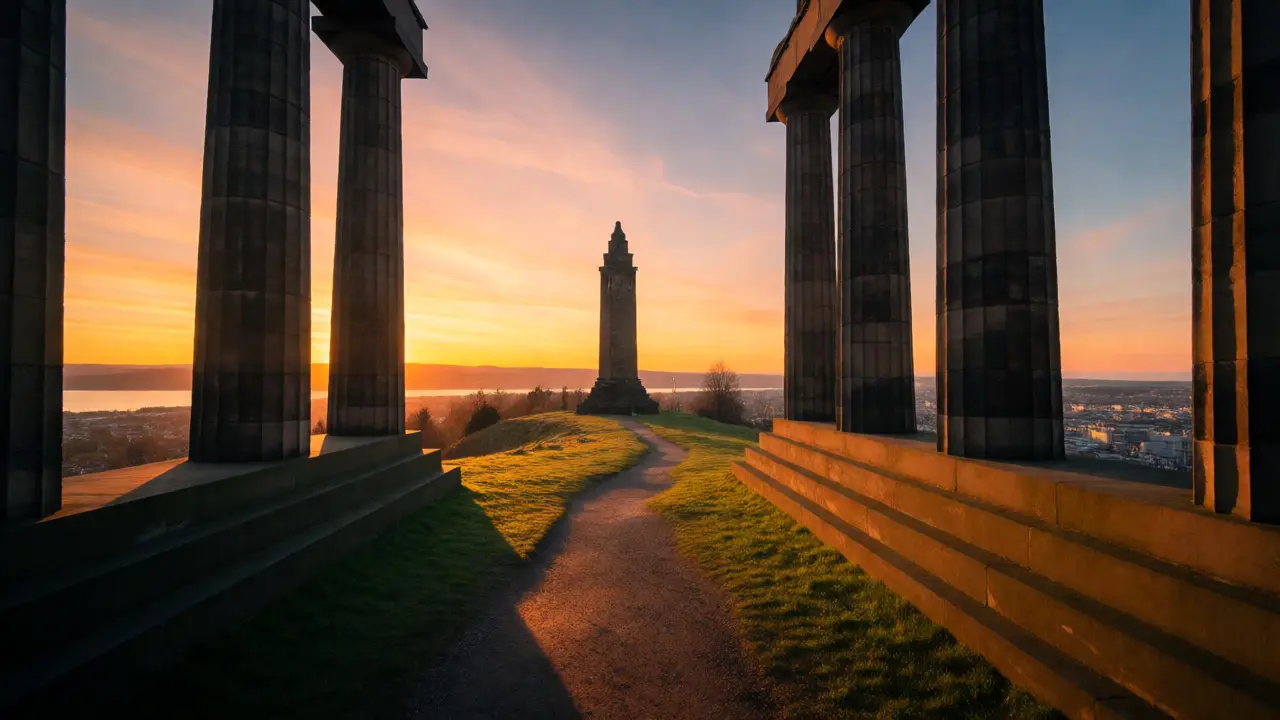
- The East Terrace: Face east. Frame the National Monument on the left and let the rising sun burst between the columns. This creates a starburst effect if you stop down your aperture to f/16.
- The West Slope: Look back toward the Old Town. You get the Castle, Scott Monument, and St Giles Cathedral in one frame. Use a long lens to stack these landmarks vertically.
- The Path Between Monuments: Walk between the Dugald Stewart and National Monuments. This gap frames the distant Pentland Hills and the Firth of Forth, giving depth to your image.
Avoid standing directly under the Nelson Monument if you want clean skies. The structure blocks a significant portion of the upper frame. Instead, position yourself 20 meters away and shoot upward to include the tower’s height without dominating the shot.
Practical Tips for Your Visit
Getting there is easy. From Waverley Station, head north on Waterloo Place. Turn right onto Regent Road. The entrance to Calton Hill is clearly marked near the intersection with Calton Road. The path is paved and well-lit, but wear decent shoes. Grass can be muddy after rain, especially near the monuments.
If you want to climb the Nelson Monument, note that it’s closed during winter months (November to March). During opening hours, it’s a narrow spiral staircase. Claustrophobics should skip it. The view from the top is spectacular, but the ground-level views are nearly identical without the £5 fee.
Food options are scarce on the hill itself. Grab coffee from a café on Princes Street before you start the climb. There’s a small kiosk near the bottom sometimes, but don’t count on it. Bring water. Hydration matters when you’re hiking uphill with a heavy camera bag.
Finally, respect the space. Calton Hill is a public park, but it’s also a heritage site. Don’t climb on the monuments. Don’t leave trash. And if you’re setting up a tripod, keep it compact. Other visitors need to pass through, especially during peak tourist season.
Is Calton Hill worth visiting if I only have one day in Edinburgh?
Yes, absolutely. It takes less than an hour to visit and offers the best panoramic view of the city for free. Prioritize it at sunrise or sunset for maximum impact. If you miss it, you miss the definitive Edinburgh photo op.
Can I drive up to Calton Hill?
No. Cars cannot drive up the hill itself. You must park nearby, such as at the Calton Road car park or along Waterloo Place, and walk up. The walk is short but steep in parts.
What is the best time of year to visit for photography?
Autumn (September to November) offers the best balance of clear skies, colorful foliage, and manageable crowds. Winter provides dramatic storm clouds and snow-covered monuments, but daylight hours are short. Summer has long days but frequent haze and larger crowds.
Are the monuments accessible for people with mobility issues?
The paths to the main monuments are paved and relatively flat, making them accessible for wheelchairs and strollers. However, the Nelson Monument requires climbing stairs, so those with mobility limitations may prefer to stay at ground level, where the views are still excellent.
Is there an entry fee for Calton Hill?
No, access to the hill and all monuments except the Nelson Monument tower is completely free. The Nelson Monument charges a small admission fee (£5 for adults) to climb to the viewing platform.
Comments (10)
-
Meagan Mueller September 1, 2026
they know what theyre doing with those unfinished columns its a psychological trap to keep tourists staring at failure while the real power structures watch from the castle
the light hitting the east side isnt natural its staged by city planners to distract us from the north face where the shadows hide the surveillance cameras i bet the time ball drop is just a signal for something else entirely

-
Dave Gibbeson September 1, 2026
LISTEN UP if you are not on that hill at 4:30 AM in June you are wasting your life energy this place is free and it gives you everything Arthur's Seat does without the knee destruction
grab a tripod stop down to f/16 and let the sun burst through those columns it is raw unfiltered power you need to feel that wind chill because it wakes up every cell in your body do not skip the blue hour that is where the magic happens and remember bring spare batteries because cold kills them fast
go now conquer the view and come back stronger than before

-
Sabrina Newland September 3, 2026
omg i love how the post talks about the "Athens of the North" 🤔 it makes me wonder if we are still trying to emulate ancient ideals or if weve just lost the plot 😂
the idea that ambition ran out of money is so poetic 💸 like were all just building half finished dreams waiting for funding that never comes 🏛️✨
do you think the unfinished nature makes it more beautiful bc imperfection feels human 🥺📷

-
Amara Akbar September 5, 2026
Thank you for such a comprehensive guide. It is truly helpful for planning a visit.
I appreciate the emphasis on accessibility. Knowing that the paths are paved is reassuring for many visitors who might otherwise hesitate.
The tip about arriving early for the blue hour is excellent advice. Patience often yields the best results in photography.

-
Mark Harvey September 6, 2026
this is exactly what people need to hear calton hill is underrated and totally worth the effort
you dont need to be a pro photographer to get great shots here just show up with a camera and an open mind
the views are incredible and the history adds so much depth to the experience go enjoy it you wont regret it

-
Art HND September 6, 2026
Nelson Monument fee is a ripoff. Ground level views are identical. Skip the stairs.

-
Brandon Olvera September 7, 2026
Scotland has its charm but don't pretend Edinburgh isn't overrated compared to American cities
we have better infrastructure and cleaner streets
Calton Hill is nice but nothing special really

-
Elizabeth Brooks September 7, 2026
hey guys quick question did anyone actually manage to catch the time ball drop at 1pm last week?
i went last month and the kiosk was closed which sucked but the view was amazing anyway
also is the path really muddy in october? im thinking of going then and dont want to ruin my shoes

-
Meagan Mueller September 9, 2026
of course the kiosk is closed its part of the pattern they control access to resources to keep you dependent on the main street vendors
the mud is intentional too designed to slow you down so you miss the optimal light window its all calculated
-
Anthony Miller September 10, 2026
Why are you asking questions instead of providing answers You are wasting space
Your ignorance is palpable and it irritates me deeply to see people seek validation rather than knowledge
You should have read the FAQ section provided in the text itself It clearly states the Time Ball drops at 1 PM GMT/BST daily regardless of kiosk status
Furthermore regarding the mud yes it is muddy after rain especially near monuments as stated plainly in the practical tips section
Do not clutter the comment section with basic inquiries when the information is right there in front of you
Your lack of attention to detail reflects poorly on your ability to engage meaningfully with content
Read carefully next time before posting trivialities that annoy everyone else
I expect better from future contributors to this discussion
Stop taking up valuable digital real estate with your incompetence
