
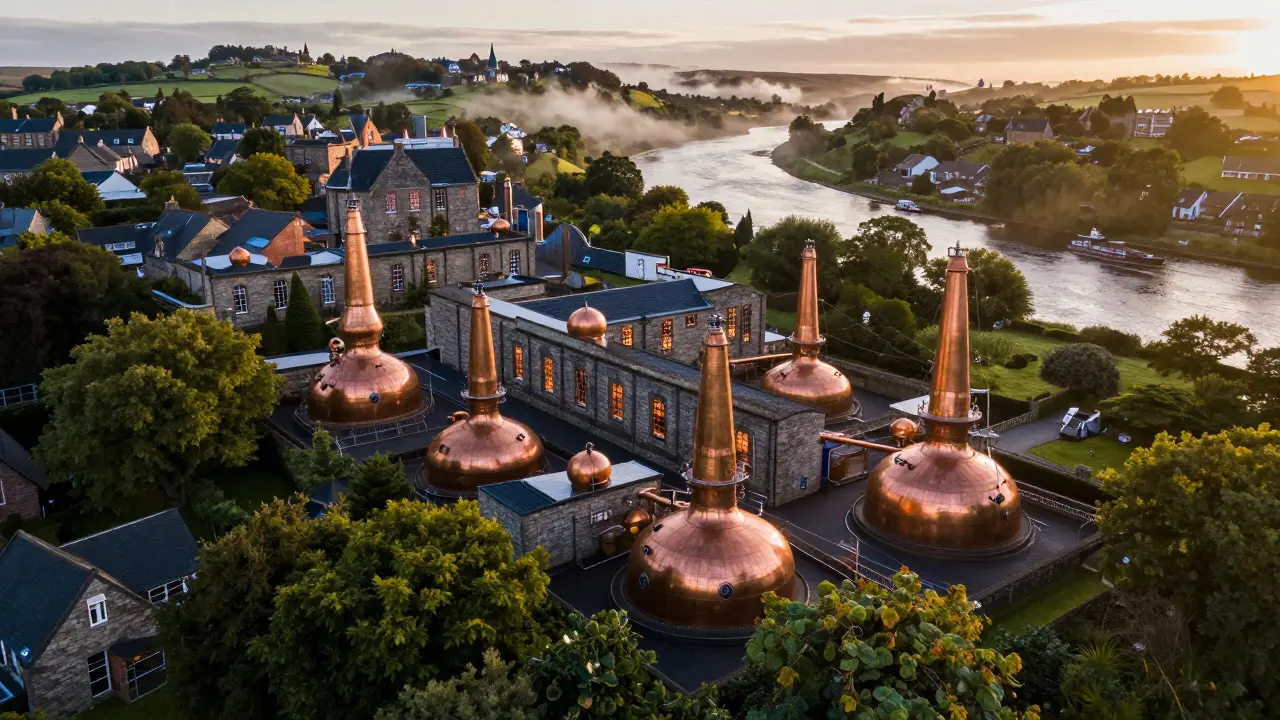
Scotland’s whisky map isn’t just a chart on a wall-it’s a roadmap to some of the most distinctive spirits in the world. Each region tells a different story, shaped by climate, water, soil, and generations of tradition. Whether you’re hopping between distilleries in a single day or planning a week-long pilgrimage, knowing where each whisky comes from changes everything. This isn’t about drinking. It’s about understanding why a dram from Islay tastes like salted peat smoke, while one from Speyside sings with honey and orchard fruit.
Why Region Matters More Than Brand
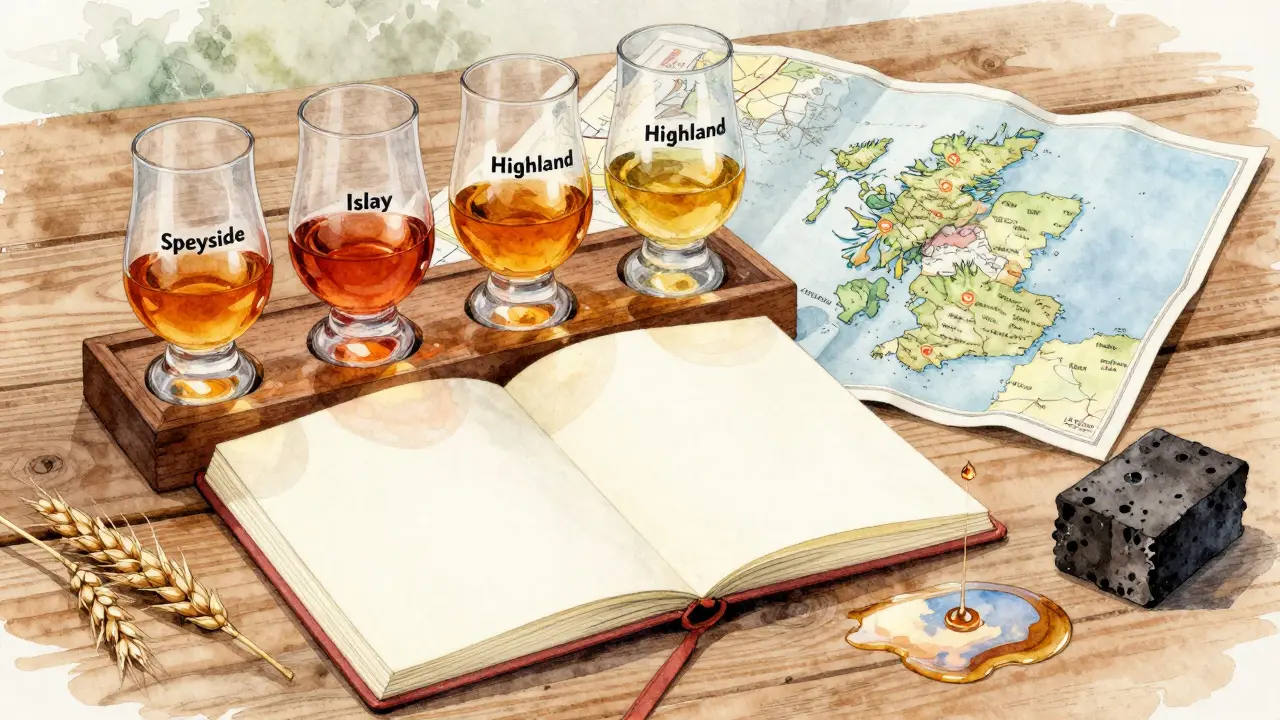
Most people think of whisky brands-Macallan, Lagavulin, Glenfiddich-but the real magic lies in where they’re made. The Scotch Whisky Association officially recognizes five whisky-producing regions: Speyside, Highland, Lowland, Islay, and Campbeltown. Each has rules, though they’re loose. The real differences? The water, the air, and the way the casks age.
Take Speyside. It’s not a province. It’s a river valley in northeast Scotland, packed with over 50 distilleries-more than any other region. The water here is soft, filtered through granite, and the air is humid from the River Spey. That’s why Speyside whiskies lean sweet: vanilla, apple, pear, citrus. Glenfiddich, Macallan, Balvenie-all sit here. If you want smooth, complex, and approachable, this is your starting point.
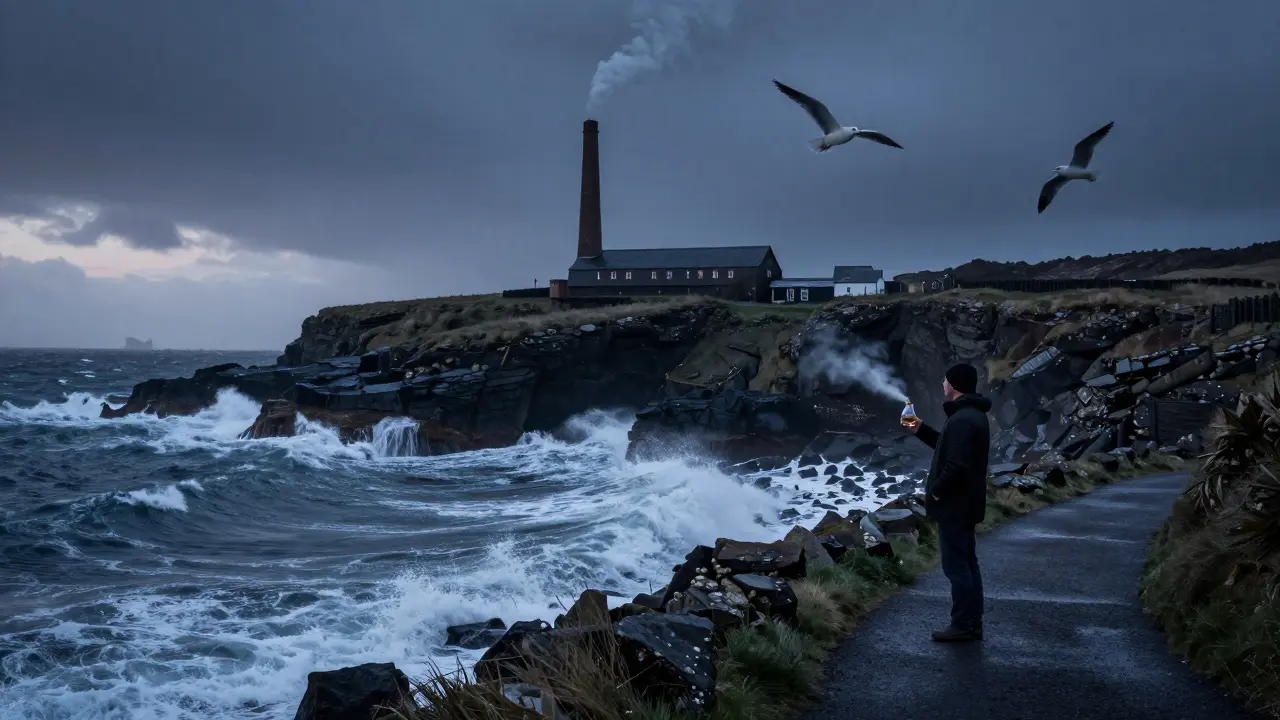
Now drive 100 miles west to Islay. The wind off the Atlantic hits these distilleries raw. The peat here is wet, dense, and loaded with seaweed. When burned to dry barley, it leaves a medicinal, smoky fingerprint on the spirit. Laphroaig, Ardbeg, Lagavulin-these aren’t just names. They’re landmarks. A single sip of Islay whisky will either hook you or send you running. There’s no middle ground.
Highland: The Vast and Varied
The Highland region covers nearly half of Scotland. That means it’s not one style-it’s dozens. The Highlands stretch from the northern coast down to the edge of Speyside. Distilleries here use everything from lightly peated barley to unpeated, and age in sherry, bourbon, or wine casks.
Look at Glenmorangie. It’s in the north, near the coast, and makes a light, floral whisky with citrus notes. But just 60 miles south, Glen Garioch pulls a deeper, spicier profile from its old stone stills. Then there’s Oban, on the west coast, caught between Highland and Islay. It’s salty, smoky, and fruity-a bridge between worlds.
If you’re driving the Highlands, don’t expect uniformity. You’ll taste everything from honeyed cream to charred oak. That’s the point. This region rewards curiosity.
Lowland: The Quiet Contender
Lowland whiskies are often overlooked. They’re not as loud as Islay, not as sweet as Speyside. But they’re elegant. Triple-distilled, usually unpeated, and light as spring water. They’re the whisky you sip slowly, not to analyze, but to enjoy.
Blair Athol, Auchentoshan, and Glenkinchie are the big names here. Auchentoshan, near Glasgow, is one of the few that still triple-distills like Irish whiskey. The result? A clean, grassy dram with notes of green apple and almond. It’s the perfect intro for someone new to whisky-or a palate cleanser between heavier drams.
Lowland doesn’t have the drama. But it has the finesse. Skip it, and you’ll miss a crucial part of Scotland’s whisky soul.
Campbeltown: The Forgotten Town
Once home to over 30 distilleries in the 1800s, Campbeltown now has three working ones: Springbank, Glen Scotia, and Kilkerran. It’s a 20-minute drive from Campbeltown village to the distilleries. You could do it all in a morning.
What makes Campbeltown unique? A briny, oily texture with a hint of smoke. It’s not as peaty as Islay, but it’s not as clean as Lowland. Think wet stones, brine, dried fruit, and a touch of leather. Springbank’s 10-year-old is a masterclass in balance. It’s the kind of whisky that makes you pause, sip again, and wonder why you didn’t try it sooner.
This region is small, but it’s dense with history. If you’re serious about whisky, you can’t skip it.
Planning Your Route: Distance, Time, and Logic
Scotland’s whisky regions are spread out. You can’t do them all in one day. But you can plan smart.
Start with Speyside if you’re flying into Aberdeen or Inverness. It’s the most concentrated. You can visit 3-4 distilleries in a single day. Glenfiddich, Macallan, and Balvenie are all within 15 miles of each other. Book tours ahead. Some, like Macallan’s new £150 experience, sell out weeks in advance.
From Speyside, head west to the Highlands. A 2-hour drive takes you to Glenmorangie near Inverness, or further to Oban on the west coast. Oban is a great pivot-it’s close to the ferry to Islay.
Islay is a full-day commitment. You need a ferry from Oban (1.5 hours) or a flight from Glasgow (30 minutes). Once there, the distilleries are clustered. Lagavulin and Laphroaig are a 5-minute drive apart. Ardbeg is 10 minutes farther. Don’t try to do all five in one day. You’ll lose the taste. Two or three max. Then rest.
Lowland and Campbeltown are easy to add if you’re near Glasgow. Glenkinchie is 20 minutes from the city. Campbeltown is a 3-hour drive, but it’s worth it if you’ve already done the others.
Pro Tips for Distillery Visits
- Book tours at least 2 weeks ahead. Popular distilleries like Macallan and Talisker have limited spots.
- Ask for a cask-strength sample. It’s often included, and it reveals the spirit’s true character.
- Bring a notebook. Write down notes on nose, palate, finish. You’ll forget what you tasted by day three.
- Don’t drink water between sips. Swish whisky around your mouth, then spit into the provided jug. You’ll taste more, and stay sharp.
- Try the distillery’s exclusive bottling. Many release limited editions only available on-site.
What to Skip
Don’t waste time on tourist traps. Some distilleries offer flashy tours with fancy gift shops but little substance. Stick to places that still distill on-site, use traditional methods, and let you see the mash tuns and stills.
Also, skip the ‘whisky trail’ bus tours unless you’re with a group. They rush you. You’ll taste 10 whiskies in 3 hours and remember nothing. Better to pick one region, slow down, and really taste.
Seasonal Considerations
Whisky distilleries are quieter in winter. November to February is low season. You’ll get more time with the distillery staff. Some even offer behind-the-scenes tours during these months. The weather? Cold. But the whisky? Warmer.
Summer brings crowds. Book early. And if you’re going in April or September, you might catch a distillery open day-cask tasting, live music, local food. Those are the days you’ll remember.
Final Thought: It’s Not About the Number
You don’t need to visit 20 distilleries to understand Scottish whisky. You need to visit three that speak to you.
One from Speyside to show you sweetness. One from Islay to show you fire. One from the Highlands or Lowland to show you depth.
Let the map guide you. But let your palate lead.
What are the five official whisky regions of Scotland?
The five official whisky regions are Speyside, Highland, Lowland, Islay, and Campbeltown. Each has distinct characteristics shaped by geography, water source, and tradition. Speyside is known for sweet, fruity whiskies; Highland for its wide variety; Lowland for light, unpeated drams; Islay for smoky, peaty flavors; and Campbeltown for briny, oily profiles.
Which region has the most distilleries?
Speyside has the highest concentration of distilleries in Scotland, with over 50 active sites. This is due to its abundant supply of pure, soft water from the River Spey and favorable climate for maturation. Famous names like Glenfiddich, Macallan, and Glenlivet all call Speyside home.
Can you visit Islay distilleries without a car?
Yes, but it’s harder. The ferry from Oban to Islay runs regularly, and once on the island, there are local taxi services and guided tours that pick up from the pier. Some distilleries offer shuttle services from the ferry terminal. But if you want flexibility, renting a car or joining a small-group tour is the best option.
Are whisky tours expensive?
Basic distillery tours in Scotland usually cost between £15 and £30 and include a tasting of 3-4 whiskies. Premium experiences-like cask selection, barrel blending, or access to rare stocks-can range from £75 to £200. Many distilleries offer discounts for booking online or visiting off-season. The most expensive tours are often worth it if you’re serious about learning.
What’s the best time of year to tour Scottish distilleries?
Late autumn (October-November) and early spring (March-April) are ideal. The weather is mild, crowds are thin, and many distilleries host special events like cask-tasting days or distiller Q&As. Winter (December-February) is quiet and intimate, perfect for in-depth tours. Summer is busy but lively, with festivals and outdoor events.
Comments (10)
-
kelvin kind February 4, 2026
Just had a Glenkinchie last night. So clean. Like drinking spring air with a side of toast.

-
Peter Reynolds February 5, 2026
Man I love how this post breaks it down. Speyside for the win every time. I went last year and did Macallan, Balvenie, and Glenfiddich in one day. Felt like a monk on a pilgrimage. No rush, just sipping and staring at the stills. The way the light hits the copper… it’s not just whisky, it’s alchemy.
And yeah, the cask-strength sample? Game changer. Tasted like liquid honey and burnt orange peel. Never thought I’d say that about something that burns your throat.
Also, spit. Always spit. I used to swallow everything till I got sick on a tour. Now I’m the guy with the spit cup looking like a pro. No regrets.

-
Ian Cassidy February 6, 2026
Islay’s peat isn’t just smoke. It’s a geologic signature. The phenols come from ancient bog vegetation, partially decomposed over millennia, then kilned at 80°C with sea salt aerosols clinging to the barley. That’s why Lagavulin tastes like a bonfire on a rocky coast. Not flavor. Chemistry.
Speyside’s soft water? Granite aquifer filtration. Low mineral content. Means fewer metallic notes, more ester formation during fermentation. That’s why you get pear and vanilla instead of sulfur and iron.
Most people think region = brand. No. Region = terroir. Same as wine. The still shape, the warehouse humidity, the cask history-all of it’s local. You can’t replicate Islay in Speyside. The air alone is different.

-
Sarah McWhirter February 6, 2026
Okay but have you ever thought that maybe the whole ‘regions’ thing is just a marketing ploy by the Scotch Whisky Association to make people think there’s more variety than there actually is?
I mean, I read somewhere that most distilleries use the same yeast strain and similar casks. And isn’t it weird that every ‘unique’ region has like three big brands that dominate the shelf? Like… is Campbeltown really that different or did they just let three distilleries survive so they could say ‘five regions’?
Also, why do they always say ‘Islay is either love or hate’? Sounds like they’re trying to scare off people who don’t want to be ‘cool’ enough to drink peat smoke. I bet if you blindfolded someone and gave them a Lagavulin and a Glenlivet, they’d pick the Islay every time. Just because it’s stronger. Not better.
And don’t even get me started on ‘cask-strength’. That’s just a fancy way of saying ‘we poured in extra alcohol so you’ll think it’s premium’. I’ve had cask-strength that tasted like rubbing alcohol with a hint of regret.

-
Ananya Sharma February 7, 2026
Let me be the first to say this: the entire concept of ‘whisky regions’ is a colonial fantasy built on romanticized nostalgia and a complete disregard for economic reality. You think Speyside’s sweetness comes from ‘soft water’? No. It comes from centuries of industrialization, corporate consolidation, and the erasure of smaller, wilder distilleries that couldn’t compete with Glenfiddich’s marketing budget.
And Highland? ‘Vast and varied’? Please. It’s a dumping ground for distilleries that couldn’t find a niche. Oban isn’t a ‘bridge between worlds’-it’s a compromise. A middle-class whisky for people too scared to commit to Islay but too pretentious to drink Lowland.
Lowland? ‘Elegant’? It’s the whisky you drink when you’re trying to impress someone who doesn’t like whisky. It’s the beige sweater of spirits. No character. No soul. Just… clean. Like a hospital room.
Campbeltown? Three distilleries left? That’s not history. That’s extinction. And the ‘briny oily texture’? That’s just saltwater leakage from the old warehouses because they can’t afford proper insulation. They’re not crafting terroir-they’re surviving.
And don’t even mention ‘book tours ahead’. That’s not access. That’s exclusion. You need money, time, and privilege to do this ‘pilgrimage’. Most people in Scotland can’t even afford a single dram, let alone a £150 Macallan experience. So who are we really celebrating here? The whisky? Or the capitalist system that turned it into a luxury status symbol?
Real whisky isn’t about regions. It’s about resistance. It’s about the illicit stills in the glens, the moonshiners who refused to register, the farmers who distilled to survive. That’s the soul. Not the gift shop at Glenlivet.

-
Zach Beggs February 7, 2026
I did Speyside last spring. Three distilleries. Two cask samples. One nap in the car. Perfect day.

-
Kenny Stockman February 7, 2026
Love this breakdown. Just wanna add-don’t skip the distillery bars. I went to Glenmorangie and they had this one 18-year-old that wasn’t on the tour. Just served it to me because I asked. Said, ‘You’ve earned it.’ That’s the kind of moment you don’t plan. Just show up, be cool, and let them guide you.
Also, the ‘spit into the jug’ thing? Total game changer. I used to feel weird about it. Now I do it like a pro. My liver thanks me. My taste buds thank me. My friends think I’m weird. Worth it.

-
Antonio Hunter February 8, 2026
I’ve been drinking Scotch for over 20 years, and I still learn something every time I read something like this. It’s easy to get caught up in the brands, the labels, the price tags-but what this post gets right is that the real story is in the land. The water. The air. The way the peat burns in a particular valley, how the salt wind rolls in off the coast, how the warehouse creaks with humidity over 12 years.
I remember visiting Springbank once in the rain. The distillery manager, an older man with calloused hands, didn’t give me a tour. He just handed me a glass and said, ‘Taste it. Tell me what you hear.’ At first I thought he was joking. But then I did. And I heard the sea. I heard the rain on the roof. I heard the stills breathing. That’s what Campbeltown does. It doesn’t shout. It whispers. And if you’re quiet enough, you’ll hear it.
That’s why I don’t care how many distilleries you visit. I care about how many moments you let yourself feel. One quiet sip, one pause, one memory made in a room where the walls still smell like barley and smoke-that’s the real journey.
Don’t chase the map. Let the map chase you.

-
Paritosh Bhagat February 8, 2026
Ugh I hate how everyone romanticizes this like it’s some sacred ritual. You know what’s really happening? Corporate consolidation. The ‘five regions’? That’s a legal fiction created to keep small producers out. I checked the HMRC records-over 70% of Scotch whisky production is controlled by just three conglomerates. Glenfiddich? Owned by William Grant & Sons. Macallan? Diageo. Laphroaig? owned by Suntory. The whole ‘authentic tradition’ is a facade.
And don’t get me started on ‘cask-strength’. That’s just a way to charge more. The alcohol content is barely above 50% in most cases. They’re not ‘revealing true character’-they’re hiding dilution. The real character is in the 40% ABV versions that most people actually drink.
Also, ‘book ahead’? That’s just gatekeeping. If you’re not rich or well-connected, you can’t get in. And ‘spit into the jug’? That’s not sophistication-it’s hygiene theater. You’re not ‘preserving your palate’-you’re avoiding getting drunk because you’re paying too much.
Real whisky lovers don’t need tours. They don’t need regions. They just need a bottle, a glass, and a quiet corner. Everything else is just marketing.

-
Fred Edwords February 10, 2026
Correction: The five official regions are Speyside, Highland, Lowland, Islay, and Campbeltown-yes, but technically, the Highland region is subdivided into ‘North Highland’ and ‘South Highland’ in many industry publications, and some argue that ‘Islands’ (including Jura, Mull, and Skye) should be a sixth region due to distinct maritime influences. The SWA officially groups them under Highland, but many connoisseurs and distillers treat them separately. For example, Talisker from Skye exhibits Islay-like peat but with a briny, peppery backbone unlike any mainland whisky. The SWA’s definition is more regulatory than sensory. Also, ‘soft water’ in Speyside is not just granite-filtered-it’s specifically from the River Spey’s glacial silt deposits, which are low in calcium and magnesium, reducing harsh mineral notes and allowing delicate esters to dominate. And while it’s true that Campbeltown has three distilleries, Springbank’s unique 2.5-time distillation process (a hybrid of double and triple) is not replicated anywhere else-making it a technical outlier, not just a regional relic.
