
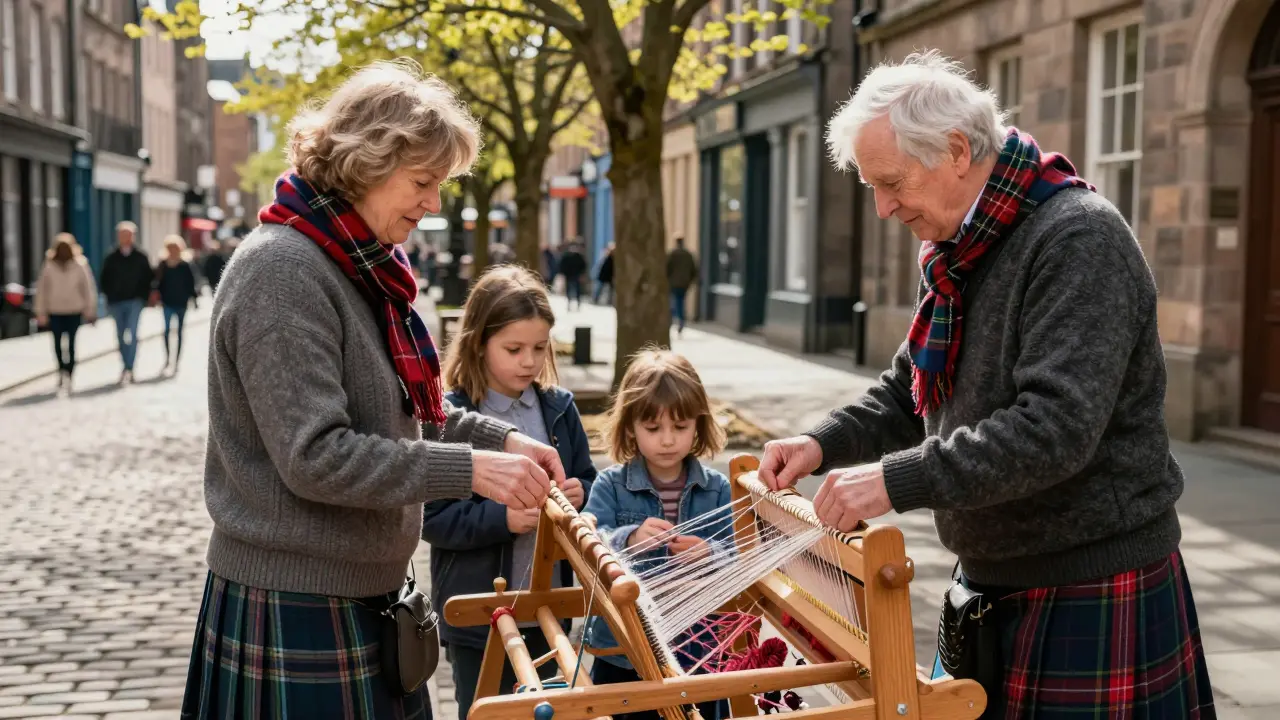
On April 6, streets in Glasgow, Edinburgh, and Dundee come alive with the deep reds, greens, and blues of tartan. Not because it’s a national holiday, but because it’s Tartan Day - a quiet, proud celebration of Scottish roots that’s been growing for decades. You won’t find parades like St. Andrew’s Day or fireworks like Hogmanay. Instead, you’ll see grandparents wearing their family plaids, schoolchildren reciting Burns poems, and local weavers setting up tables outside craft shops with bolts of handwoven cloth. It’s not flashy. But it’s real.
Why April 6?
The date isn’t random. It marks the anniversary of the Declaration of Arbroath in 1320 - a letter sent to the Pope by Scottish nobles declaring Scotland’s independence from England. It’s one of the earliest documents in history to argue that a nation’s sovereignty comes from its people, not its king. That idea, written in Latin on parchment, became a foundation for modern democracy. In 1998, the U.S. Congress officially recognized April 6 as Tartan Day to honor Scottish-American heritage. Scotland followed suit in 2008, not as a public holiday, but as a cultural observance.
Here in Dundee, where my grandmother wove tartan on a loom until she was 82, the day feels personal. It’s not about politics. It’s about remembering who you are.
What Is Tartan, Really?
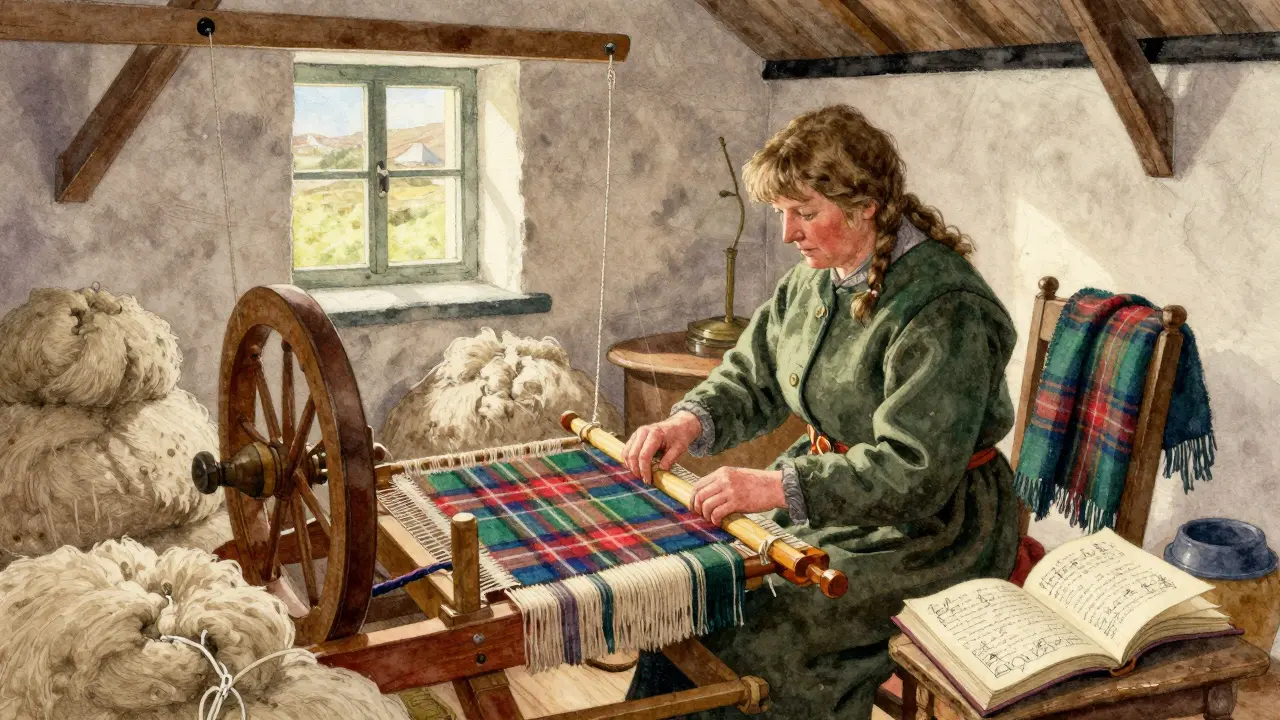
Tartan isn’t just a pattern. It’s a code. Each clan - MacLeod, Campbell, Fraser - had its own set of colors and thread counts. Back in the 18th century, after the Jacobite uprisings, the British government banned tartan for over 30 years. They thought it was a symbol of rebellion. But people kept weaving it in secret. Women hid looms under floorboards. Men wore small pieces stitched into their socks. The cloth survived because it carried identity.
Today, there are over 7,000 registered tartans. Some are for clans. Others for cities, universities, or even companies like Johnnie Walker. The most famous? The Royal Stewart - red with thin black and green lines. It’s worn by the royal family and sold in every tourist shop. But if you want the real thing, ask for the specific pattern of your ancestors. Many families in the Highlands still know theirs by heart.
How Tartan Day Is Celebrated Across Scotland
In Edinburgh, the National Museum of Scotland hosts free talks on Highland history. Local schools invite elders to bring their tartan kilts and tell stories of the Clearances - how families were forced off their land, but carried their patterns with them. In the Outer Hebrides, women gather in croft houses to weave new tartans using wool from their own sheep. In Aberdeen, the Highland Games start early on April 6, with caber tossing and pipe bands playing tunes passed down for generations.
Here in Dundee, the celebration is simpler. The city council sets up a small tent near the V&A museum with free tartan scarves for kids. Local weavers from the nearby village of Friockheim bring their looms and let anyone try their hand at weaving. No pressure. No cost. Just hands moving threads, learning how something so simple - a grid of colored lines - can hold centuries of memory.
Tartan in Modern Scotland
These days, you’ll see tartan on sneakers, phone cases, and even electric cars. The Scottish government uses it in branding campaigns to attract tourists. But the deeper meaning hasn’t faded. In 2023, a survey by the Scottish Tartans Authority found that 68% of Scots under 35 own at least one tartan item - not because it’s trendy, but because they feel connected to it.
There’s a reason for that. In a world of fast fashion and disposable culture, tartan is slow. It takes weeks to weave a single piece. Each thread is dyed by hand. The patterns are recorded in ledgers kept in Edinburgh’s National Archives. When you wear it, you’re not just wearing fabric. You’re wearing history.
How to Participate
You don’t need to be Scottish to join in. If you’re in Scotland on April 6, here’s how to make it meaningful:
- Wear something tartan - even a scarf or pin.
- Visit a local weaver or textile museum. Many offer free tours on that day.
- Ask someone about their family tartan. Most will be happy to share.
- Learn one line of a Scottish poem or song. Even just “Auld Lang Syne” works.
- Support a small business that makes authentic tartan. Avoid mass-produced imports.
Don’t go to a souvenir shop and buy a cheap kilt from China. That’s not celebration. That’s appropriation. True tartan comes from Scotland. The threads are spun here. The dyes are made here. The stories are told here.
Where to Find Authentic Tartan
If you want to buy something real, go to these places:
- Johnstons of Elgin - Founded in 1797. They still use traditional wool mills in Moray.
- Lochcarron of Scotland - Based in the Highlands. They weave over 1,000 tartans and register each one.
- The Scottish Tartans Authority - In Perth. They keep the official register. You can search your surname there.
- Local craft fairs - Especially in the Borders and Highlands. You’ll meet the weaver, hear their story, and know exactly where your tartan came from.
Prices vary. A handwoven scarf might cost £80. A full kilt? Around £500. But it lasts a lifetime. And if you pass it down, it becomes part of your family’s story.
Why This Matters Today
Scotland is changing. Young people are moving to cities. Gaelic is fading. Many families no longer know their tartan. But April 6 is a quiet act of resistance. It says: We remember. We hold on. We pass it on.
Last year, a 12-year-old girl from Inverness came to the Dundee weavers’ event. She didn’t know her clan’s pattern. So she sat with an elder, and together they picked colors from her grandmother’s old shawl. They wove a new tartan - one that didn’t exist before. They called it “Clan MacLeod of Inverness.”
That’s the spirit of Tartan Day. Not just honoring the past. But making it alive again.
Is Tartan Day a public holiday in Scotland?
No, Tartan Day on April 6 is not a public holiday in Scotland. Businesses, schools, and government offices remain open. It’s a cultural observance - not a day off. People celebrate by wearing tartan, attending local events, or learning about their heritage, but there are no official closures or paid leave.
Can anyone wear any tartan, or are there rules?
There are no strict rules. Anyone can wear any tartan, even if they don’t have a family connection to it. Traditionally, people wore their clan’s pattern, but today, many choose tartans based on where they live, their school, or just the colors they like. The only exception is the Royal Stewart tartan, which is reserved for members of the British royal family - though it’s widely worn by others, especially tourists.
How do I find my family’s tartan?
Start by searching your surname at the Scottish Tartans Authority’s online register. If your name is linked to a clan, you’ll find the official pattern. If not, you might be connected to a regional tartan - like the Edinburgh or Highland district patterns. Some names have multiple tartans. If you’re unsure, visit a weaver or museum. They can help you trace your roots or suggest a meaningful alternative.
What’s the difference between tartan and plaid?
In Scotland, tartan is the correct term. It refers to a specific woven pattern with a set thread count and color sequence, registered and tied to a clan or region. Plaid is an American term that originally meant a blanket or shawl made from tartan. Today, people use “plaid” to describe any crisscross pattern, even if it’s not woven or Scottish. So while all Scottish tartans are plaid, not all plaids are tartan.
Why do some tartans have different versions - like modern, ancient, muted?
The variations come from how the dyes were made. In the 1700s, natural dyes from plants and lichens created softer, earthy tones - what we now call “ancient” or “muted.” Modern dyes, introduced in the 1800s, produced brighter, more saturated colors. Today, you can choose between these versions based on preference. Ancient tones are popular for formal wear. Modern tones are common in fashion. Muted versions are often used in homes or for historical reenactments.
Comments (12)
-
poonam upadhyay January 27, 2026
Okay but let’s be real-tartan isn’t even originally Scottish, it’s just what the British made them wear after they crushed the clans, and now we’re all romanticizing oppression like it’s a fashion line? 🤡

-
Shivam Mogha January 28, 2026
Wore my clan tartan scarf today. Quiet pride.

-
mani kandan January 30, 2026
It’s fascinating how something as simple as a woven pattern can carry so much historical weight. The fact that people risked punishment to keep weaving their identities into cloth speaks volumes about the human need for belonging. Not just fabric-it’s memory made tangible.

-
Rahul Borole January 31, 2026
It is imperative to note that the preservation of cultural heritage through artisanal practices such as tartan weaving represents a vital counter-narrative to global homogenization. One must prioritize authentic, locally sourced textiles to uphold cultural integrity and economic sustainability in Highland communities.

-
Sheetal Srivastava January 31, 2026
Let’s not pretend this is about heritage-it’s performative nostalgia. You’re wearing a commodified colonial relic while ignoring the real trauma of the Clearances. The ‘Royal Stewart’ isn’t a symbol of pride, it’s a status marker for people who want to feel aristocratic without the responsibility. And don’t get me started on how tourism industrializes grief.

-
Bhavishya Kumar January 31, 2026
There is a critical error in the text. The term plaid was never used in Scotland to describe a blanket. It is a Scots word meaning blanket or cloak, derived from Gaelic plaide. The modern American usage conflates it with tartan which is incorrect. Also, the Declaration of Arbroath was written in Latin, not Old English. Fix this.

-
ujjwal fouzdar February 1, 2026
Think about it-tartan is the original blockchain. Each thread is a hash, each pattern a public ledger of blood and soil. We’re not just wearing colors-we’re wearing ancestral signatures, encrypted in wool, passed down like a secret only the heart remembers. The British tried to erase it. They failed. Because you can’t kill a story by banning a pattern. You just make it more sacred.

-
Anand Pandit February 1, 2026
My grandad taught me how to weave when I was ten. We used leftover wool from his old coat. I didn’t know my clan’s tartan back then, but now I do-and I made my own version with blue for the sea and green for the hills near where he grew up. It’s not official, but it’s mine. And that’s what matters.

-
Bharat Patel February 3, 2026
There’s something quietly revolutionary about choosing to remember. In a world that tells us to upgrade, discard, and move on, tartan says: stay. Hold. Be. It doesn’t shout. It doesn’t demand. It just is-and in that stillness, it resists. Maybe that’s why it survives.

-
Bhagyashri Zokarkar February 4, 2026
i mean like wow i never knew tartan was so deep like i thought it was just like those flannel shirts my uncle wore but now i feel kinda emotional like my great grandma had this shawl with red and black and i never asked what it meant and now im like oh god i shouldve asked

-
Rakesh Dorwal February 6, 2026
Don’t be fooled-this Tartan Day is just the UK’s way of distracting us from the real issue: the English stole our language, our land, and now they sell our culture back to us for £500 kilts. The royal family wears Royal Stewart? Of course they do. They’re the ones who banned it in the first place. Wake up.

-
Vishal Gaur February 7, 2026
so i went to the event in edinburgh and the weaver lady was super nice and let me try the loom and i messed up so bad like i think i made a spiral not a tartan but she just laughed and said thats fine the first one always looks like a cat walked on it and then she gave me this tiny scarf she wove with my name in it which was so sweet and now i wear it every day even if it makes me look like a tourist which i am but like… i dont care anymore
