
The Edinburgh International Children’s Festival isn’t just another event on the calendar-it’s the one time of year when the whole city turns into a stage for young imaginations. Every May, over 100 performances from more than 20 countries fill theatres, parks, and even abandoned warehouses with stories that speak directly to kids. No sugar-coated fairy tales or overdone puppet shows here. This is live theatre made for children, by artists who know exactly how to hold their attention.
What Makes This Festival Different?
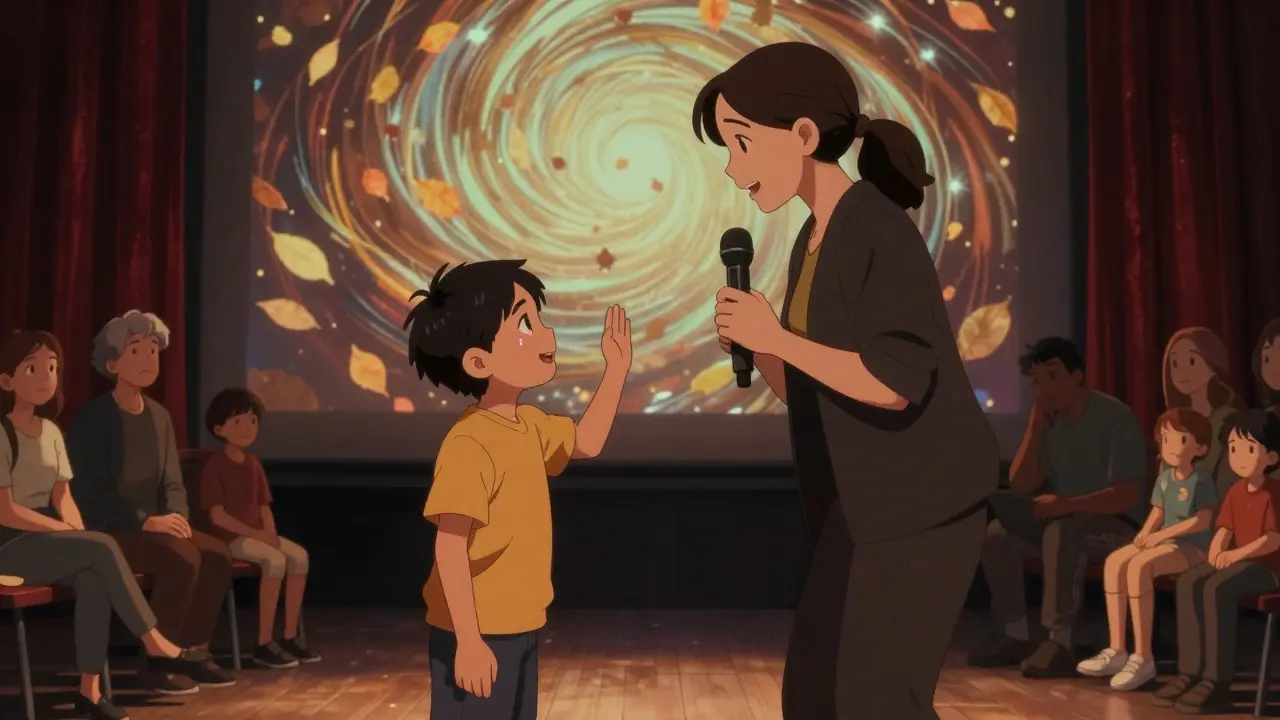
Most kids’ shows are designed to entertain parents while keeping children quiet. The Edinburgh International Children’s Festival flips that. Here, children aren’t just audience members-they’re active participants. In Wanderer, a production from South Korea, kids walk through a maze of light and sound, choosing their own path through the story. In Whisper, a French company invites children to sit on stage, whispering secrets to actors who then turn them into songs. These aren’t performances you watch. They’re experiences you live.
The festival doesn’t assume kids need simplified stories. A 2024 survey of parents showed that 78% of children who attended said they understood the plot of complex shows like The Girl Who Swallowed the Moon-a dark, poetic tale from Lithuania about grief and hope. Kids aren’t dumbed down. They’re trusted.
Where the Shows Happen
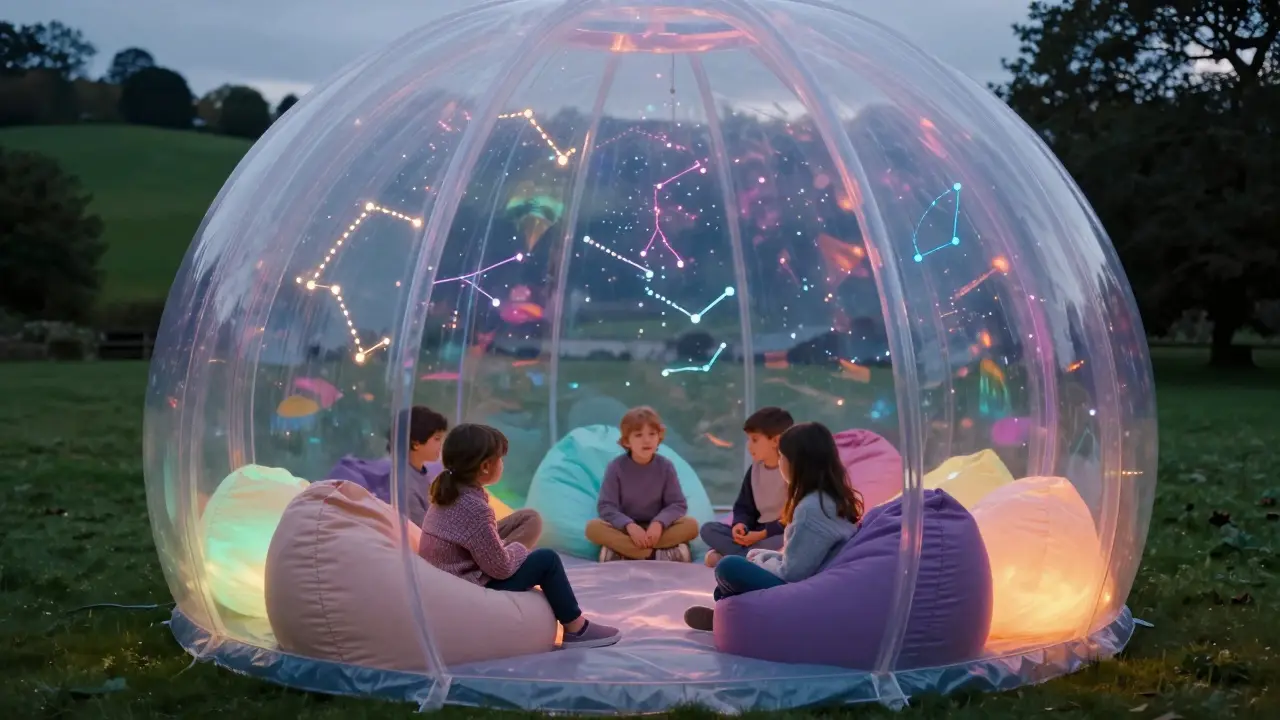
You won’t find this festival in just one building. It spills out across Edinburgh. The main hub is the Traverse Theatre, but you’ll also find performances in the hidden courtyard of the Scottish Poetry Library, the echoing halls of the Royal Mile’s old school buildings, and even on the steps of the Scottish National Gallery. One year, a show called Clouds took place inside a giant inflatable dome set up in Holyrood Park. Kids sat on beanbags under glowing fabric that shifted color with the music.
Each venue is chosen for its feel, not its capacity. A tiny room with 20 seats might host a show about loneliness, while a big tent on the Grassmarket might hold a wild, noisy dance party about space exploration. The location isn’t just background-it’s part of the story.
Who Performs Here?
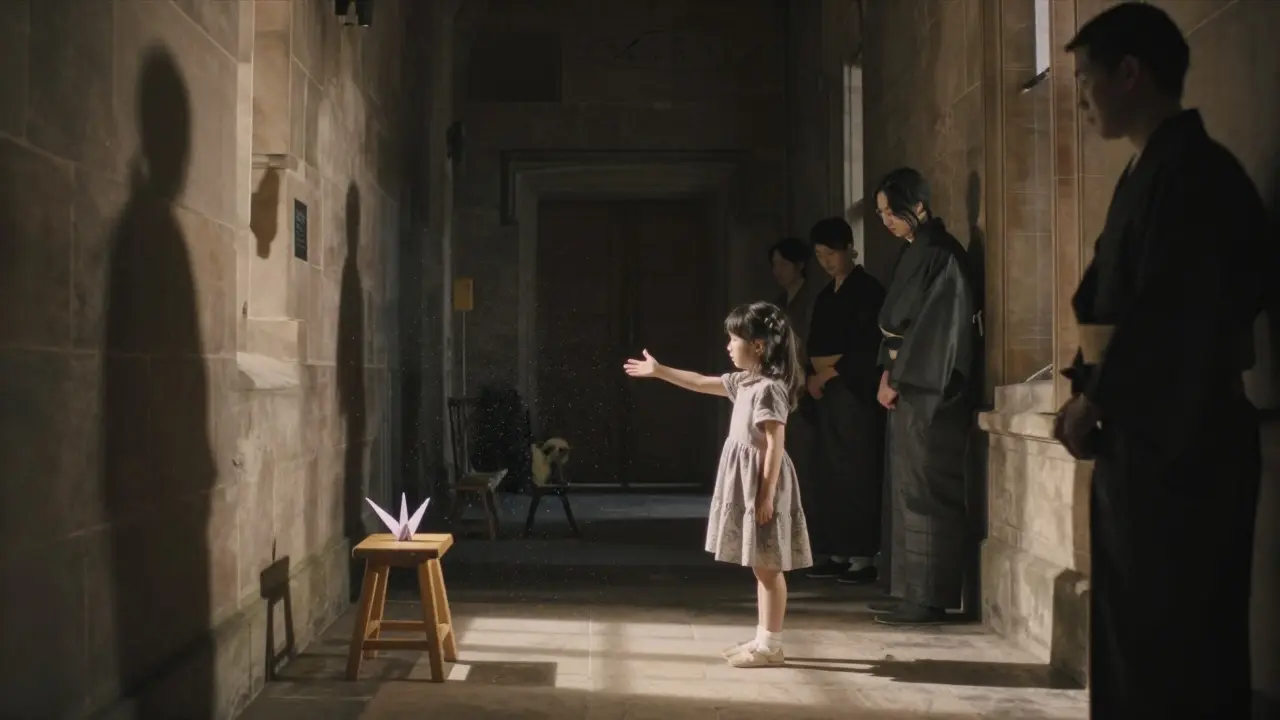
Artists come from places you might not expect. A group from Senegal uses only drums, voice, and clay to tell a myth about the first child. A troupe from Japan performs without speaking, using shadow and movement to show a girl’s journey through grief after losing her dog. There’s no language barrier here-just emotion, rhythm, and physical storytelling.
Scotland’s own companies are just as bold. The National Theatre of Scotland’s Lost and Found lets children search the stage for hidden objects that unlock scenes from their own lives. One child found a red sock-and suddenly, the whole play shifted to a story about a lost pet, told in the child’s own words.
Age Isn’t a Barrier
You might think this is only for kids under 10. It’s not. The festival has shows for babies under 1 year old-soft lights, gentle sounds, and slow movements designed for tiny eyes and ears. There are shows for teens, too. My Body, My Rules, a bold piece from Norway, explores consent and identity through dance and spoken word. It’s not childish. It’s necessary.
The festival breaks age groups into three clear categories: Under 3s, 4-8s, and 9-14s. Each show is labeled clearly. Parents don’t have to guess. You’ll see toddlers in strollers at one show, and 13-year-olds sitting alone at another, quietly wiping tears after a performance about friendship ending.
How to Plan Your Visit
- Book early. Tickets for popular shows sell out within hours, even for free events.
- Use the Festival Pass-a £15 card that gives you discounts on 5+ shows. It pays for itself in two tickets.
- Try the Family Friday program: every Friday, free workshops let kids make masks, write stories, or build puppets with artists.
- Bring snacks. The festival doesn’t have a cafeteria, but there are food trucks outside every venue with vegan hot dogs and fruit cups.
- Don’t force attendance. If your child doesn’t want to sit through a show, step outside. The festival encourages breaks. There are quiet rooms with pillows and books, and even a sensory garden with wind chimes and scented plants.
Why It Matters
This festival isn’t about making kids laugh. It’s about helping them feel seen. In a world where children’s media is often loud, fast, and commercial, this is the opposite. It’s slow. It’s quiet. It’s honest. One mother told a reporter after seeing The Quiet Room, a show about a boy who stops speaking after his sister moves away: "My daughter, who hasn’t said a word in months, cried during the last scene. Then she hugged me and said, ‘I get it.’"
That’s the magic. No screens. No ads. Just real people, real stories, and real feelings-given space to breathe.
What’s New in 2026?
This year, the festival introduces Story Trails: outdoor paths through the Royal Botanic Garden where each step unlocks a short audio story. You don’t need a ticket-just a phone and headphones. There’s also a new partnership with the Edinburgh Science Festival to create shows that blend theatre and science. One, called Gravity Is a Lie, lets kids float in a zero-gravity chamber while actors tell a story about falling in love.
And for the first time, every show will have a signed version for Deaf children, with BSL interpreters integrated into the performance-not just standing off to the side, but part of the action.
Final Thoughts
If you’re looking for a family outing that feels like an adventure, not a chore, this is it. No gimmicks. No merch stalls. Just theatre that remembers children aren’t just smaller adults-they’re their own kind of audience, with their own rules, their own fears, and their own wonder.
Bring them. Let them lead. And don’t be surprised if you leave with a new way of seeing the world.
Are tickets expensive for the Edinburgh International Children’s Festival?
No. Most shows cost between £5 and £12 per child, with adults often getting in free or at half price. There are also dozens of free performances each year, especially during Family Friday events. The Festival Pass, which costs £15, lets you save on 5 or more shows and is worth it if you plan to see more than two.
Can I bring a baby to a show?
Yes. The festival has a special category for under-3s, with shows designed for babies. These are quiet, slow, and sensory-friendly-perfect for tiny audiences. Strollers are welcome, and staff are trained to help if a baby gets fussy. There are even nursing rooms and changing stations in every main venue.
Do I need to understand the language to enjoy the shows?
Not at all. Many shows are physical theatre, dance, or visual storytelling with no spoken words. Even shows in other languages use movement, music, and expression to convey emotion. Kids don’t need to understand every word-they just need to feel the story. The festival encourages this, and many parents say their children connect more deeply without relying on dialogue.
Is the festival accessible for children with disabilities?
Yes. Every venue is wheelchair accessible. There are sensory-friendly performances with lowered lights and sound, and quiet rooms available for breaks. All shows include BSL interpretation for Deaf children, and audio descriptions for blind or visually impaired kids. The festival works with special needs organizations to tailor experiences-just contact them ahead of time to arrange support.
How long do the shows last?
Most shows are between 30 and 50 minutes long-perfect for young attention spans. There are no intermissions. Some of the longest shows run up to 70 minutes, but they’re clearly labeled for older children. The festival keeps timing short to respect how kids experience time differently than adults.
Comments (8)
-
vidhi patel March 2, 2026
The Edinburgh International Children’s Festival is, without a doubt, one of the most meticulously curated cultural experiences for young audiences in the Western world. The structural integrity of the programming-particularly the explicit age categorization and the integration of sensory-friendly venues-is not merely thoughtful; it is pedagogically revolutionary. One must commend the curatorial team for eschewing the infantilizing tropes that dominate mainstream children’s media. The deliberate absence of commercial branding, coupled with the rigorous selection of international physical theatre, elevates this event to the level of high art.

-
Priti Yadav March 3, 2026I swear this whole thing is a psyop. They say 'no screens' but what they're really doing is conditioning kids to be obedient to authority figures in dark rooms. Who funds this? The UN? The WHO? The fact they have 'quiet rooms' and 'sensory gardens' is a dead giveaway-they're preparing children for something. And don't get me started on the BSL interpreters being 'part of the action.' That's not inclusion, that's surveillance disguised as art.

-
Ajit Kumar March 4, 2026
It is, in fact, profoundly disturbing that so many parents appear to believe that children are capable of comprehending complex emotional narratives without the scaffolding of didactic clarity. The assertion that a child can 'understand' a Lithuanian play about grief-without explicit linguistic or narrative anchors-is not only empirically dubious but ethically reckless. Theatre, even when intended for children, must retain didactic coherence; otherwise, one risks psychological disorientation rather than emotional resonance. Furthermore, the notion that 'no language barrier exists' because of physical storytelling is a romantic fallacy, one that ignores the cognitive development literature on symbolic representation in pre-adolescents.

-
Diwakar Pandey March 5, 2026
I took my niece to Wanderer last year. She was seven. She didn’t say much afterward, just sat on the floor drawing a maze with crayons for an hour. Then she handed me one of the drawings and whispered, 'This is where I went.' I didn’t ask. I didn’t need to. The show didn’t explain anything. It just let her be. That’s rare. Most kids’ stuff tries to teach, or sell, or distract. This? This just held space. I didn’t know I needed that until I saw her face.

-
Geet Ramchandani March 7, 2026
Let’s be real-this festival is just performative wokeness wrapped in velvet curtains. They’re not ‘trusting’ kids; they’re exploiting their vulnerability for cultural clout. Who cares if a 13-year-old cries at a Norwegian play about consent? That’s not empowerment-that’s emotional manipulation disguised as art. And the fact they’re now adding audio stories in botanical gardens? Next thing you know, they’ll be embedding subliminal messages in wind chimes. The whole thing is a marketing gimmick for liberal elites who want to feel virtuous while their kids zone out in a giant inflatable dome. Also, why is there no mention of parental consent forms? I’m sure there’s a waiver buried somewhere that says ‘we’re not liable if your child develops existential dread.’

-
Pooja Kalra March 8, 2026
There is something quietly sacred in how the festival refuses to explain. In a world where every experience must be quantified, labeled, and monetized, to allow a child to sit in silence and feel without being told what to feel-that is a radical act of humility. I do not know if this is ‘good’ theatre. I only know that when I watched my nephew stare at a moving shadow for ten minutes, unmoved by noise or distraction, I realized: perhaps he was seeing something I had forgotten. The festival does not give answers. It only holds the question.

-
Sumit SM March 10, 2026I LOVE this festival!! It’s not just a festival-it’s a movement!! The fact that they’ve integrated BSL into the performance itself? That’s not accessibility-that’s ARTISTIC REVOLUTION!! And the zero-gravity show?!! Are you kidding me?!! Kids floating while being told a love story?!! That’s not theatre-that’s ALIEN MAGIC!! I’m booking tickets for my whole family next year!! Bring on the clay drums from Senegal!! Bring on the whispering French actors!! This is what the world needs-not more cartoons, not more algorithms, but THIS!!

-
Paul Timms March 11, 2026My son was nonverbal until he was six. We saw Lost and Found. He found a red sock. He spoke for the first time that day. Not because the show told him what to feel. But because it let him be the one who decided what it meant.
