
Edinburgh doesn’t need a big budget to blow your mind. You can walk its cobbled streets, climb ancient hills, and stand inside world-class museums-all without spending a penny. The city is built on layers of history, art, and nature, and most of it’s open to anyone with good shoes and a curious mind.
Explore Holyrood Park and Arthur’s Seat
| Feature | Details |
|---|---|
| Height | 251 meters (823 feet) |
| Trail length (main route) | 2.5 km round trip |
| Time to climb | 30-45 minutes |
| Best view spot | Summit overlooking the Old Town |
| Open year-round | Yes, daylight hours |
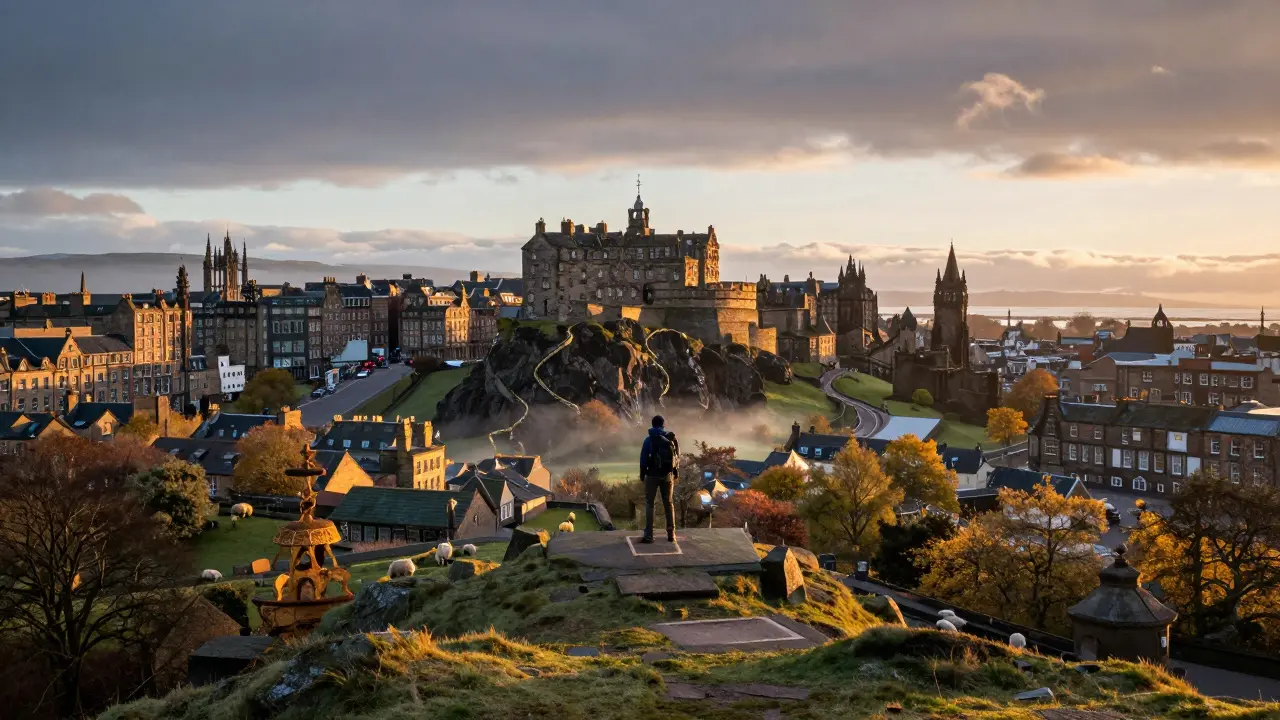
Arthur’s Seat isn’t just a hill-it’s a volcano that last erupted over 350 million years ago. Today, it’s the centerpiece of Holyrood Park, a wild, 250-acre green space right next to the Palace of Holyroodhouse. The climb is steep in places, but the path is clear and well-trodden. You’ll pass sheep grazing on the slopes and catch glimpses of the Firth of Forth in the distance.
At the top, you get one of the best free views in Scotland: the entire Old Town stretched out below you, with the castle perched on its rock, the Royal Mile winding down like a ribbon, and the modern skyline of New Town beyond. Go at sunrise or just before sunset. The light turns the sandstone buildings golden, and the city feels quiet, even in peak season.
Visit the National Museum of Scotland
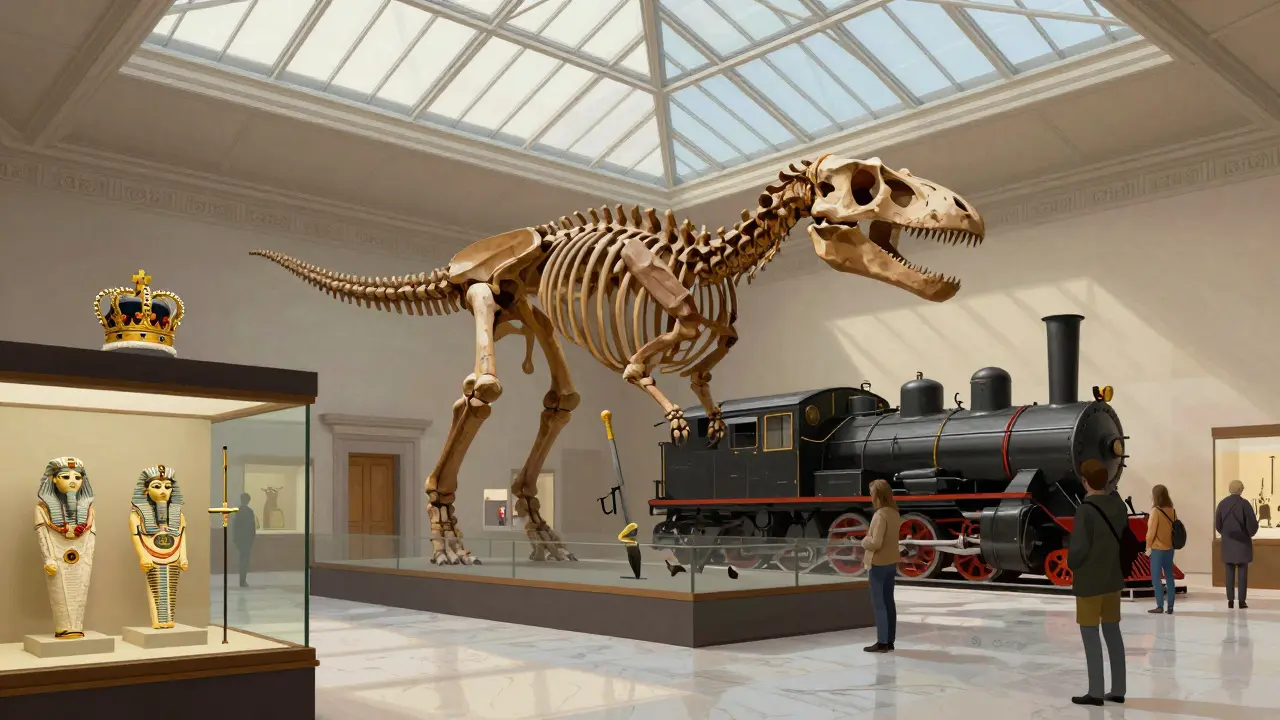
The National Museum of Scotland is the largest museum in the country-and it’s completely free. Inside, you’ll find everything from ancient Egyptian mummies to a 19th-century steam locomotive, a giant dinosaur skeleton, and a collection of Scottish jewels that include the Honours of Scotland-the crown, scepter, and sword used in coronations since the 15th century.
The museum’s architecture is as impressive as its exhibits. The modern wing, opened in 1998, has soaring glass ceilings and a giant curved staircase that looks like a giant seashell. The upper floors hold the science and technology galleries, where you can touch a real meteorite and see how early Scots built the first telegraph system.
Don’t miss the Scottish History galleries on the lower levels. They tell the story of Scotland from the Stone Age to the present day using real artifacts: a Viking sword found near Edinburgh, a medieval knight’s armor, and the original ballot box used in the 1997 devolution referendum. No ticket needed. Just walk in, and spend hours.
Wander the Royal Mile
The Royal Mile isn’t just a tourist strip-it’s a living piece of medieval Edinburgh. It runs from Edinburgh Castle at the top to Holyrood Palace at the bottom, a stretch of just over a mile, but packed with centuries of history. You’ll walk past 16th-century tenements, hidden courtyards, and doorways that haven’t changed since the 1700s.
There are no entry fees to walk the street, but you’ll find plenty of free things to see. Stop at the Canongate Kirk, a 17th-century church with a quiet graveyard where poets and philosophers are buried. Look up at the carved stone faces on the buildings-some are grotesques meant to scare off evil spirits. Visit the Lawnmarket, where you’ll find the oldest public house in Scotland, the Sheep Heid Inn, still serving ale since 1360.
On weekends, street performers fill the air with music. Bagpipers, jugglers, and folk singers make the street feel alive. You don’t have to tip them, but if you do, you’re supporting local artists-not a corporate tour operator.
Stroll Through Princes Street Gardens
Princes Street Gardens sits right below Edinburgh Castle, dividing the New Town from the Old. It’s a 12-acre park with flower beds, fountains, and quiet benches where locals read, nap, or just watch the world go by. The gardens are split into two parts: West and East. The West Gardens have a large pond and a bandstand where free concerts happen in summer.
The real magic? The view of the castle from the gardens. You can sit on a bench, eat a sandwich from a local bakery, and look up at the fortress perched on its volcanic plug. It’s the same view that artists painted in the 1800s-and it hasn’t changed. The gardens are open every day from dawn to dusk, and they’re always clean, safe, and full of life.
See the Scottish National Gallery
Just off the Royal Mile, the Scottish National Gallery holds one of the finest collections of fine art in the UK-and again, it’s free. Inside, you’ll find works by Rembrandt, Van Gogh, Turner, and Scottish masters like Sir Henry Raeburn and John Knox.
The building itself is a neoclassical masterpiece, with marble floors and high ceilings lit by natural light. The ground floor has European paintings from the Renaissance to the 19th century. The upper floors focus on Scottish artists. Look for The Skating Minister by Henry Raeburn-it’s small, but it’s one of the most famous paintings in Scotland.
The gallery doesn’t crowd you. You can spend an hour or four, and no one will rush you. There are free guided tours every day at 2 p.m., led by knowledgeable volunteers who know the stories behind each brushstroke.
Walk the Grassmarket and Victoria Street
Just behind the Royal Mile, the Grassmarket was once Edinburgh’s market square and public execution site. Now, it’s a cozy, cobbled alley lined with independent cafes, bookshops, and pubs with outdoor seating. The buildings are painted in soft pastels, and the street slopes gently downhill, giving you a view of the castle from a different angle.
Victoria Street, a narrow, curved lane that runs from the Grassmarket to the Royal Mile, looks like a scene from Harry Potter. The colorful buildings, curved design, and flower boxes make it feel like a fairytale alley. It’s one of the most photographed spots in Edinburgh-and you don’t pay a cent to walk it.
At the top of Victoria Street, you’ll find the Writers’ Museum, which honors Robert Burns, Sir Walter Scott, and Robert Louis Stevenson. It’s small, but full of original manuscripts, personal letters, and even the walking stick Scott used. Entry is free, and the staff are always happy to chat.
Watch the sunset at Calton Hill
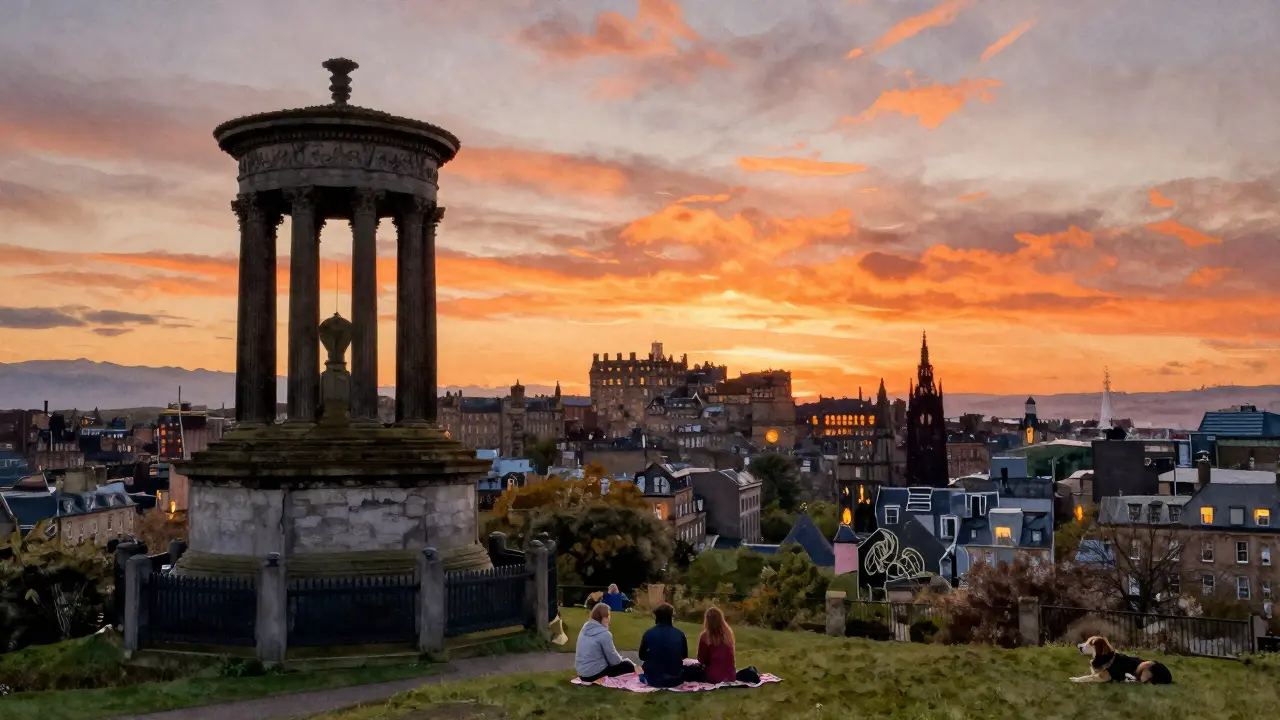
Calton Hill is often overlooked by tourists who head straight for Arthur’s Seat. But it’s just as rewarding-and easier to climb. The hill is dotted with monuments: the National Monument (a replica of the Parthenon), the Nelson Monument, and the Dugald Stewart Monument, all built in the early 1800s.
From the top, you get a panoramic view of the city: the castle on the left, the Firth of Forth in the distance, and the skyline of New Town stretching out like a grid of stone and glass. At sunset, the light hits the castle and turns it orange. Locals bring picnics, dogs, and guitars. Sometimes, someone will start singing. No one minds.
It’s a 15-minute walk from the city center, and the path is flat and paved. You can even bring a blanket and watch the stars come out after dark. There’s no fence, no gate, no fee. Just you, the city, and the sky.
Visit the Writers’ Museum and the Museum of Childhood
Both are tucked away in quiet corners of the Old Town and both are free. The Writers’ Museum, as mentioned, celebrates Scotland’s literary giants. The Museum of Childhood, located in a restored 19th-century building, is a delight for all ages. It’s filled with toys from the 1800s to the 1990s: tin soldiers, wooden trains, board games, and even a 1950s tea set.
There’s a section on how children lived in Edinburgh a hundred years ago-what they wore, what they played, how they went to school. Kids love it. Adults get nostalgic. And no one charges you to look.
Find quiet corners in Dean Village
Just a 20-minute walk west of the city center, Dean Village feels like another century. Once a milling community powered by the Water of Leith, it’s now a peaceful cluster of stone cottages, moss-covered bridges, and narrow lanes lined with trees. The river runs quietly beneath footbridges, and herons stand still in the shallows.
There’s no sign saying “tourist attraction.” No gift shops. Just locals walking their dogs, cyclists taking the scenic route, and a few sketch artists sitting with pads. You can follow the Water of Leith Walkway all the way to the sea-it’s flat, paved, and free.
It’s the kind of place you stumble into, and suddenly, you forget you’re in a city.
Why Edinburgh Works for Budget Travelers
Most cities charge for views, museums, and parks. Edinburgh doesn’t. It believes culture and nature belong to everyone. That’s why you can walk from the castle to the sea, stopping at six free museums, three parks, and four historic streets without spending a pound.
It’s not just about saving money. It’s about experiencing the city the way locals do-on foot, with curiosity, and without a ticket. The city doesn’t need to sell you access. It’s proud of what it’s got, and it wants you to see it.
Are all museums in Edinburgh really free?
Yes, the National Museum of Scotland, the Scottish National Gallery, the Museum of Childhood, and the Writers’ Museum are all free to enter. Some smaller galleries and special exhibitions may charge, but the major institutions never do. You can spend a full week in Edinburgh’s top museums without paying a penny.
Can I hike Arthur’s Seat in winter?
Yes, but be prepared. The path can be icy or muddy after rain. Wear sturdy boots with grip, and check the weather before you go. Snow is rare but possible in January. The views are even more dramatic in winter-fog rolling over the city, the castle looking like a ghost. Just don’t go alone if it’s dark or stormy.
Is Princes Street Gardens open at night?
The gardens close at dusk, around 6 p.m. in winter and 9 p.m. in summer. But the surrounding area-Princes Street, the Scott Monument, the castle-remains accessible. You can still walk around the perimeter and see the castle lit up at night. It’s one of the best free night views in the city.
What’s the best free spot for photos in Edinburgh?
The viewpoint from Calton Hill, looking toward the castle and the Royal Mile, is the most photographed. But for something less crowded, try the top of Victoria Street looking down toward the Grassmarket. The colorful buildings and curved street make for a perfect frame. Sunrise at Arthur’s Seat also gives you a clean, empty view of the city.
Do I need to book anything in advance for these free attractions?
No. None of the free parks, trails, or museums require booking. You can walk in anytime during opening hours. The only exceptions are special exhibitions inside the museums-which are rare and clearly marked as paid. Stick to the permanent collections, and you’re all set.
Next Steps: Make the Most of Your Free Day
Start early. Head to Arthur’s Seat at sunrise, then walk down to the National Museum for coffee and a few hours of history. Lunch in the Grassmarket, then wander the Royal Mile and pop into the Writers’ Museum. End the day with sunset at Calton Hill, and if you’re still walking, follow the Water of Leith to Dean Village.
Bring water, a light jacket, and a notebook. You’ll want to write down what you see. Edinburgh doesn’t charge you to see its soul. But it’s up to you to pay attention.
Comments (14)
-
Janiss McCamish January 19, 2026
Arthur’s Seat at sunrise is pure magic. I’ve done it three times now-each time felt like the first. No crowds, just the wind and the city waking up below you.
Bring a thermos. You’ll thank yourself.

-
Richard H January 21, 2026
Free? Yeah right. This is just propaganda. Everything in Europe is paid for by taxes-someone’s paying for those museums. Stop pretending it’s charity.

-
Ashton Strong January 21, 2026
It is truly remarkable how Edinburgh has preserved its cultural heritage with such generosity. The commitment to public access-free museums, open parks, unobstructed views-reflects a deep civic philosophy that prioritizes collective enrichment over commercial exploitation.
One cannot help but admire the city’s stewardship of its legacy.

-
Steven Hanton January 23, 2026
I appreciate how the post highlights not just the big spots but the quiet corners too-Dean Village, the Grassmarket, Victoria Street. Those are the places where you really feel the soul of the city.
Most tourists miss them because they’re chasing the postcard views. But the magic’s in the little alleys and the mossy bridges.
Take your time. Walk slow. Let the city breathe with you.

-
Pamela Tanner January 24, 2026
Correction: The Scottish National Gallery does not house works by John Knox-he was a 16th-century theologian and reformer, not a painter. The artist referenced is likely John Knox’s contemporary, or perhaps you meant John Bellany or Sir Henry Raeburn.
Small detail, but accuracy matters when sharing cultural information.

-
Kristina Kalolo January 24, 2026
I went to Edinburgh last fall and did exactly this itinerary. The Writers’ Museum was a surprise-didn’t expect to spend an hour reading Stevenson’s letters. Worth every minute.
Also, the sheep on Arthur’s Seat are way more chill than the tourists.

-
ravi kumar January 25, 2026
Calton Hill at dusk is better than any Instagram filter. I sat there with my chai and watched the castle lights turn on. No one talked. No one needed to.
That’s the kind of peace you don’t find in cities with entrance fees.

-
Megan Blakeman January 26, 2026
Okay, I just cried a little reading this. Like, actually cried. Not because I’m emotional (I’m not) but because… this is what the world should be like. Free access to beauty. No gatekeepers. No paywalls. Just… you, the stones, the sky.
Thank you.
(((hugs)))

-
Akhil Bellam January 27, 2026
Let’s be honest-this is just a glorified travel blog for budget tourists who can’t afford real culture. The National Museum? It’s a glorified thrift store with dinosaur bones. And Arthur’s Seat? It’s a hill with sheep. If you think this is ‘world-class,’ you’ve never been to Paris, Rome, or Tokyo.
Edinburgh is charming, sure-but don’t act like it’s the Vatican of free art.

-
Amber Swartz January 28, 2026
OMG I went to the Writers’ Museum and the woman who worked there was SO SWEET she gave me a handwritten note with a quote from Burns?? I’m still crying. Like, why is everyone so nice here??
Also, Victoria Street is literally a fairy tale. I swear I saw a wizard. Or maybe it was just the mist. Either way, I’m moving there. #EdinburghOrBust

-
Robert Byrne January 29, 2026
You said the Royal Mile has no entry fees-that’s true. But you didn’t mention that 80% of the shops there are overpriced tourist traps selling ‘authentic’ tartan socks made in China.
Don’t let the ‘free’ vibe fool you. The city profits off your ignorance. Walk the street, yes-but buy nothing. That’s the real free experience.

-
Tia Muzdalifah January 29, 2026
Dean Village?? I didn’t even know that place existed until my Airbnb host whispered about it like it was a secret. I walked there at 7am and the only sound was the river and a dog barking at a squirrel. I felt like I’d time-traveled.
Also, the coffee at the little cafe? 2.50 quid. Best. Brew. Ever.
ps: i spelled ‘cafe’ wrong. again. sorry.

-
Zoe Hill January 30, 2026
I loved the part about the skating minister! I went to the gallery and stood in front of it for like 20 minutes just staring. It’s so quiet and weird and perfect. Also, the museum staff gave me a free postcard. I didn’t ask. They just handed it to me. I’m keeping it forever.
ediburgh is magic. even if i misspelled it. again.

-
Albert Navat February 1, 2026
From a UX standpoint, the city’s free-access model is a brilliant retention strategy. You’re not paying for entry-you’re paying for dwell time. The museums and parks function as high-engagement touchpoints that drive ancillary revenue through food, merch, and guided tours.
It’s a freemium model disguised as altruism. The city is monetizing your emotional connection.
Smart. But not ‘free.’
