
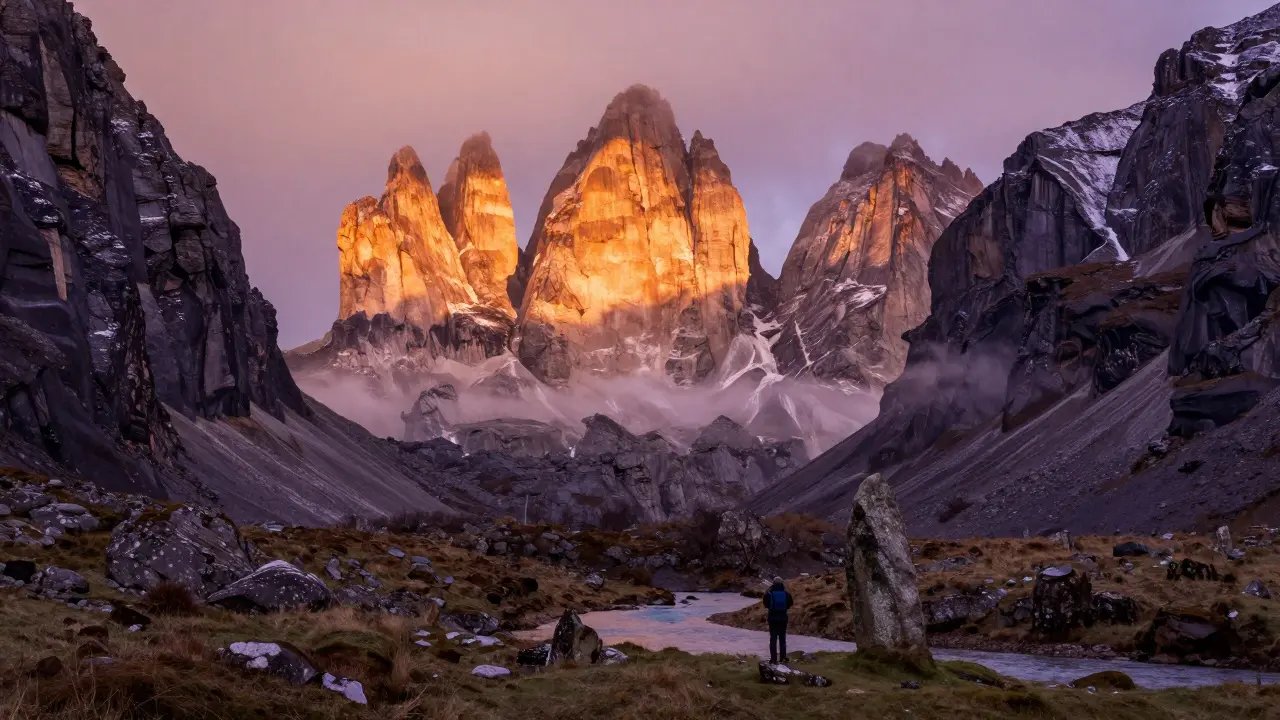
Glencoe Valley isn’t just a scenic stretch of mountains and mist-it’s a place where history bleeds into the landscape. If you’ve ever seen photos of its jagged peaks rising above green valleys, you’ve seen one of Scotland’s most iconic views. But behind the postcard beauty lies a story of betrayal, loss, and survival that still echoes through these glens today. This isn’t just a hike destination. It’s a memorial, a mystery, and a masterpiece of nature all rolled into one.
Why Glencoe Feels Different from Other Scottish Glens
There are dozens of glens in the Highlands-Glen Coe, Glen Etive, Glen Shiel-but none carry the same weight. Glencoe’s shape is unmistakable: a narrow, winding corridor between the Three Sisters and the Buachaille Etive Mòr, carved by glaciers over 10,000 years ago. The rock faces are dark, almost black, from ancient volcanic activity. Waterfalls tumble down in spring, and in winter, snow clings to the cliffs like lace.
But what makes Glencoe stand out isn’t just the geology. It’s the silence. Even when tourists crowd the parking lot at the Glencoe Visitor Centre, the valley itself feels empty. That’s not because it’s remote-it’s because of what happened here. The land remembers.
The Glencoe Massacre: A Betrayal in the Snow
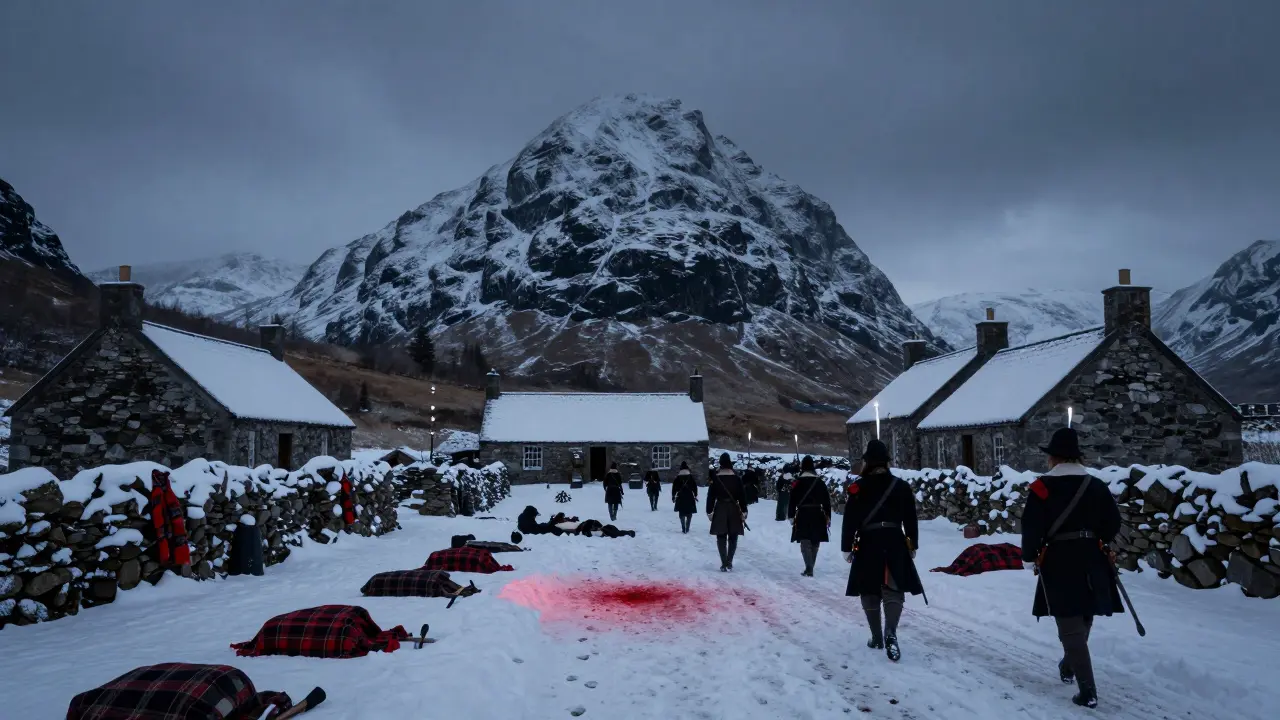
On February 13, 1692, over 30 members of the Clan MacDonald of Glencoe were murdered by soldiers who had been their guests for nearly two weeks. The killers were from the Campbell clan, loyal to King William of Orange. They had been invited into homes, fed, given warmth. Then, in the dead of night, they turned on their hosts.
The massacre wasn’t random violence. It was political. The MacDonalds had been slow to swear allegiance to the new king after the Glorious Revolution. When they finally did-on January 6, 1692-their oath was accepted, but only barely. A bureaucratic error, or perhaps a deliberate one, meant the paperwork didn’t reach the right desk in time. The government ordered the clan’s destruction as an example.
Not all of them died that night. Some escaped into the snow. Others were chased down and killed in the hills. Children were spared, but many families were wiped out. The event became known as the Glencoe Massacre, and it’s still taught in Scottish schools as a warning about loyalty, power, and betrayal.
Today, you can stand at the site where the killings began. A simple stone marker near the old Glencoe Inn reads: “Here died many of the Clan MacDonald of Glencoe, murdered by soldiers under the command of Captain Robert Campbell of Glenlyon, on the 13th of February, 1692.” No names. No dates beyond the year. Just the truth.
Walking the Massacre Route: What to See
If you visit Glencoe today, you don’t need a guide to feel the weight of history. The landscape tells the story.
- The Three Sisters: These three peaks loom over the valley floor. They’re the first thing you see when driving in from Fort William. Locals say the middle peak looks like a woman kneeling-some believe it’s the spirit of a mother who lost her family that night.
- The Old Military Road: Built after the massacre to control the Highlands, this narrow path still runs through the glen. Walk it for an hour, and you’ll understand why the MacDonalds couldn’t escape. The soldiers had the high ground.
- The Glencoe Visitor Centre: Run by the National Trust for Scotland, it has a small but powerful exhibit. Original letters, maps, and artifacts from the time. The audio recording of a descendant reading a family letter is haunting.
- The Massacre Stone: A flat slab near the river, where bodies were found after the snow melted. It’s unmarked, but locals know where it is. Don’t touch it. It’s not a monument-it’s a grave.
Many people come here to hike the Aonach Eagach ridge or climb Buachaille Etive Mòr. But if you only walk one trail, make it the short path from the visitor centre to the massacre site. It’s less than a mile. Quiet. Cold. And unforgettable.
Glencoe’s Natural Beauty: Why It’s Called Scotland’s Most Beautiful Glen
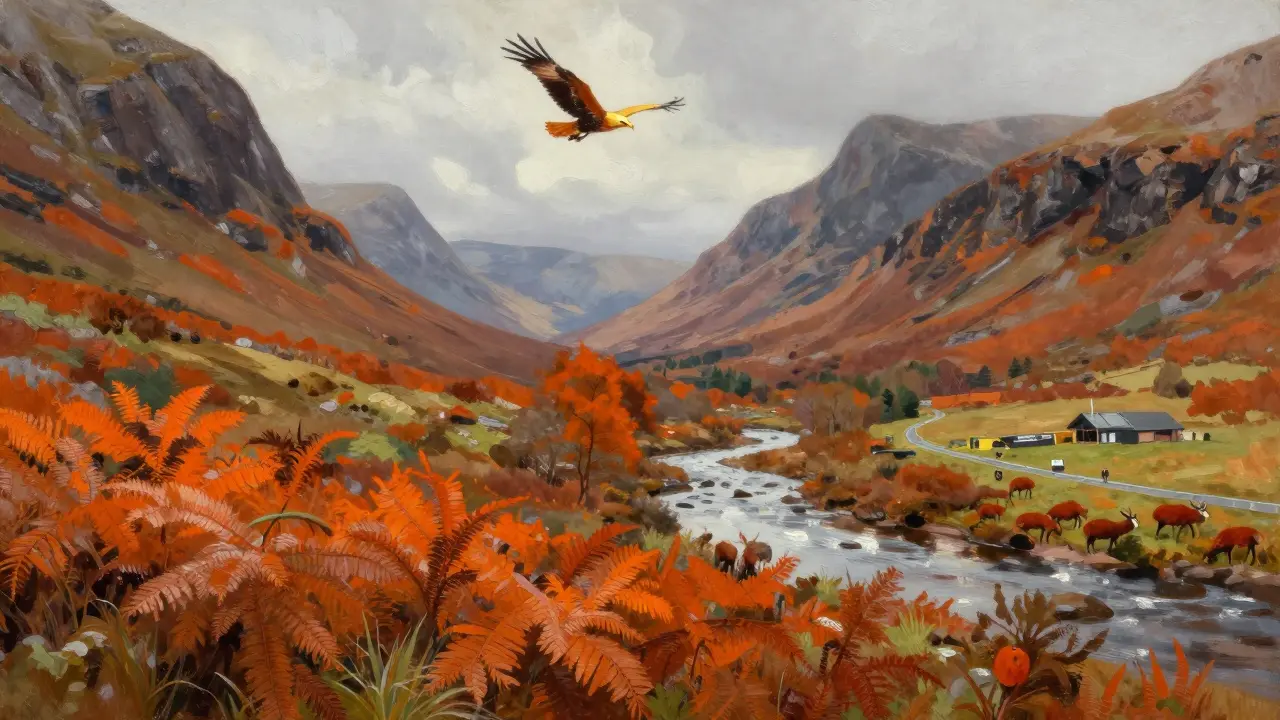
Even without the history, Glencoe would be legendary. It’s one of the few places in the world where you can stand in a valley and see four mountain ranges at once. The colors change with the light. In autumn, the bracken turns burnt orange. In spring, the rivers run milky with glacial silt. In winter, the whole valley turns silver under snow.
Wildlife thrives here too. Red deer roam the slopes. Golden eagles circle above the cliffs. You’ll hear the call of the ptarmigan-a bird that turns white in winter-before you see it. The valley is a protected site under the UK’s National Scenic Area designation, meaning no development is allowed. No hotels, no billboards, no roads cutting through the heart of it.
Photographers come from all over the world for the “Glencoe Light.” That moment just after sunset when the last rays hit the peaks and the valley below turns deep purple. It lasts maybe ten minutes. If you’re lucky, you’ll be there when it happens.
How to Visit Glencoe: Practical Tips
Glencoe is easy to reach but hard to prepare for. Here’s what you need to know:
- Best time to visit: Late spring to early autumn (May-September). Days are long, trails are dry, and the weather is usually kind. Winter visits are dramatic but dangerous-snow and ice make paths treacherous.
- Where to park: The main parking lot at the Glencoe Visitor Centre is free but fills up by 10 a.m. on weekends. Arrive early or use the smaller lot near the old inn.
- What to bring: Waterproof layers. Even in summer, the valley gets sudden rain and wind. Sturdy boots. A map. And respect. This isn’t a theme park.
- Don’t miss: The view from the A82 road as you enter the glen from the west. Pull over at the designated viewpoint. It’s the classic postcard shot.
There are no restaurants inside the glen. Pack food. There are no ATMs. Bring cash. The nearest town, Fort William, is 12 miles away. Plan ahead.
Glencoe Today: A Place of Memory and Wonder
People still come to Glencoe to mourn. Scottish clans gather here every February to lay flowers at the Massacre Stone. Tourists take selfies with the Three Sisters. Hikers push themselves up the ridges. Children run through the grass, unaware of the blood that soaked the soil.
Glencoe doesn’t ask you to choose between beauty and tragedy. It holds both. You can stand in awe of its scale and still feel the chill of its past. That’s why it’s not just the most beautiful glen in Scotland. It’s the most honest.
Is Glencoe safe to visit alone?
Yes, Glencoe is generally safe for solo visitors, but only if you’re prepared. The trails are well-marked, but weather changes fast. Always check the forecast, carry a fully charged phone, and let someone know your route. Avoid hiking the Aonach Eagach ridge without experience-it’s a technical scramble. Stick to the lower paths if you’re alone.
Can you camp in Glencoe?
Wild camping is allowed in Glencoe under Scotland’s Right to Roam law, as long as you follow the Scottish Outdoor Access Code. No fires, no litter, no camping near buildings or livestock. The best spots are away from the main road, near the river but above the flood line. There are also two official campsites: Glencoe Youth Hostel and Glencoe Holiday Park.
Are there guided tours of the Glencoe Massacre site?
Yes. Several local operators offer walking tours focused on the massacre and its history. The most respected are run by Highland History Tours and Glencoe Heritage. They don’t dramatize the events-they use original documents, maps, and oral histories. These tours are often booked months in advance during summer.
Why is Glencoe so dark and moody compared to other glens?
The rock in Glencoe is made of volcanic basalt and schist, formed over 400 million years ago. These rocks are naturally dark and absorb light. Combine that with frequent cloud cover and narrow valley walls that block sunlight for much of the day, and you get the brooding, dramatic look Glencoe is famous for. It’s not just atmosphere-it’s geology.
Is Glencoe worth visiting if I’m not into history?
Absolutely. Even if you don’t care about the massacre, Glencoe is one of the most photographed and painted landscapes in the UK. It’s a paradise for photographers, hikers, climbers, and anyone who wants to feel small in the presence of nature. The views are unforgettable, the air is clean, and the silence is rare. History adds depth-but the beauty stands on its own.
What to Do After Glencoe
Glencoe is best experienced as part of a longer journey through the Highlands. After your visit, head to Fort William for a warm meal and a pint at The Clachaig Inn. Then drive north to Glen Coe’s neighbor, Glen Etive, where the river cuts through even wilder terrain. Or take the road to Loch Linnhe and catch a ferry to the Isle of Mull. You’ll find more mountains, more silence, more stories waiting.
Glencoe doesn’t give up its secrets easily. But if you listen-really listen-you’ll hear them in the wind, in the water, and in the stillness between the cliffs.
Comments (12)
-
Meghan O'Connor January 26, 2026
This article is riddled with grammatical errors-like ‘glens-Glen Coe’ without a space, and ‘Buachaille Etive Mòr’ inconsistently accented. Also, ‘the land remembers’? That’s not history, that’s New Age nonsense. And why is there no citation for the ‘bureaucratic error’ claim? Someone needs to fact-check this before it gets shared again.

-
Mark Nitka January 27, 2026
People act like Glencoe is some unique tragedy, but the British did worse elsewhere. The Highland Clearances were systematic ethnic cleansing. This massacre? It was one bad day in a century of oppression. Don’t get me wrong-it’s awful-but don’t turn it into a martyr narrative. The real story is how Scotland still lets this myth fuel division.

-
Kelley Nelson January 27, 2026
One must, with the utmost intellectual rigor, acknowledge that the author’s romanticization of the landscape as a ‘memorial’ borders on the aesthetically reductive. The geological formations are indeed compelling, yet the anthropomorphic attribution of agency to inanimate terrain-‘the land remembers’-is a fallacy of misplaced concretion. One might posit that the emotional resonance is culturally constructed, not inherent. The piece, while visually evocative, lacks epistemological discipline.

-
Aryan Gupta January 28, 2026
Wait-this is all a cover-up. The British didn’t kill them. The Campbells were set up. The real killers were the Freemasons. They used the massacre to control the Scottish resistance. The ‘bureaucratic error’? A fake document planted by the Crown to make it look like an accident. The ‘massacre stone’? A decoy. The real site is under the visitor center. They’ve been hiding the truth since 1715. Google ‘Glencoe Masonic Cipher’-it’s all there if you know where to look.

-
Fredda Freyer January 29, 2026
Glencoe’s power isn’t in the blood on the rocks-it’s in the silence that follows. You can’t feel the weight of history if you’re too busy taking selfies. I’ve stood there at dawn, alone, and the wind doesn’t sound like nature-it sounds like whispering. Not ghosts. Just the echo of people who weren’t allowed to grieve. The real tragedy isn’t that they died. It’s that their names were erased so quickly. And now we turn it into a photo op. The valley doesn’t care about your Instagram. It remembers what you refuse to say out loud.

-
Gareth Hobbs January 30, 2026
Scotland’s sooo sensitive about this. Bloody Irish and Yanks always whinge about ‘massacres’-what about the Normans? The Romans? The English didn’t even start it! The MacDonalds were thieves and raiders! And now we’re supposed to bow down to a bunch of clan drama? Get over it. The British Empire built the modern world. This? This is just drama for tourists. And why’s the article so damn long? No one cares. Also, ‘glacial silt’? That’s not even a word. It’s mud.

-
Zelda Breach February 1, 2026
Wow. Another ‘beautiful but tragic’ piece. Let me guess-next you’ll say the land is ‘haunted by the spirits of the innocent’? Please. The MacDonalds were tax evaders who refused to swear loyalty. The government had every right to enforce the law. If you’re going to romanticize a clan that raided neighbors and stole cattle, maybe don’t pretend they were saints. This isn’t history. It’s a Disney movie with better lighting.

-
Alan Crierie February 2, 2026
Thank you for writing this with such care. I’ve visited Glencoe twice, and I still get choked up at the Massacre Stone. I love how you included the wildlife and the light-so many forget it’s not just about the past. I also appreciate the practical tips. I’m bringing my niece next month-she’s 8 and loves eagles. I’ll show her the Three Sisters and tell her about the quiet. Not the blood. Just the quiet. 🌿

-
Denise Young February 3, 2026
Let’s deconstruct the narrative architecture here. The author employs a dual-layered rhetorical strategy: the sublime aesthetic of the landscape as a veil for the traumatic historical substrate. This is classic postcolonial melancholia-beauty as a distraction from structural violence. The ‘silence’ isn’t spiritual-it’s performative. The visitor center’s audio recording? A curated trauma commodity. The ‘Glencoe Light’? A neoliberal spectacle. We’re not visiting a memorial-we’re consuming a brand. And yet… I still go every autumn. Because even manufactured grief feels real when the wind cuts through your coat like it remembers.

-
Sam Rittenhouse February 4, 2026
I read this while sitting on my porch in Oregon, and I just started crying. Not because I’m Scottish. Not because I know the history. But because I’ve stood in places like this-where the air feels heavy with things you can’t name. I don’t need to know every name on the stone to feel how alone they must’ve been. I’ve lost people. And sometimes, silence is the only thing left that understands. Thank you for honoring that.

-
Peter Reynolds February 6, 2026
Agreed with Fred on the grammar stuff but also just want to say I hiked the Old Military Road last summer and it was the most intense thing I’ve ever done. Not because of the history but because the rocks were so slippery and the fog rolled in so fast I thought I was gonna die. Then I saw a golden eagle just hovering above me like it was watching me. Felt like the valley was testing me. Didn’t take any pics. Just sat there for an hour. Didn’t need to. The land knows.

-
Fred Edwords February 8, 2026
Correction: The MacDonalds swore allegiance on January 6, 1692, but the official documentation wasn’t received by the Secretary of State until January 18-two days after the deadline. This was not a ‘bureaucratic error’ but a deliberate omission by John Dalrymple, Master of Stair, who had long sought to eliminate the clan. The massacre was premeditated. The article understates the malice. Also, ‘Buachaille Etive Mòr’ is correctly spelled with the accent on the ‘ò’-please fix.
