
Planning a trip to the islands shouldn’t mean giving up on comfort or safety-especially if you or someone in your group uses a wheelchair, mobility aid, or needs extra space to move around. Islands like the Hebrides, Orkney, and Shetland offer breathtaking views and quiet charm, but getting around isn’t always easy. The good news? More places are making real changes. You can now find ferries with ramps, hotels with roll-in showers, and trails that welcome walkers and wheelchairs alike. It’s not perfect everywhere, but it’s better than it was five years ago-and knowing what to look for makes all the difference.
Ferries That Work for Everyone
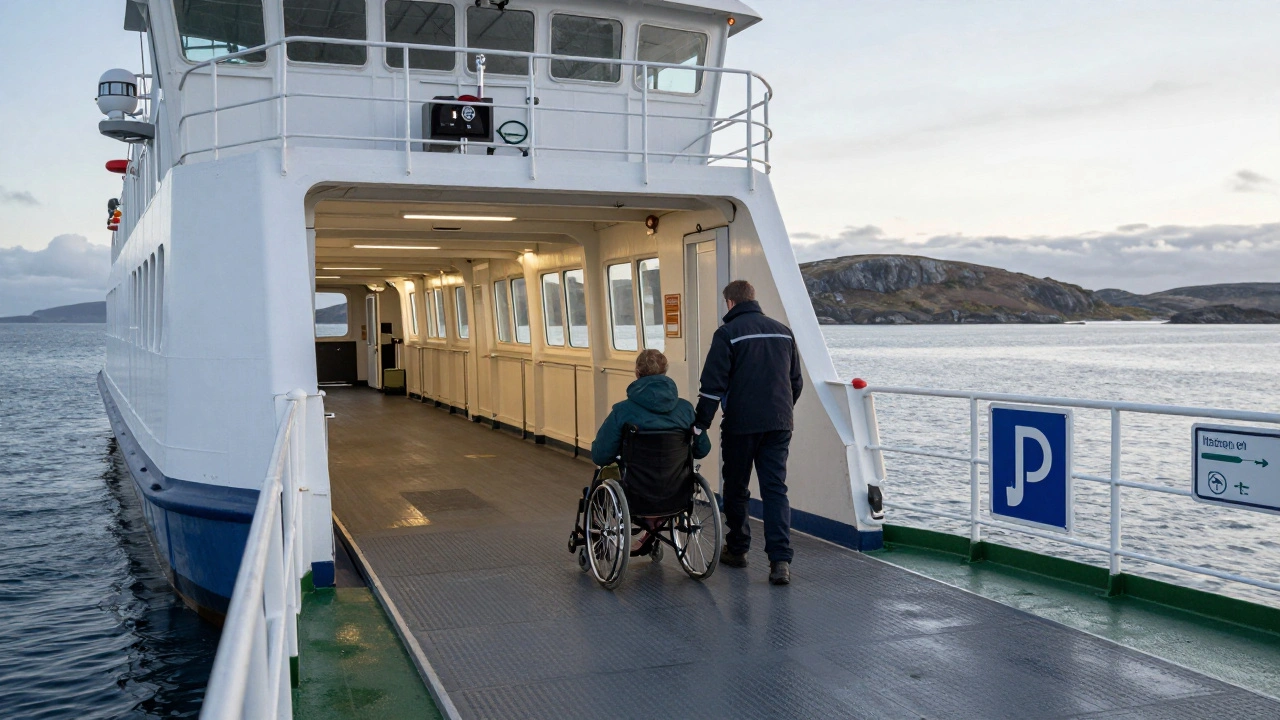
Getting to the islands starts with the ferry. Not all ferries are built the same. Caledonian MacBrayne (CalMac), which runs most routes in western Scotland, has updated nearly all its main vessels since 2020. Their newer ships, like the MV Caledonian Isles and MV Hebrides, have level boarding ramps, wide corridors, and designated wheelchair spaces with securement points. Crew members are trained to assist with boarding, and you can request help when booking-no need to wait until you’re at the dock.
On the east coast, NorthLink Ferries between Aberdeen and Orkney/Shetland also offer accessible cabins and lifts between decks. Their terminal in Aberdeen has accessible parking, elevators, and accessible restrooms. Always book your accessible space ahead of time. Even if a ferry looks accessible on paper, spots are limited. Don’t assume you can just show up and get help.
Some smaller operators, like the ferry from Mallaig to Armadale on Skye, still use older boats with steep ramps. If you’re unsure, call ahead. Ask: "Is there a level boarding ramp? Can you assist with mobility devices? Is there space for a power chair on board?" Most companies now have dedicated accessibility lines. Use them.
Where to Sleep: Rooms That Actually Work
"Accessible room" is a term that gets thrown around a lot. A room with a grab bar isn’t enough. True accessibility means more than one bathroom feature-it’s about space, control, and safety throughout the whole stay.
Look for these must-have features:
- Doorways at least 32 inches wide (most standard doors are 28 inches-too tight for many wheelchairs)
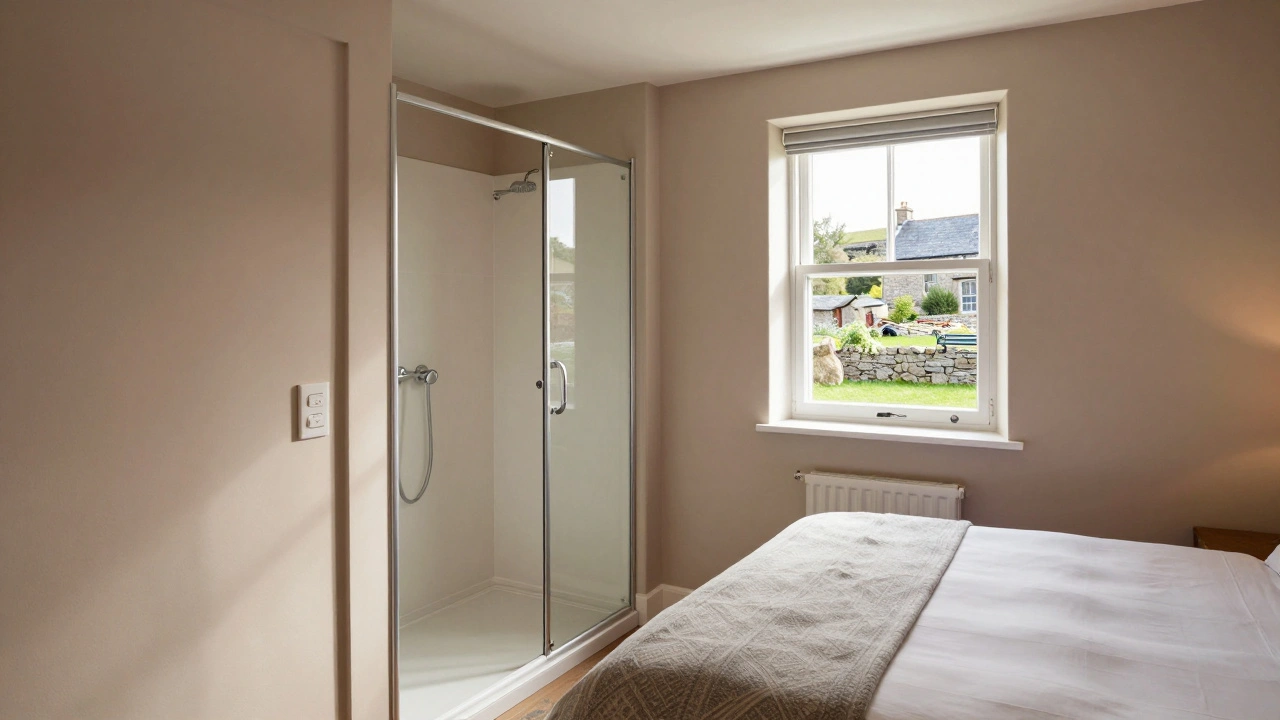
- Roll-in showers with no lip or step, and a fold-down seat
- Bed height between 18 and 23 inches-so you can transfer easily from a wheelchair
- Light switches, thermostats, and phone controls within reach (under 48 inches)
- Emergency pull cords in the bathroom and bedroom
Hotels like The Puffin Inn on the Isle of Mull and The Harbour Hotel in Stromness, Orkney, have been audited by Disability Rights UK and meet these standards. Even some B&Bs, like The Croft House on Harris, now offer dedicated accessible rooms with reinforced walls for grab bars and adjustable-height sinks.
Don’t trust just the hotel’s website. Call and ask for a video walkthrough. Show them your mobility device and ask: "Will my chair fit through the door? Can I turn around in the bathroom? Is the shower floor slippery?" Real answers beat marketing photos.
Terrain: Paths, Hills, and Real-World Challenges
Even if your room is perfect, the outside world might not be. Island terrain is often rough. Cobblestones, steep slopes, and unpaved paths are common. But many islands are improving.
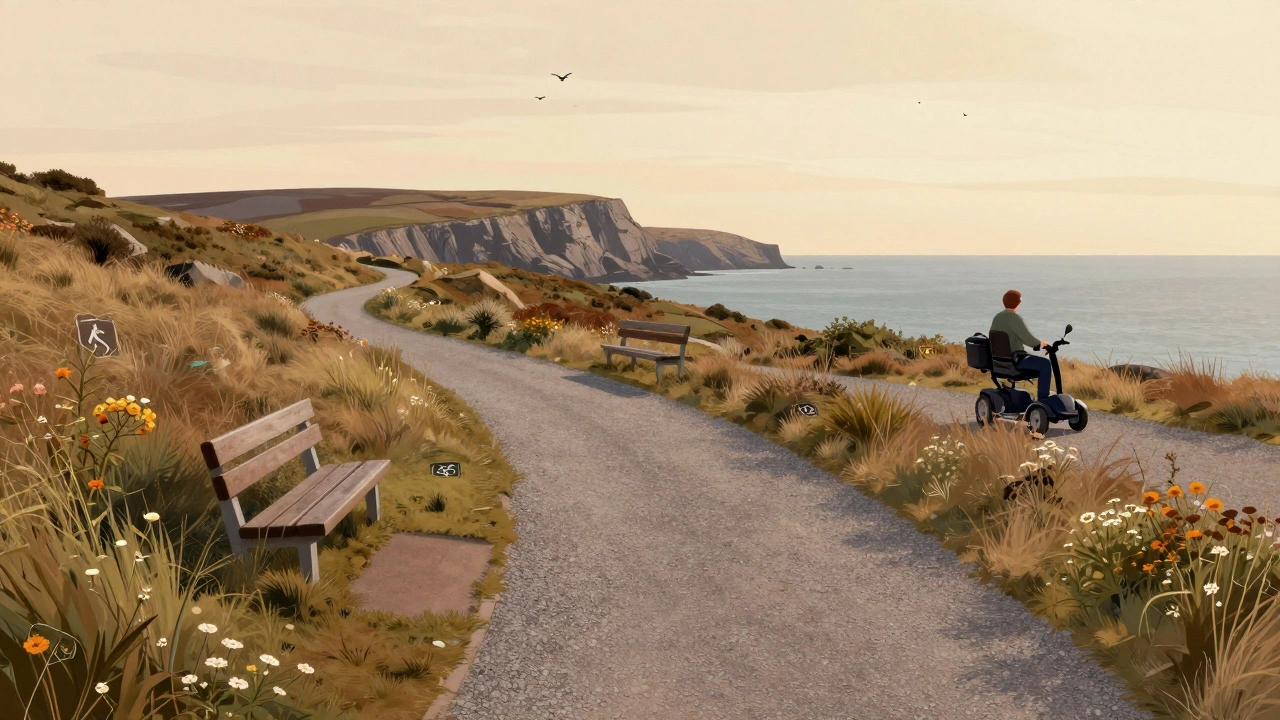
On the Isle of Arran, the coastal path from Brodick to Blackwaterfoot has been resurfaced with compacted gravel and includes resting benches every 200 meters. The Isle of Wight’s Tennyson Trail now has wheelchair-friendly sections with gentle gradients and handrails. In Orkney, the Ring of Brodgar has a paved loop that’s fully accessible and offers stunning views without needing to climb.
Check with local visitor centers before heading out. Many now have printed or digital accessibility maps showing:
- Paved vs. gravel paths
- Steepness ratings (some use a 1:12 gradient rule-1 inch of rise for every 12 inches of length)
- Locations of accessible toilets
- Places where assistance is available
Don’t skip the local advice. A resident might tell you that the path to the lighthouse on Lewis looks flat on the map-but after rain, it turns into a muddy slope. That’s the kind of detail you won’t find online.
What to Pack Beyond the Basics
You don’t need a lot, but a few smart additions make a big difference:
- A portable ramp (under 2 feet long) for small steps at guesthouses
- Non-slip shoe covers for wet or uneven ground
- A waterproof seat cushion for outdoor benches
- Extra batteries for power chairs-charging stations aren’t always easy to find
- A list of local emergency contacts, including accessible taxi services
Some islands have mobility equipment rental. On Mull, you can rent a beach wheelchair for exploring the shore. On Hoy, the Orkney Heritage Trust loans out all-terrain mobility scooters for free with a deposit. Ask when you book your stay.
Real Stories, Real Changes
Emma, who uses a power wheelchair, visited the Isle of Jura last summer. She was nervous. The island has no public buses, and the roads are narrow. But she booked with Jura Guest House, which had a ramp, wide bathroom, and a staff member who met her at the ferry with a portable ramp. She spent three days exploring the coast in a rented all-terrain chair. "I didn’t think I’d be able to see the wild ponies up close," she said. "But I did. And no one made me feel like a burden."
That’s the kind of experience becoming more common. It’s not about perfection-it’s about willingness. Places that listen, adapt, and train their staff are the ones you’ll want to return to.
Planning Your Trip: A Simple Checklist
Here’s what to do before you book:
- Confirm your ferry has level boarding and space for your mobility device
- Call your accommodation and ask for a detailed description of the accessible features
- Ask for a video tour if you can’t visit in person
- Check if the island has accessible walking paths and where they are
- Find out if there’s a local mobility equipment rental or assistance service
- Book accessible parking at the ferry terminal ahead of time
- Carry a printed list of your needs in case tech fails
It’s not about being difficult. It’s about being prepared. The more you plan, the more you’ll enjoy the quiet beauty of island life-without the stress of barriers you didn’t see coming.
Why This Matters Now
In 2025, accessibility isn’t a bonus-it’s a standard. The UK’s Accessible Travel Taskforce reported a 47% increase in island accommodations meeting minimum accessibility standards since 2021. That’s because travelers like you are asking for it. And because the law is catching up. New building codes in Scotland now require all public accommodations to meet BS 8300:2018 standards for accessibility.
When you choose an accessible stay, you’re not just booking a room. You’re supporting businesses that care. And you’re helping make travel better for the next person.
Are all ferries in Scotland wheelchair accessible?
No, not all. Larger ferries operated by CalMac and NorthLink are mostly accessible, but smaller, private operators may still use older vessels with steps or narrow ramps. Always call ahead and ask for specifics about boarding ramps, space for mobility devices, and crew assistance. Don’t rely on website claims alone.
What’s the difference between "accessible" and "ADA compliant" on the islands?
The ADA (Americans with Disabilities Act) doesn’t apply in Scotland. Instead, UK and Scottish standards like BS 8300:2018 are used. An "accessible" room in Scotland should meet these local guidelines: wide doors, roll-in showers, emergency cords, and proper bed height. Always ask for details rather than assuming "accessible" means the same as in the US.
Can I rent a mobility scooter on the islands?
Yes, in many places. The Isle of Mull, Orkney, and the Isle of Wight offer rentals for both standard and all-terrain scooters. Some are free with a deposit; others cost £25-£50 per day. Book ahead-availability is limited, especially in peak season. Local visitor centers can help you find options.
Are there accessible toilets on the islands?
Most major visitor sites, ferry terminals, and towns have accessible toilets. Rural areas may not. Check with the local council or visitor center for a map of accessible facilities. Many now have digital maps or QR codes you can scan for real-time updates.
What should I do if my accessibility needs aren’t met?
Speak up immediately. Most businesses want to help and can adjust if given notice. If you’re not satisfied, contact the Scottish Tourism Alliance’s Accessibility Feedback Line. They track complaints and work with businesses to improve. Your feedback helps others.
Next Steps: Where to Go Next
Start with the Isle of Mull-it’s the most developed for accessible travel in the Inner Hebrides. Then consider Orkney for its flat, well-maintained heritage trails and friendly locals. If you’re up for a longer trip, Shetland offers remote beauty with improving infrastructure. And if you’re looking for something quieter, the Isle of Eigg has a community-run accessible path to its famous Singing Sands beach.
Accessible travel isn’t about finding perfect places. It’s about finding places that care enough to try. And that’s something worth supporting.
Comments (13)
-
Amit Umarani December 6, 2025
Finally someone writes about this without sounding like a travel brochure. I booked a ferry last year and they said "accessible" but the ramp was a glorified plank. Crew didn’t even know where the securement points were. Don’t trust the website. Call. Always call.
Also, the "roll-in shower" label? Half the time it’s just a shower chair shoved in a tiny bathroom. Real accessibility is space to turn, not just a grab bar and a prayer.

-
Kayla Ellsworth December 7, 2025
So we’re celebrating that some islands are now barely meeting the bare minimum? Wow. Groundbreaking. Next they’ll invent oxygen.
I’m sure the 47% increase in "accessible" accommodations means nothing when 90% of the population still can’t access the trails, the pubs, or the damn bus stops. This isn’t progress. It’s PR.

-
Soham Dhruv December 8, 2025
big love to the folks actually doing the work here
i went to mull last year and the guesthouse had a ramp and even lent me a beach chair for the shore. staff didn’t make me feel like a project, just a guest. that’s all you really need
also the portable ramp trick? life saver. bought one for $40 on amazon. fits in my bag. use it everywhere now
just call ahead and be chill. most people want to help, they just don’t know how unless you tell them

-
Bob Buthune December 10, 2025
I’ve been waiting my whole life for this moment. Finally, someone acknowledges that travel isn’t just for the able-bodied. I cried when I read about the all-terrain scooter on Hoy. I’ve spent decades being told "it’s too rough" or "you’ll be a burden."
Now I’m not just allowed to go-I’m invited. And that changes everything. I’m not just a traveler anymore. I’m a person who deserves to see the wild ponies, the lighthouses, the quiet beaches without someone whispering behind my back.
Thank you. Not just for the info, but for seeing us. For writing this like we matter. I’m not crying because I’m sad. I’m crying because I finally feel seen.

-
Jane San Miguel December 10, 2025
Let’s be honest-this article is a textbook example of performative accessibility. "Roll-in showers" and "level boarding" are baseline standards, not achievements. The fact that we’re applauding this as progress reveals how catastrophically low the bar has been.
And please, stop using "accessible" as a marketing term. It’s meaningless unless it’s certified under BS 8300:2018 with third-party audits. Otherwise, it’s just corporate greenwashing dressed up as compassion.

-
Kasey Drymalla December 11, 2025
they’re lying. all of it. the ferries are rigged. the ramps are fake. the "accessible" rooms? they just put a grab bar in the bathroom and call it a day. they want you to think you’re welcome so you don’t sue them
the real reason they're doing this? insurance. the government is forcing them. they don’t care. they just want you to shut up and pay
they still won’t let you on the old boats. they just say "we have one" and then make you wait 3 hours while they "find the ramp"
trust no one. not even the website. not even the staff. they’re all in on it

-
Dave Sumner Smith December 12, 2025
you think this is about accessibility? nah. this is about control. they want you to book everything in advance so they can track you. they want you to call ahead so they can log your disability. they want you to use their rentals so they can monitor your movements
why do you think they put QR codes on the accessible toilets? so they can see who’s using them. so they can charge extra for "premium accessibility"
they’re not helping you. they’re profiling you. and soon they’ll start denying access if you don’t sign their consent forms
they’re building a surveillance state for disabled people and calling it progress

-
Jason Townsend December 12, 2025
you know what’s wild? the fact that we still have to ask for help. like we’re begging for basic dignity
they say "we’re improving" but they’re still putting the ramp in the back alley. still making you wait for staff to unlock the bathroom. still putting the emergency cord out of reach
it’s not about the equipment. it’s about the attitude. and that hasn’t changed one bit
if you’re still making us prove we’re worthy of access, you’re not helping. you’re just doing the bare minimum so you don’t get sued

-
Antwan Holder December 14, 2025
they say "it’s not perfect but it’s better"
but what does that mean? better than what? than when we were locked in our homes? than when we were told islands were for "the healthy"? than when we were invisible?
it’s not about better. it’s about enough. and right now? it’s never enough.
every time someone says "you can go now" they’re not giving you freedom. they’re granting you permission. and permission can be taken away.
we don’t need permission. we need rights.
and until that happens, no amount of ramps or QR codes will make this real

-
Angelina Jefary December 15, 2025
you missed a comma after "Mull" in the next steps section. also "BS 8300:2018" is italicized in the original standard but you didn’t italicize it. this is sloppy. if you’re going to cite standards, cite them correctly.
also "portable ramp" should be hyphenated as "portable-ramp" when used as an adjective. you wrote "a portable ramp for small steps"-that’s grammatically incorrect. it should be "a portable-ramp solution".
and why is "all-terrain" capitalized in one place and not another? consistency matters.

-
Jennifer Kaiser December 17, 2025
I want to thank the author for writing this with such care. I’ve been traveling with a mobility aid for 12 years, and this is the first time I’ve seen a guide that doesn’t feel like it was written by someone who’s never left the mainland.
What stood out most was the part about calling ahead and asking for a video walkthrough. I’ve been told "yes, we’re accessible" so many times-only to show up and find the doorframe is 2 inches too narrow. A video doesn’t lie.
And the part about the lighthouse on Lewis? I had no idea. I’m booking my trip next week. Thank you for giving me back the hope that I can still see the wild places without being treated like a problem to be managed.

-
TIARA SUKMA UTAMA December 19, 2025
just book with the ones that have the ramp. skip the rest. easy.

-
Jasmine Oey December 20, 2025
OMG I’m literally crying rn. I’ve been waiting my whole life for this. I went to the Hebrides last year and the hotel said "accessible" but the bathroom was so tiny I had to turn sideways. I felt so alone.
But now? I’m going back. I’m bringing my mom. I’m renting that beach wheelchair. I’m gonna sit on the Singing Sands and just… breathe. No one’s gonna tell me I don’t belong here anymore.
Thank you for seeing me. I’m not just a traveler-I’m a person. And I’m finally allowed to be one.
