
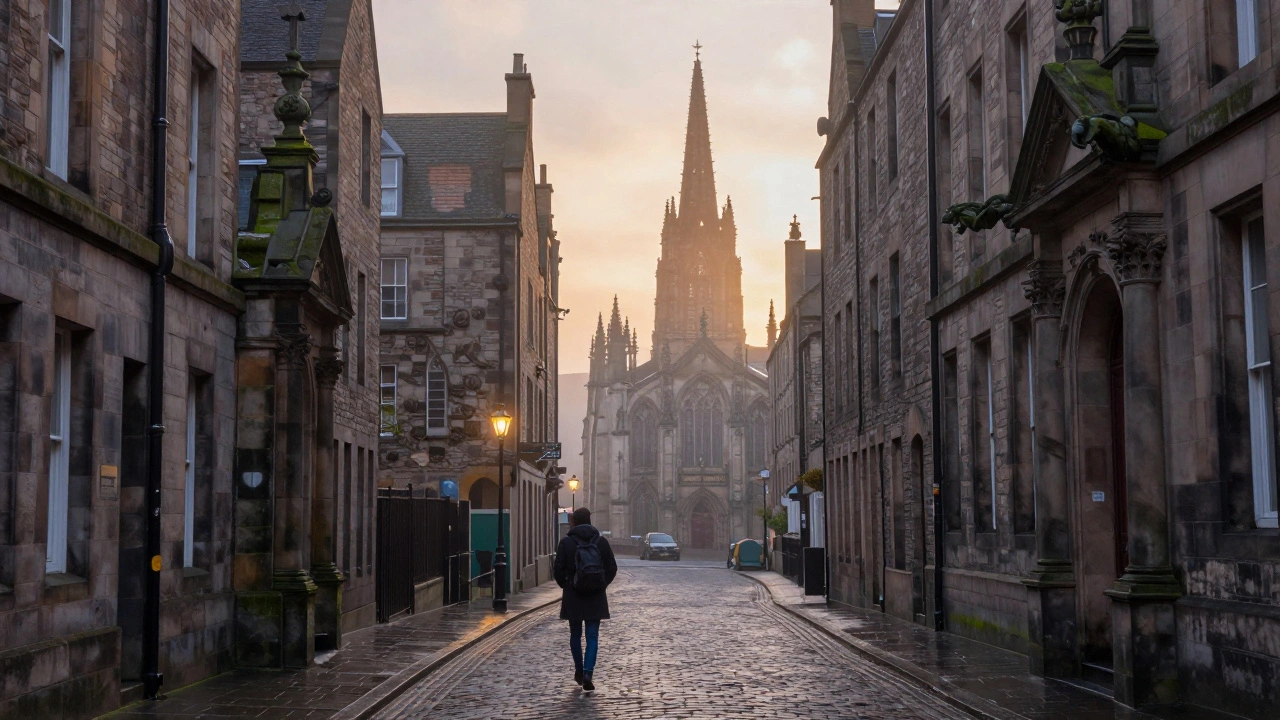
Edinburgh and Glasgow aren’t just cities-they’re open-air museums where every cobblestone, stone arch, and faded plaque tells a story. You don’t need a tour guide or a ticket to experience their deepest history. All you need is good shoes, a little curiosity, and the right path. These self-guided walks let you walk through centuries without leaving the sidewalk.
Edinburgh: From Royal Fort to Royal Mile
Start at Edinburgh Castle, perched on an extinct volcano. It’s not just a castle-it’s where kings were born, wars were planned, and prisoners were held for decades. The Crown Jewels of Scotland sit inside, but the real treasure is the view. Look down the Royal Mile and you’re staring at 1,500 years of history.
Walk down the Royal Mile, the spine of the Old Town. This isn’t just a street-it’s a timeline. At the top, you’re in the 12th century. By the bottom, you’re in the 18th. Along the way, you’ll pass St. Giles’ Cathedral, where John Knox preached the Reformation. Notice the dark, narrow wynds branching off to the sides? Those were the homes of ordinary people-crowded, damp, and often shared by families and livestock. The John Knox House, a rare surviving pre-Reformation building, still stands with its original timber frame.
At the bottom of the Royal Mile, you’ll reach Holyrood Palace. This is where Mary, Queen of Scots lived-and where her secretary, David Rizzio, was murdered in 1566. The bloodstain on the floor? Probably not real, but the story is. The palace grounds include the ruins of Holyrood Abbey, founded in 1128. Walk among the broken arches and imagine monks chanting in the shadow of kings.
Don’t miss the Canongate Kirkyard at the end of the Royal Mile. This cemetery holds the graves of famous Scots: Adam Smith, the father of modern economics; and the poet Robert Fergusson, who inspired Burns. The gravestones here are older than the United States. Some are carved with skulls and hourglasses-reminders that death was always close in these streets.
Glasgow: From Industrial Powerhouse to Cultural Heart
Glasgow’s history isn’t written in castles-it’s written in factories, churches, and the bones of its people. Start at Glasgow Cathedral, the only medieval cathedral in mainland Scotland to survive the Reformation intact. Built in 1197, its pointed arches and stained glass are untouched by modern renovation. The crypt below holds the tomb of Saint Mungo, the city’s founder. Legend says he brought a bird back to life, made a tree bloom, and saved a lost ring-all miracles that earned him sainthood.
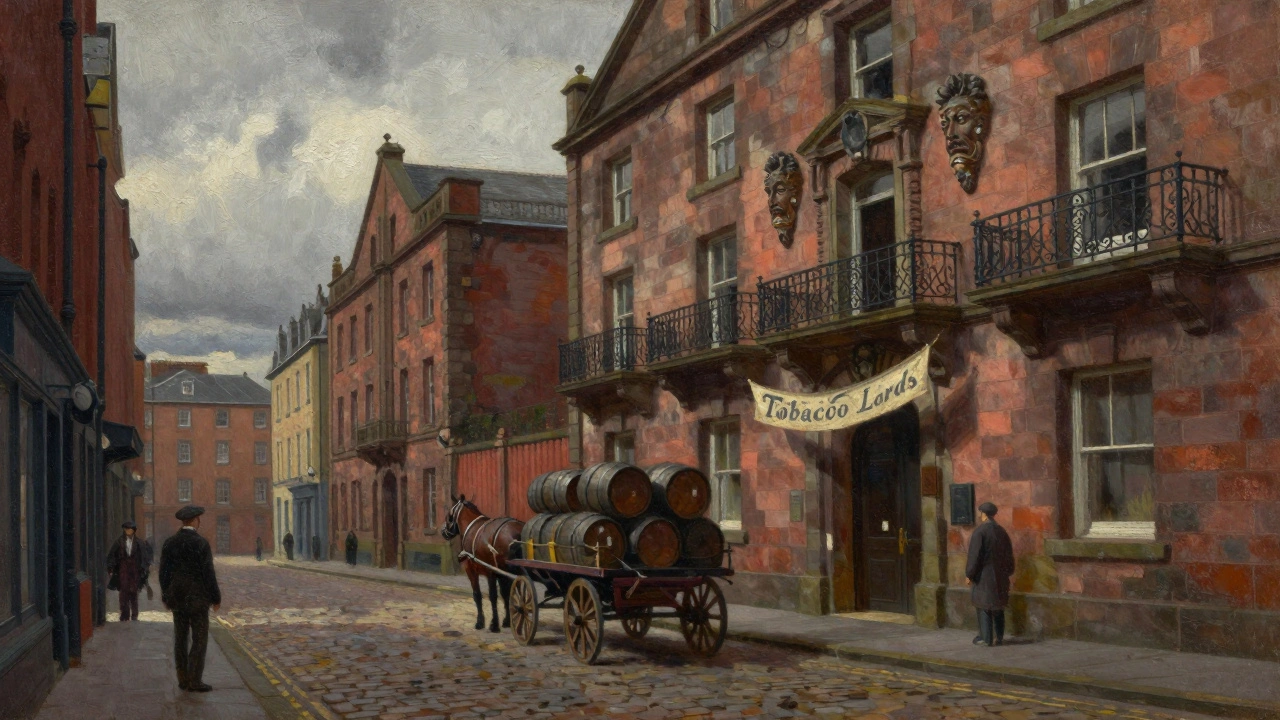
Walk east to the Merchant City, where 18th-century merchants made fortunes from tobacco and sugar. The grand stone buildings with ornate balconies? They were once warehouses. The Trongate area, once the city’s main market, still has its original 18th-century ironwork. Look up at the facades-you’ll see carved faces of merchants, sailors, and even a few enslaved people, reminders of Glasgow’s dark role in the transatlantic trade.
Head to the Glasgow Green, the city’s oldest park, established in 1450. This was where workers gathered for protests, where the first public library in Scotland opened in 1869, and where the first Scottish football match was played in 1873. The People’s Palace museum here tells the story of ordinary Glaswegians-their homes, their strikes, their songs. The glasshouse dome holds recreated Victorian tenements, complete with shared toilets and no running water.
End your walk at the River Clyde. In the 19th century, this was the busiest shipyard in the world. The Titan Crane, still standing, lifted 1,000-ton hulls into place. Walk along the water and you’ll see the Archerfield House-a rare surviving example of a 17th-century merchant’s villa. It’s quiet now, but once, it echoed with the clatter of hammers from nearby shipyards.
Why Self-Guided Works Better Than Guided
Guided tours rush you past the details. They tell you when the castle was built. They don’t let you pause at the crack in the wall where a soldier once carved his name in 1745. Self-guided walks give you space to notice what matters to you.
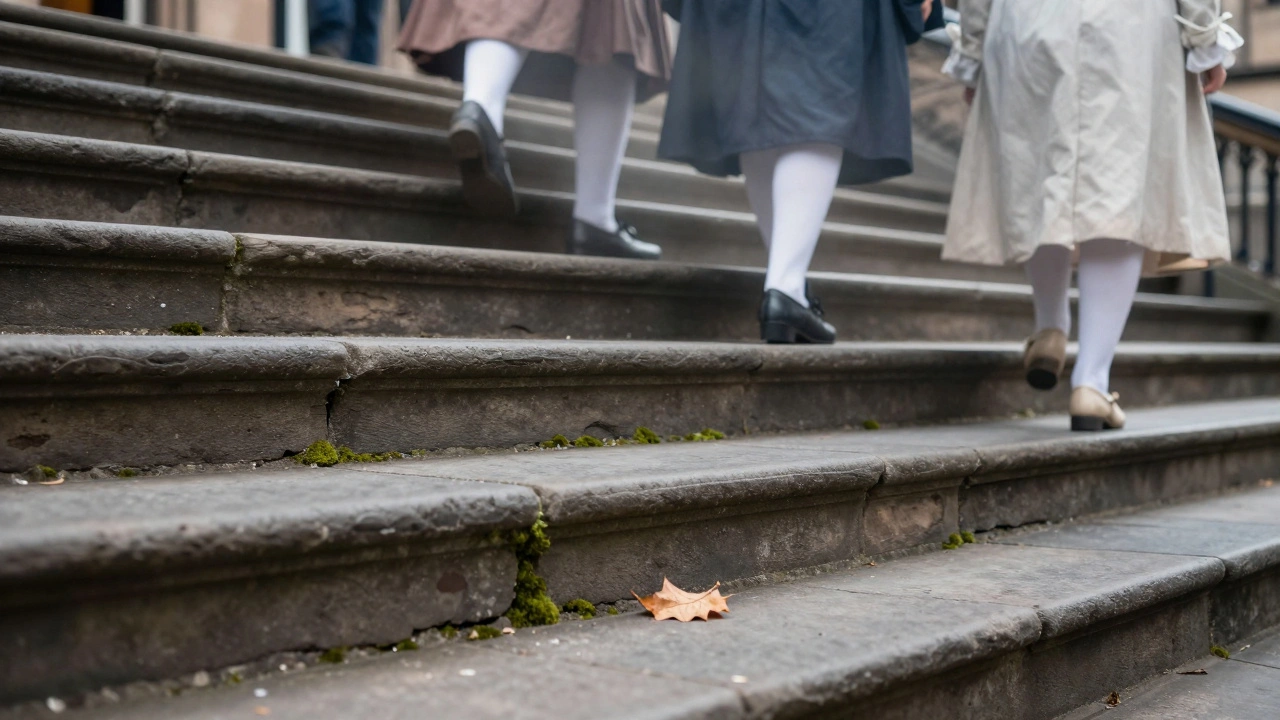
Look at the weathered stone steps outside the Royal Mile’s Signet Library. They’re worn down by thousands of feet over 200 years. That’s not history on a plaque-it’s history in the shape of the ground.
Self-guided walks also let you follow your own rhythm. Found a pub with a 1780s sign? Sit down. Saw a plaque about a forgotten poet? Read it twice. The city doesn’t hurry. Neither should you.
What to Bring and When to Go
Wear waterproof shoes. Edinburgh’s cobbles are slippery when wet. Glasgow’s streets are smoother, but rain is constant. Bring a light rain jacket-even in summer.
Best time to walk? Early morning. The crowds haven’t arrived. The light hits the stone just right. In Edinburgh, walk the Royal Mile before 9 a.m. You’ll have the entire street to yourself. In Glasgow, the Merchant City is quietest before noon.
Bring a phone with offline maps. Download Google Maps offline for both cities. GPS works fine, but you won’t always have signal in the narrow wynds.
Don’t carry a heavy guidebook. Use the free Historic Environment Scotland app. It has audio clips, historical photos, and GPS-triggered info as you walk. No need to carry extra weight.
Hidden Gems Most Tourists Miss
In Edinburgh, find the Mary King’s Close entrance on the Royal Mile. It’s not the touristy underground tour-just walk to the alley beside the Signet Library. Look for the small door with the iron ring. That’s where the original close began. Even if you don’t go down, stand there and imagine the families who lived here before the plague.
In Glasgow, skip the big museums. Instead, find the St. Mungo’s Museum of Religious Life and Art-it’s small, quiet, and has a 13th-century reliquary that survived the Reformation. Or wander the Glasgow Necropolis, the city’s hillside graveyard. The monuments here are more dramatic than any cathedral. A man buried in 1843 has a full-size statue of himself, arms crossed, staring at the cathedral.
What to Do After Your Walk
After Edinburgh, head to The Scotch Whisky Experience for a tasting. Not the tourist trap one-go to The Voodoo Rooms instead. Their whisky flights include rare single malts from distilleries that closed in the 1980s.
In Glasgow, stop at Barrowland Ballroom for a pint. It’s been open since 1934. The floor still creaks the same way it did when workers came here after shifts. The walls are covered in old concert posters-some from the 1970s, still faded but legible.
Both cities have small bookshops tucked into old buildings. In Edinburgh, find The Writers’ Museum’s gift shop. In Glasgow, try Bookabook on Byres Road. They sell first editions of Scottish poets for under £10.
Final Tip: Walk Slowly, Look Up
Most people walk with their eyes on the ground, watching for cracks. But history isn’t on the pavement. It’s on the rooftops. Look up. You’ll see carved gargoyles, broken chimneys, faded murals, and initials scratched into stone by people who lived here 300 years ago.
These walks don’t require tickets. They don’t need schedules. You just need to show up-and let the stones speak.
Are these walks suitable for beginners?
Yes. Both routes are flat or gently sloping, with no steep climbs or technical terrain. Edinburgh’s Royal Mile is paved and wide. Glasgow’s Merchant City has smooth sidewalks. You can do either walk in under three hours at a relaxed pace. Comfortable shoes are the only requirement.
Can I do both walks in one day?
Technically yes, but you’ll miss the details. Edinburgh and Glasgow are 50 miles apart. Driving takes about an hour, but you’d lose half your day to travel. Better to pick one city per day. If you’re short on time, choose Edinburgh for royal history or Glasgow for industrial stories.
Are there restrooms along the routes?
Yes. Edinburgh has public toilets near the Castle, St. Giles’ Cathedral, and Holyrood Palace. Glasgow has facilities at Glasgow Green, the People’s Palace, and near the Cathedral. Most are free, but some charge 50p. Carry loose change just in case.
Is it safe to walk alone?
Absolutely. These are well-traveled, central routes. Edinburgh’s Royal Mile and Glasgow’s Merchant City are busy even on weekdays. Avoid isolated alleys after dark, but the main paths are perfectly safe during daylight hours. Many locals walk them daily.
Do I need to book anything in advance?
No. These are public streets and open-air sites. You don’t need tickets to walk the Royal Mile, Glasgow Green, or the Merchant City. Only if you want to enter the Castle, Palace, or Cathedral do you need to pay-and even then, you can just walk past them without going in.
What’s the best season for these walks?
Spring (April-May) and early autumn (September-October) are ideal. The weather is mild, the crowds are smaller, and the light is perfect for photos. Winter is cold and wet, but if you don’t mind the chill, you’ll have the streets almost to yourself. Summer is busy but lively.
Comments (14)
-
Patrick Bass December 3, 2025
That bit about the worn steps at the Signet Library? Brilliant. I’ve stood there for ten minutes just watching people walk over them, never thinking about who else had done the same thing centuries ago. No plaque needed.

-
Tyler Springall December 5, 2025
How utterly pedestrian. You treat these walks like a tourist brochure. Have you ever read Macpherson’s Ossian? The real poetry of Edinburgh lies in its Gaelic echoes, not in some over-glorified cobblestone stroll. You’ve missed the soul entirely.

-
Colby Havard December 5, 2025
While the author’s sentiment is, on the surface, aesthetically pleasing, the underlying epistemological framework is deeply flawed: the notion that ‘history speaks through stones’ is a romantic fallacy. History is constructed-archived, curated, often erased. The ‘bloodstain’ at Holyrood? A manufactured myth. The ‘carved initials’? Likely 19th-century vandalism mislabeled as ‘medieval graffiti.’ You are not listening to the stones-you are being sold a story.
And yet… I concede: the act of pausing, of choosing to look up, is a radical act of resistance against the algorithmic present. So, perhaps the value lies not in the stones-but in the choice to observe them.

-
Amy P December 6, 2025
OH MY GOD I JUST WENT TO GLASGOW LAST MONTH AND I SPENT AN HOUR STANDING IN FRONT OF THAT STATUE OF THE GUY STARING AT THE CATHEDRAL IN THE NECROPOLIS AND I CRIED. NOT BECAUSE I WAS SAD-BECAUSE HE LOOKED SO MAD AT THE WORLD. LIKE HE KNEW WHAT WAS COMING. I TOOK 47 PHOTOS. NONE OF THEM CAPTURED IT. YOU HAVE TO BE THERE. THE STONE IS COLD. THE AIR SMELLS LIKE MOSS AND OLD RAIN. I STILL THINK ABOUT HIM.

-
Ashley Kuehnel December 7, 2025
Love this! Just a quick tip-some folks don’t know that the free Historic Environment Scotland app also has hidden audio stories from local historians. I used it in Mary King’s Close and heard a 17th-century woman’s diary entry read by her descendant. Chills. Also, if you’re in Glasgow, try the little tea shop next to the Necropolis-The Velvet Teapot. They have scones with heather honey. Best. Snack. Ever. 😊

-
adam smith December 8, 2025
Interesting. I did the walk. It was fine. Shoes were good. No problems. The city was there. I saw the castle. I walked the street. I looked up once. That was enough. I like my coffee. I like my shoes. I like my walks. Done.

-
Mongezi Mkhwanazi December 8, 2025
Let me be blunt: you are indulging in a sanitized, bourgeois nostalgia. The Royal Mile? A theme park for the gentry. The ‘ordinary people’ you romanticize? They were starved, illiterate, and crushed under feudalism. The ‘monuments’ you admire? Built by slave money. The ‘quiet alleys’? Where children died of typhus in the 1840s. You walk these streets as a tourist, not as a witness. And you call it ‘history’? It’s a performance. The stones don’t speak-they scream, and you’re too polite to hear them.

-
Mark Nitka December 9, 2025
Guys, let’s all just chill. Tyler, you’re overthinking it. Mongezi, you’re right-but you’re also scaring people away from something beautiful. The point isn’t to fix history. It’s to feel it. I walked both routes last October. Saw a kid in Edinburgh tracing a name on a gravestone with his finger. That’s the real treasure. Not the politics. Not the myths. Just that moment.

-
Kelley Nelson December 11, 2025
While the prose is undeniably lyrical, the structural integrity of the argument lacks academic rigor. The conflation of anecdotal observation with historical fact-particularly in reference to the ‘bloodstain’ at Holyrood-is methodologically unsound. One must question the epistemic authority of such sentimental narratives in a post-positivist historiographical landscape.

-
Aryan Gupta December 12, 2025
Did you know the Royal Mile was once used to transport plague victims to mass graves? The ‘hidden door’ near Signet Library? It leads to a tunnel that was used to smuggle bodies out at night. The app doesn’t tell you that. The government buried the truth. The ‘free app’? A distraction. The stones are watching. They remember everything. And they’re not done speaking.

-
Fredda Freyer December 13, 2025
I’ve walked these streets in every season. Winter, when the mist clings to the castle like a ghost’s breath. Summer, when the light turns the stone gold. But what I’ve learned isn’t in the architecture-it’s in the silence between the footsteps. The city doesn’t want you to know its secrets. It wants you to feel them. And that’s why you come back. Not for the plaques. Not for the photos. But for the quiet that settles in your bones when you finally stop talking.

-
Gareth Hobbs December 15, 2025
Typical. Americans think they’ve ‘discovered’ history because they walked a street. We’ve been walking these cobbles since the Romans left. And you’re telling us to use an app? The real history’s in the language-the way we say ‘aye’ or ‘wee’ or ‘bairn’. Not in your bloody GPS. And don’t get me started on ‘the stone speaks’-that’s poetry, not fact. Scotland’s not a theme park. It’s a nation. And you’re just passing through.

-
Zelda Breach December 15, 2025
Oh wow. Another ‘walk slowly and look up’ essay. How original. Did you also write about how ‘the wind whispers secrets’ and ‘the rain remembers’? Please. The only thing these walks reveal is how easily people mistake nostalgia for depth. You didn’t ‘connect’ with history-you just took pictures of old bricks and called it enlightenment. Wake up.

-
Alan Crierie December 17, 2025
Just wanted to say thank you for this. I’m from Belfast, and I’ve been to both cities a dozen times. But this? This is the first time I’ve read something that made me want to go back and walk them again-not to check off sights, but to listen. I took my 8-year-old to the Necropolis last week. She sat by that statue of the man staring at the cathedral for 20 minutes. Didn’t say a word. Just… looked. I think she understood something. You’ve reminded me why I love these places. 🌿
