
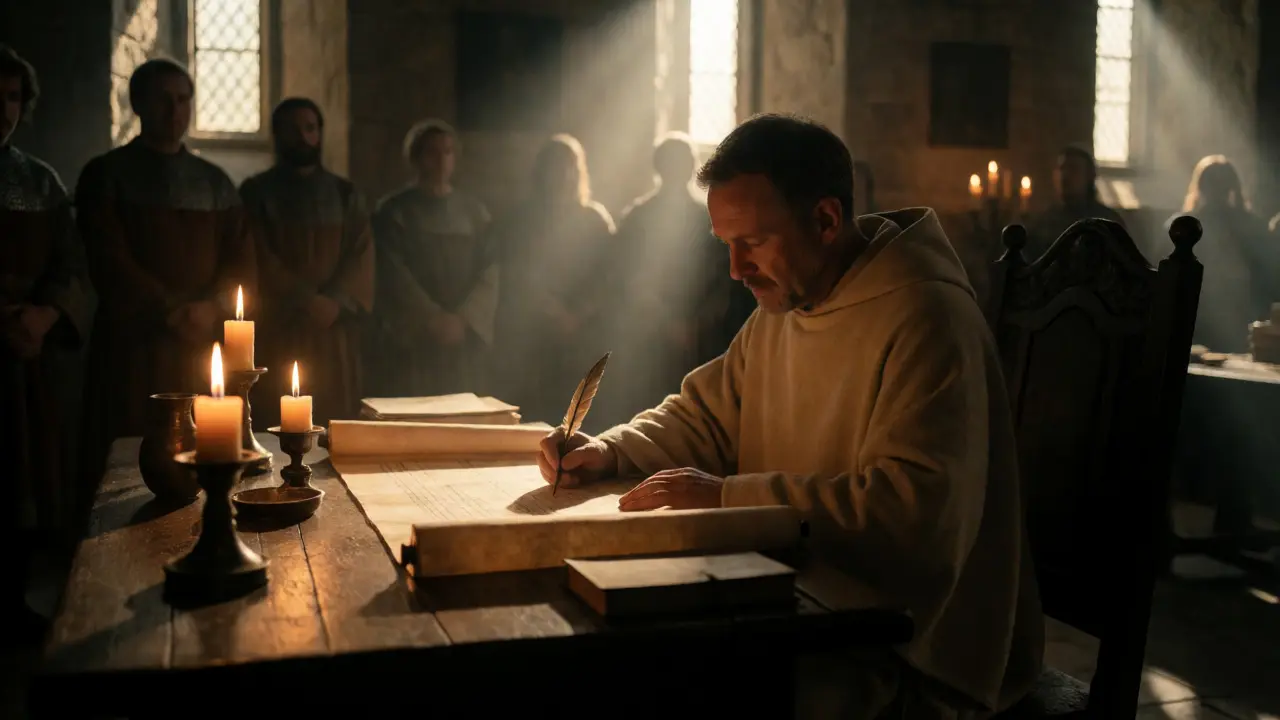
You’ve probably heard the phrase. It’s on t-shirts in Edinburgh, quoted by politicians during election campaigns, and printed in every second tourist brochure. "For freedom." But do you actually know what the Declaration of Arbroath is? And more importantly, why does a letter written in 1320 still make people’s hearts beat faster today?
It’s not just old parchment. It’s one of the most powerful political statements ever made in Europe. If you’re planning a trip to Arbroath Abbey, or if you’re just curious about where Scotland got its spine, this guide breaks down the document, the place, and the meaning without the dusty academic jargon.
The Quick Takeaways
- What it is: A letter sent by Scottish nobles to Pope John XXII in 1320, asserting Scotland’s sovereignty.
- Why it matters: It’s often called the first declaration of human rights, predating the US Declaration of Independence by 450 years.
- The Location: Written at Arbroath Abbey, founded by William the Lion. The ruins are open to the public year-round.
- The Reality Check: It didn’t instantly end the wars. It was a diplomatic move that helped secure the Treaty of Edinburgh-Northampton in 1328.
Why Did They Write It? The Political Chess Game
Imagine being King Robert the Bruce. You’ve been fighting for independence from England for over a decade. You won the big battle at Bannockburn in 1314, which sounds great, but winning a battle doesn’t mean winning the war. England still controlled parts of southern Scotland. Worse, the Pope had excommunicated Bruce because he killed his rival, John Comyn, in a church. In the medieval world, being excommunicated meant you were basically an outcast. No other king wanted to ally with you. Your trade routes were blocked. You were isolated.
So, what did Bruce do? He didn’t send an army. He sent a letter. This wasn’t just any letter; it was a masterclass in propaganda and diplomacy. The goal was simple: convince the Pope that Robert the Bruce was the legitimate King of Scots, that the English were the aggressors, and that Scotland had always been independent. To do this, they needed to appeal to the highest authority in Christendom while simultaneously rallying their own people.
The Declaration of Arbroath was drafted to achieve two things. First, it told the Pope: "Look, we are a free nation. We have our own history, our own laws, and our own king. Leave us alone." Second, it told the Scottish barons: "We are all in this together. If Bruce falls, we all fall." It was a binding contract among the elite. By signing it, these nobles put their necks on the block. If the plan failed, Edward II of England would have executed them all as traitors.
The Document Itself: More Than Just Words
Let’s look at what’s actually inside the text. It’s written in Latin, obviously, because that was the language of international diplomacy. The style is flowery, biblical, and dramatic. It traces Scottish history back to the Scythians (a bit of myth-making there) to prove that Scotland has existed longer than England. It argues that kings are not appointed by God alone but are chosen by the people to protect their liberty.
This last point is the kicker. Most historians agree that the section claiming a king could be deposed if he failed to defend his country’s freedom is unique for its time. It suggests that sovereignty comes from the community, not just divine right. Compare this to the Magna Carta, which was about limiting the king’s power over barons. The Declaration goes further-it’s about the collective will of the nation.
| Attribute | Detail |
|---|---|
| Date Signed | April 6, 1320 |
| Recipient | Pope John XXII |
| Authorship | Largely attributed to Bernard of Linton, Abbot of Arbroath |
| Language | Latin |
| Signatories | 51 Barons and Nobles |
| Current Location | National Records of Scotland, Edinburgh |
Notice the date. April 6 is now celebrated as Tartan Day in many places, marking the anniversary of the signing. Also, note the authorship. While Bruce led the charge, the actual writing is credited to Bernard of Linton, the abbot of the local monastery. This highlights how crucial the Church was to statecraft in the Middle Ages. Monks weren’t just copying Bible verses; they were drafting international treaties.

Visiting Arbroath Abbey: Where History Happened
If you want to stand where the ink dried, head to Arbroath. The abbey is a striking ruin of red sandstone, located right on the coast. It’s easy to get to from Dundee-just a short train ride or drive along the A92. The contrast between the red stone and the grey North Sea sky is something you don’t see anywhere else in Scotland.
The abbey was founded in 1178 by King William the Lion. It was originally a Tironensian monastery, known for strict discipline and manual labor. Over time, it became incredibly wealthy, partly due to its control over the local fishing industry. When the Declaration was being drafted, the abbey was a hub of learning and administration. The scriptorium here was likely where the scribes copied the final version.
Today, the site is managed by Historic Environment Scotland. There’s a visitor center that explains the context well, avoiding the dry textbook approach. You can walk through the cloisters, see the remains of the chapter house, and climb up to the tower for a view of the town. The atmosphere is quiet, almost solemn. It’s a good place to think about the weight of those signatures. Fifty-one men gathered here, knowing they might be hanged for treason if things went wrong.
| Feature | Details |
|---|---|
| Opening Hours | Varies by season; generally 9:30 AM - 5:30 PM in summer |
| Entry Fee | Free for Historic Environment Scotland members; small fee for others |
| Accessibility | Partial access for wheelchairs; uneven ground in ruins |
| Best Time to Visit | Spring for wildflowers, or Autumn for dramatic coastal light |
| Nearby Attraction | Arbroath Smokies market (try the fish!) |
The Aftermath: Did It Work?
Here’s the part most summaries skip: The Declaration didn’t fix everything overnight. The Pope was skeptical. He didn’t immediately lift the excommunication. In fact, negotiations dragged on for another eight years. So, was it a failure? Not at all.
The Declaration laid the groundwork for the Treaty of Edinburgh-Northampton in 1328. In this treaty, England finally recognized Robert the Bruce as King of Scots and acknowledged Scotland’s borders as they stood. Crucially, it also included a marriage alliance between Bruce’s son, David, and Edward II’s daughter, Joan. That peace held until after Bruce’s death in 1329.
Think of the Declaration as the intellectual foundation for that legal victory. Without the moral high ground established in 1320, the diplomatic pressure on the Pope and the English court wouldn’t have been as effective. It shifted the narrative from "Bruce is a rebel" to "Scotland is a sovereign nation under siege." Once that story took hold in European courts, it became much harder for England to justify continued aggression.
Myths vs. Facts: Clearing Up the Confusion
There are some persistent myths around this document. Let’s bust a few so you don’t repeat them on your next pub quiz night.
Myth 1: It was signed by everyone in Scotland.
False. Only 51 barons and prelates signed it. It was an elite document. However, it claimed to represent the "community of the realm," which was a new concept for the time.
Myth 2: It created Scottish identity.
Partially true, but exaggerated. Scottish identity existed before 1320. The Declaration codified it and gave it a political voice, but it didn’t invent it from scratch.
Myth 3: It’s older than the Magna Carta.
Nope. The Magna Carta was 1215. The Declaration was 1320. But the Declaration is arguably more radical in its view of popular sovereignty. Magna Carta protected baronial rights; the Declaration spoke of national freedom.
Myth 4: The original is in Arbroath.
No. The original manuscript is kept in the National Records of Scotland in Edinburgh. What you see at the abbey is usually a facsimile or a digital display. Handle the real thing with care-it’s fragile!
Why It Still Matters Today
You might ask, why care about a 700-year-old letter? Because it set a precedent. The idea that a government derives its legitimacy from the consent of the governed isn’t just a modern democratic ideal; it has roots in this text. When modern movements fight for self-determination, they often cite the Declaration as historical proof that such ideas aren’t foreign imports-they’re homegrown.
In contemporary Scotland, the phrase "Not for glory, riches, or honors... but for freedom alone" resonates deeply. It’s used in debates about devolution, independence, and even social justice. It reminds people that political structures exist to serve the people, not the other way around. Whether you’re a nationalist, a unionist, or indifferent, you can’t deny the rhetorical power of the text.
Moreover, it serves as a reminder of Scotland’s complex relationship with Europe. For centuries, Scotland looked to France and Rome for alliances against England. The Declaration was an attempt to reintegrate Scotland into the European community of nations after being ostracized. That theme of looking outward while defining oneself inwardly is still very relevant in post-Brexit Britain.
Practical Tips for History Buffs
If you’re diving deeper into this topic, here are a few things to keep in mind:
- Read the Translation: Don’t rely on snippets. Read the full translation online. Look for the specific clauses about the right to depose a tyrant. It’s surprisingly modern-sounding.
- Visit the National Museum: If you’re in Edinburgh, go to the National Museum of Scotland. They often have exhibits related to the Wars of Independence, including context for the Declaration.
- Check Local Events: Around April 6, Arbroath holds festivals. Even if you miss the exact day, checking local listings can lead to reenactments or lectures.
- Combine with Dunnottar Castle: If you’re traveling the east coast, stop at Dunnottar Castle near Stonehaven. It’s another key site in the Wars of Independence and offers stunning coastal views similar to Arbroath.
Understanding the Declaration of Arbroath isn’t just about memorizing dates. It’s about grasping how words can shape reality. In 1320, a group of men decided that their nation’s story mattered enough to write it down and demand recognition. That act of defiance, preserved in red sandstone and Latin script, continues to inspire long after the ink faded.
Who wrote the Declaration of Arbroath?
While commissioned by King Robert the Bruce, the actual drafting is widely attributed to Bernard of Linton, the Abbot of Arbroath Abbey. He was a skilled diplomat and scholar who crafted the argument for the Pope’s attention.
Is the Declaration of Arbroath older than the US Declaration of Independence?
Yes, significantly. The Declaration of Arbroath was signed in 1320, whereas the US Declaration of Independence was adopted in 1776. This makes the Scottish document nearly 450 years older.
Where can I see the original Declaration of Arbroath?
The original manuscript is held in the National Records of Scotland in Edinburgh. It is rarely displayed publicly due to its fragility, but high-quality reproductions are available at Arbroath Abbey and various museums.
Did the Declaration of Arbroath end the Wars of Independence?
Not immediately. It was a crucial diplomatic step that helped lead to the Treaty of Edinburgh-Northampton in 1328, which officially ended the conflict. The Declaration itself did not stop military actions instantly.
What language was the Declaration written in?
It was written in Latin. This was the standard language for international diplomacy and church correspondence in medieval Europe, ensuring it could be read by the Pope and other European monarchs.